Most people only discover their risk tolerance *after* a brutal crypto drawdown. By then it’s usually too late. Let’s walk through what actually happened to dollar-cost averaging (DCA) across past cycles, and how you can bend this “boring” strategy into something much smarter for bear markets.
—
What we’re really talking about when we say “DCA”
Dollar‑cost averaging sounds complicated, but it’s simple:
You invest a fixed amount of money at regular intervals, no matter what the price is.
– $100 every Monday into BTC
– $50 every time you get paid
– 0.01 BTC on the 1st of each month
No chart-reading, no “waiting for the bottom”, no 3 a.m. panic decisions. Over time you automatically buy more when the price is low and less when it’s high.
But that’s the textbook definition. In crypto, especially in bear markets, we need something sharper.
—
Why DCA looks boring — and why that’s a feature
In raging bull markets, everyone is a genius. In brutal bear markets, everyone suddenly becomes a “long-term investor” by force. DCA is one of the very few strategies that actually has data behind it across *multiple* Bitcoin cycles.
When people ask “is dollar cost averaging profitable in crypto bear markets”, they usually want a one-word answer. Reality is messier, but the pattern is clear: pure DCA into BTC across any full 4‑year cycle (peak → bottom → next peak) has historically beaten most “I’ll time the dip” attempts.
It doesn’t mean you always get perfect results. It means you survive long enough to still be in the game.
—
Quick definitions (so we don’t talk past each other)
Keep these in mind as we go through case studies:
– Bear market – Extended period of falling prices. In crypto this can be ‑70% to ‑85% from the top, sometimes more for altcoins.
– Bull market – Explosive upside after a long accumulation phase.
– DCA (Dollar-Cost Averaging) – Investing the same amount on a schedule, ignoring the current price.
– Lump-sum investing – Putting all your cash in at once.
– Cycle – Roughly halving to halving for Bitcoin (about 4 years), with one major blow‑off top and one brutal bear.
—
Case study 1: DCA through the 2018 Bitcoin winter
Let’s reconstruct a simple long term bitcoin dca strategy performance example.
– Start: January 2018 (BTC around $14k, fresh off the $20k top)
– End: December 2020 (roughly at the edge of the next big bull phase)
– Strategy: $200 every two weeks into BTC, regardless of price
Text‑diagram of what happened:
– Early 2018: you’re DCA’ing into a falling knife
– Late 2018: BTC around $3–4k, your DCA buys *a lot* more BTC
– 2019–2020: price grinds up, you keep buying, but each contribution adds fewer coins
If we sketch the *price* vs *BTC accumulated*:
Price (log-ish, very rough):
$20k |■■
$15k |■■■
$10k |■■
$5k |■
$3k |■
+—————–
2018-2019-2020
BTC accumulated over time:
BTC
1.2 | ■■■■
0.9 | ■■■■
0.6 | ■■■■
0.3 |■■■■
+—————–
2018-2019-2020
Notice something: your *average cost* ends up much closer to the mid-range of the bear market, not the top.
If you did a simple crypto dca backtest past cycles like this one, across 2014–2017 and 2018–2021, a pattern emerges:
– Starting DCA *after* a peak still works if you keep going deep into the bear.
– Stopping too early (e.g. “I give up, I’m out”) usually locks in a terrible average entry.
—
Case study 2: 2021 peak → 2022 hell → 2024 recovery
Now let’s look at a more recent scenario, closer to home.
Assumptions:
– Start: November 2021 (BTC around $60–69k)
– You commit: $300 on the 1st of each month
– You continue through 2022 (FTX collapse, macro fear), 2023 and into early 2024
What happens?
You buy at:
– Late 2021: $60–69k
– Mid 2022: $25–30k
– Late 2022: ~$16–18k (peak despair)
– 2023: $25–35k
– Early 2024: higher, but you already hold a significant base
Diagram of your *average cost per BTC* over time:
Cost
60k |■■
45k | ■■■
30k | ■■■■
20k | ■■■
15k | ■
+—————-
2022 2024
At the start, your average is ugly — you’ve only bought near the top. But as the bear market stretches out and you keep buying, your average cost gravitates toward the bear market range (20–30k). By early 2024, with BTC trading above your blended entry, your PnL flips from red to green *without* needing to call the bottom perfectly.
This is why, in practice, the best crypto dca strategy for bear markets isn’t “start DCA at the bottom” (because you won’t know the bottom). It’s:
> Start when it feels uncomfortably early, but commit to surviving the *entire* ugly part of the cycle.
—
Comparing DCA vs “I’ll just buy the dip”
Let’s be honest: most “buy the dip” people end up doing this:
1. Buy a little on the first -20% drop.
2. Freeze on the next -40%, swear never to touch crypto again.
3. Come back when price is up +200% and “it feels safe” again.
DCA is boring because it intentionally removes your emotional timing from the equation.
Compared with lump-sum investing:
– Lump-sum at the *top* of the cycle can lead to ‑70% unrealized drawdown.
– DCA from top → bottom → partial recovery tends to seriously reduce that average cost.
But there’s a catch. If you DCA into random altcoins that never make new highs, no schedule will save you. DCA is not a cure for bad asset selection.
—
So… is DCA “enough” in crypto bear markets?
As a pure strategy, yes, DCA into BTC or a tiny shortlist of robust assets has historically worked over full cycles.
But crypto is volatile enough that we can actually do better than blindly throwing in the same amount regardless of context. That’s where some unconventional twists enter.
When people ask “how to invest in crypto during bear market” and only get “just DCA and chill” as an answer, they’re being undersold. You can stay systematic *and* be a bit smarter.
—
Unconventional twist #1: Volatility‑weighted DCA
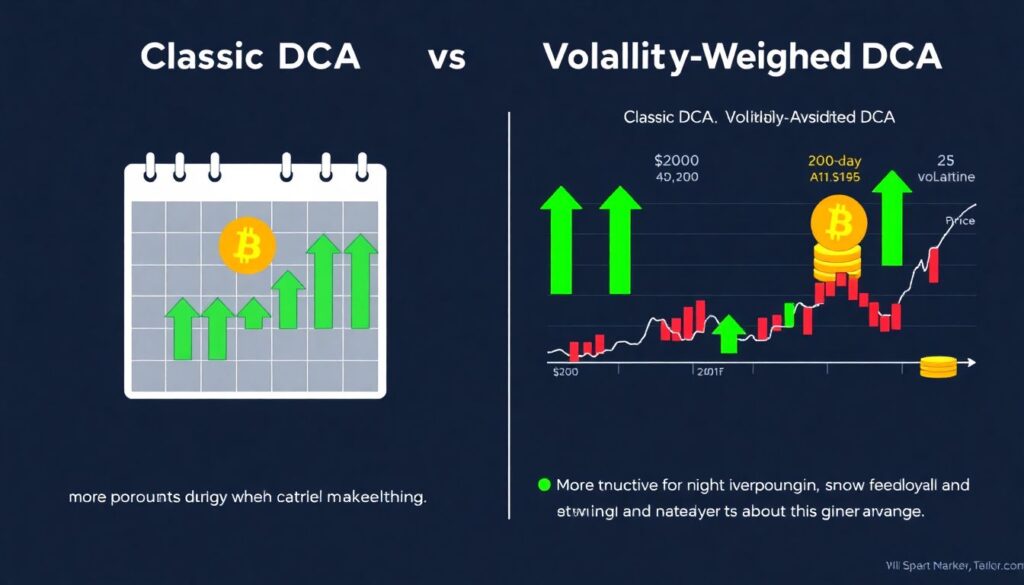
Classic DCA:
– $200 every two weeks, no matter what.
Volatility‑weighted DCA idea:
– You pre‑define a range of volatility (say, using BTC’s 30‑day realized volatility or even simpler, % from 200‑day moving average).
– You *increase* your contribution when volatility and drawdown are high (extreme fear) and *decrease* it when volatility is low and price is extended.
Simple example using “distance from 200‑day MA”:
– Price < -40% below 200‑day MA → invest 2x your base amount - Price between -20% and -40% → invest 1.5x - Price between 0% and -20% → normal amount - Price above 0% (price > MA) → half amount or pause
Text‑diagram of contribution size:
Contribution
2.0x |■■
1.5x | ■■
1.0x | ■■
0.5x | ■
+—————-
deeply low high
What this does:
– Bears: you buy more while BTC is battered.
– Late bull: you naturally cool down without timing the exact top.
It’s still systematic, still rules‑based, but smarter than flat DCA.
—
Unconventional twist #2: “Bear bucket” mental accounting
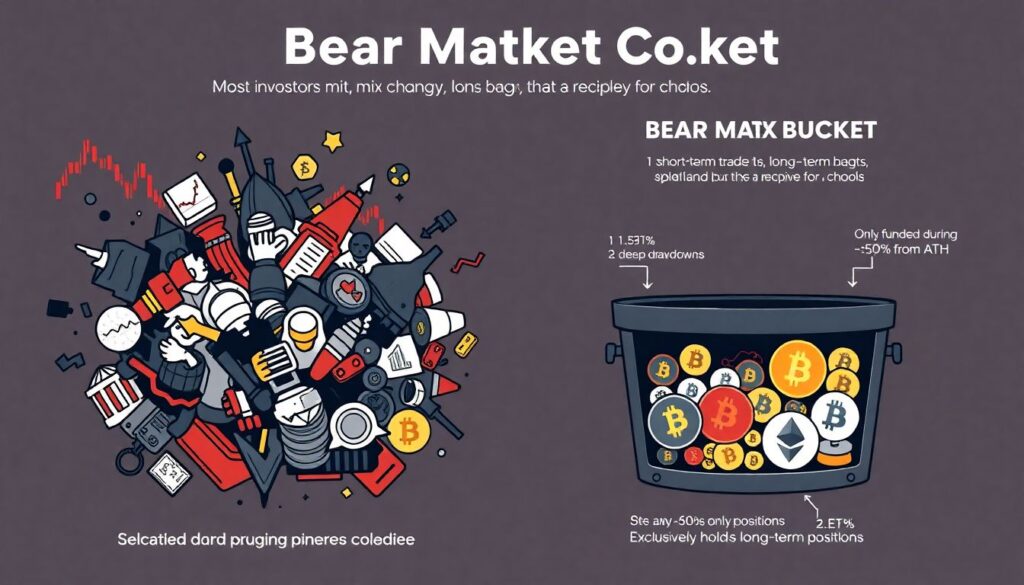
Most investors mix everything: short‑term trades, long‑term bags, speculative altcoins. In a bear, this is a recipe for chaos. Instead:
Create a dedicated Bear Market Bucket:
– Only funded during deep drawdowns (say BTC down >50% from ATH).
– This bucket exclusively holds long‑term positions (BTC, ETH, maybe 1–2 large caps).
– Rules: cannot be sold until either
– BTC makes a new ATH, or
– at least 3–4 years pass.
Now DCA *only* into that bucket when bear conditions are clearly present. You’re not just buying because “it’s Tuesday” — you’re buying because the market is clearly discounted versus recent history, and you’ve quarantined that capital from your day‑trading brain.
This lets you run:
– A normal DCA into a broad portfolio (if you want), plus
– A bear‑only DCA into your highest‑conviction assets.
—
Unconventional twist #3: DCA into *dry powder*, not directly into coins
Here’s a mental flip that helps if you’re afraid of overpaying.
Instead of saying:
> I’ll DCA $400/month into BTC directly.
Say:
> I’ll DCA $400/month into a “Bear Cash Reserve”, and only convert to BTC when preset drawdown levels are hit.
Example rules:
– Every month, send $400 to a separate “ammo” account.
– If BTC drops 20% from a local high → deploy 20% of your ammo.
– Another 20% drop from there → deploy another 20%, and so on.
– If price recovers and makes new highs without triggering all your tranches, the remaining cash stays as future dry powder.
This blends:
– The discipline of DCA (you’re always funding the war chest).
– The benefit of “buy the dip” (but with rules, not vibes).
It’s still a crypto dca backtest past cycles kind of strategy if you test it over previous BTC price histories: funding is constant, deployment is conditional.
—
How this stacks up against other “bear strategies”
Other common approaches:
– Stay 100% in stablecoins and wait
– Pro: you don’t lose money on the way down.
– Con: you almost never pull the trigger aggressively enough.
– All‑in after a huge crash
– Pro: spectacular if you catch the real bottom.
– Con: statistically, you won’t. And you may be out of nerve or cash by then.
– Active trading with leverage
– Pro: looks genius on screenshots.
– Con: over a multi‑year bear, funding fees + chops + liquidation risk eat most people alive.
Against these, DCA (and its smarter variants) looks… patient. But when you break it down across multiple full cycles, the survival rate and outcome distribution usually look *far* better.
—
Practical checklist: building your own bear‑proof plan
Use this as a sanity framework before the next winter hits:
– Define your core asset set
– e.g. BTC only, or BTC + ETH, plus *maybe* 1–2 large caps you deeply understand.
– Choose your base DCA amount and schedule
– Something you can keep paying for 2–3 years without stress.
– Decide on one twist (not three at once)
– Volatility‑weighted DCA
– Bear Market Bucket
– DCA into dry powder with rule‑based deployment
– Commit your rules in writing
– “I will DCA $X per month into BTC as long as I have income, regardless of headline noise, until at least [date or price milestone].”
And just as important:
– Decide what you *won’t* do
– No 50x leverage “revenge trades” during capitulation
– No rage‑selling your entire stack during macro panic
– No chasing every shiny new alt project with your long‑term bucket
—
The subtle edge of “pre‑deciding”
The strongest edge of DCA in crypto isn’t mathematical; it’s psychological. When everyone around you is screaming that “crypto is dead” and BTC is down 70–80%, your emotional brain wants to *sell*, not buy.
DCA flips that script by making “buying low” automatic. And when you add rule‑based twists (volatility weighting, bear buckets, ammo accounts), you level up from “I hope this works” to “I have a clear playbook for winter.”
So, if you’re still wondering “is dollar cost averaging profitable in crypto bear markets”, here’s the condensed answer from the last decade of history:
– DCA into strong assets *throughout* the cycle has worked far better than most discretionary timing.
– Structured, rule‑based enhancements to DCA can significantly improve average cost and risk control.
– The real failure mode isn’t DCA itself — it’s quitting halfway through the bear or DCA’ing into assets that never recover.
Surviving the next bear market isn’t about guessing where Bitcoin bottoms. It’s about deciding, *before you’re scared*, how you’ll behave when fear is everywhere — and then letting your system do the heavy lifting.