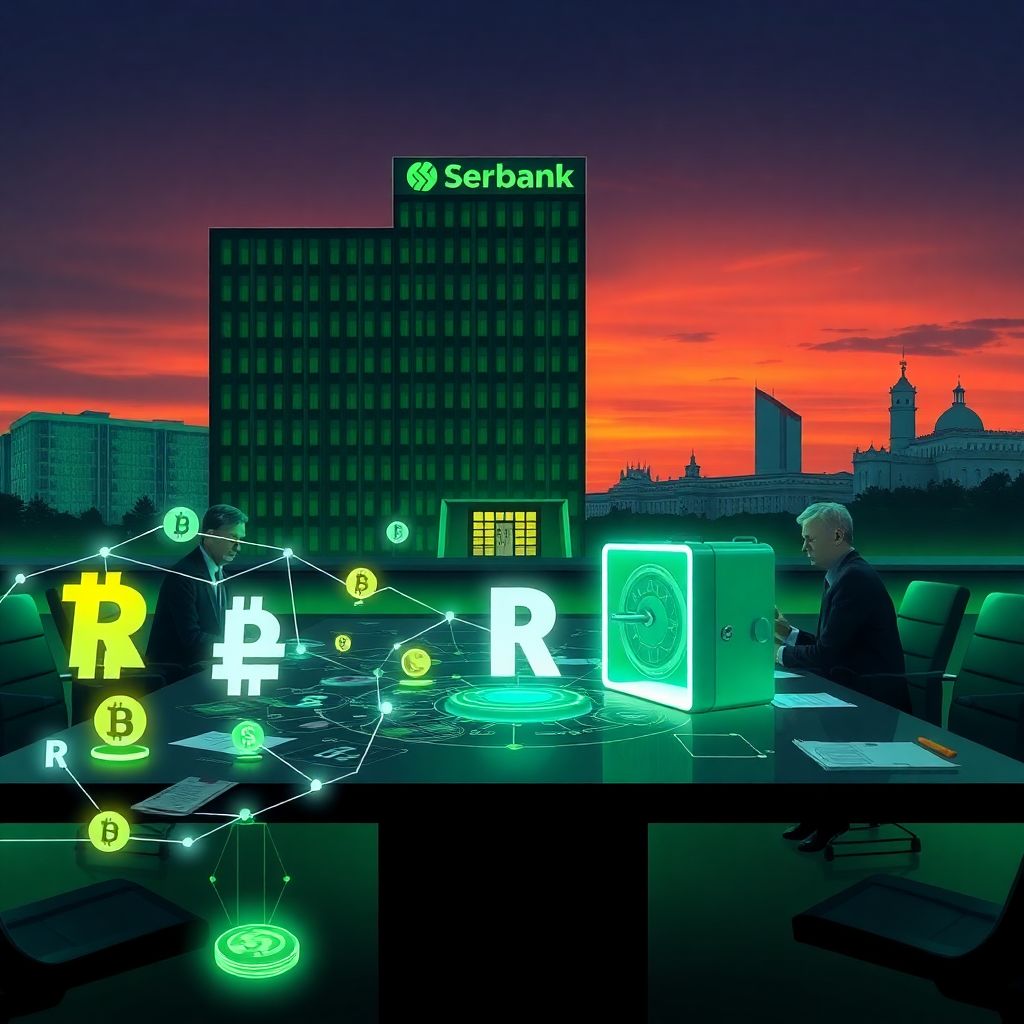
Russia’s Sberbank prepares crypto‑backed ruble loans, calls clear regulation a prerequisite
Russia’s largest lender, Sberbank, is moving closer to launching loans in rubles secured by cryptocurrencies, signaling another step in the country’s gradual integration of digital assets into its financial system. The bank stresses, however, that any such product will only be possible with solid regulatory backing from the state.
Anatoly Popov, Deputy Chairman of Sberbank’s Management Board, confirmed in a recent interview that the bank is actively studying how to use cryptocurrencies as collateral for traditional loans. According to him, Sberbank is evaluating several “new financial instruments” that would allow clients to pledge crypto and receive funding in rubles.
“We are currently exploring the possibility of lending secured by cryptocurrency,” Popov said, noting that the internal work on scenarios and risk models is already underway. He emphasized that the concept is not just theoretical: the bank is looking at how such loans could function in practice, from valuation and custody to liquidation procedures.
At the same time, Popov acknowledged that the legal environment in Russia is not yet ready for fully fledged crypto‑backed lending. He described the existing regulatory framework for cryptocurrencies as being at a “very early stage,” making it necessary for Sberbank to cooperate closely with authorities. The bank intends to work with regulators on “relevant solutions” that would make crypto‑secured loans compliant with Russian law and supervisory expectations.
Popov expressed optimism that these efforts will produce tangible results. He said Sberbank hopes to announce the first such transactions in the foreseeable future, hinting that pilot deals or limited‑scope products could appear once the legal and technical foundations are in place.
Beyond the prospect of crypto‑backed loans, Sberbank is expanding its broader digital asset business. Popov revealed that since the beginning of 2025, the bank has arranged more than 160 issuances of digital assets on its own blockchain‑based platform. These issuances cover a range of financial instruments and are aimed at both corporate and institutional clients seeking alternative ways to raise capital or structure investments.
Sberbank’s relationship with blockchain technology stretches back nearly a decade. The bank began testing distributed ledger solutions as early as 2015 through pilot programs that explored internal settlements, document management, and cross‑border payments. These experiments culminated in the creation of a dedicated Blockchain Laboratory in 2018, tasked with developing and integrating blockchain‑based products into Sberbank’s broader ecosystem.
A major milestone came in March 2022, when Sberbank obtained a license from the Bank of Russia to issue and exchange so‑called Digital Financial Assets (DFAs) in a regulated environment. This license allowed the bank to legally operate a platform for tokenized instruments under Russian law, bringing its blockchain experiments firmly into the realm of supervised financial activity. Since then, the institution has steadily built out its digital asset offerings, focusing on compliant, institution‑grade tools.
In an earlier interview this month, Popov also touched on the bank’s interest in decentralized finance (DeFi). Sberbank, he said, is closely watching how DeFi protocols evolve in order to understand which elements could complement rather than replace traditional banking services. Instead of attempting to build a fully isolated DeFi ecosystem of its own, the bank is studying ways to connect with existing decentralized networks in a controlled, regulated manner.
One of the key areas of focus is asset tokenization. Sberbank views tokenization as a promising bridge between conventional financial infrastructure and decentralized platforms. By converting real‑world assets such as bonds, receivables, or real estate into digital tokens recorded on a blockchain, the bank believes it can unlock new liquidity channels and create more flexible investment products. In this vision, clients could eventually move value between tokenized instruments on Sberbank’s platform and compatible DeFi environments, albeit within a regulated perimeter.
This push comes at a time when Russia’s stance on cryptocurrencies is gradually softening, particularly as policymakers look for tools to mitigate the impact of Western sanctions and maintain access to global value flows. While authorities remain wary of speculative use and capital flight, they are increasingly open to tightly controlled, infrastructure‑oriented applications of crypto and blockchain.
The Bank of Russia, the country’s central bank, recently proposed a set of legislative changes aimed at expanding access to cryptocurrencies under strict investor protection and compliance rules. The proposal envisages a structured regulatory framework that would define who can use digital assets, under what conditions, and through which intermediaries. The central bank has indicated that it wants this framework to be operational by July 2026, setting a clear timeline for lawmakers and market participants.
Other major Russian banks are also preparing for this shift. Earlier this month, VTB, the country’s second‑largest lender, revealed plans to offer spot cryptocurrency trading to high‑net‑worth clients starting in 2026. This would mark one of the first large‑scale, bank‑mediated crypto trading services for affluent investors in Russia, further indicating that digital assets are being integrated into the mainstream financial sector rather than remaining on its fringes.
How crypto‑backed loans could work in Russia
If Sberbank’s plans materialize, a typical crypto‑backed loan product in Russia would likely be conservative in design. Borrowers could pledge recognized cryptocurrencies or tokenized assets as collateral, which Sberbank would hold in secure custody, most likely through its own regulated digital asset platform. In return, clients would receive ruble‑denominated loans for business or investment purposes.
To manage volatility risk, the bank would probably apply significant over‑collateralization, requiring borrowers to deposit crypto worth notably more than the loan itself. If the value of the pledged assets fell below a certain threshold, Sberbank could demand additional collateral or begin partial liquidation of the digital assets, similar to how margin lending is handled in traditional markets. Such mechanisms would be baked into the contractual and technical design of the product.
Given Russia’s regulatory approach, these loans would almost certainly target corporates, professional investors, or high‑net‑worth clients at first, rather than retail borrowers. Authorities are likely to restrict broad public access until they are confident that consumer protection, anti‑money‑laundering, and sanctions‑screening mechanisms are robust and well‑tested.
Regulatory challenges Sberbank must navigate
For Sberbank, the main obstacle is not technology but law. Russian regulators need to clarify how cryptocurrencies are classified for collateral purposes: whether they are treated as property, digital rights, or a distinct asset category, and how they can be seized or liquidated in case of default. This has implications for courts, bankruptcy procedures, and enforcement authorities.
Another challenge is aligning crypto‑backed lending with Russia’s anti‑money‑laundering and counter‑terrorist‑financing regime. Banks must be able to trace the origin of pledged digital assets, apply sanctions screening, and ensure that no restricted entities are benefiting from such products. This may require using blockchain analytics tools and setting strict onboarding criteria for potential borrowers.
Taxation is also a key question. Regulators and the Ministry of Finance must determine how to treat gains, losses, and interest payments linked to crypto‑collateralized loans, both for corporate and individual clients. Clear tax guidance will be essential if Sberbank wants to scale such services beyond isolated pilot transactions.
Why Sberbank cares about DeFi and tokenization
Sberbank’s focus on DeFi and tokenization is not just a branding exercise. For a large universal bank, integrating selected DeFi mechanisms could reduce operational costs, speed up settlements, and enable new forms of programmable finance. For example, tokenized bonds or loans issued on Sberbank’s platform could, in the future, be automatically serviced through smart contracts, with coupon payments, collateral top‑ups, and corporate actions executed on‑chain.
Connecting with existing DeFi ecosystems, rather than building a closed internal network, could also give clients access to global liquidity pools. Institutional investors might, for instance, use tokenized versions of traditional instruments as collateral in both centralized and decentralized markets, while staying within regulatory boundaries agreed upon with Russian authorities.
At the same time, Sberbank is likely to adopt a “walled‑garden” approach: only vetted protocols, whitelisted participants, and assets that meet strict compliance criteria would be allowed to interact with its systems. This hybrid model—open enough to benefit from DeFi innovation, but controlled enough to satisfy regulators—appears to be the direction in which the bank is headed.
Implications for Russia’s financial system
If Sberbank successfully launches crypto‑backed ruble loans, it could set a precedent for other financial institutions in Russia. As the country’s dominant bank, Sberbank often acts as a testing ground for new financial products that later become standards across the sector. A functioning, regulated model for using digital assets as collateral could encourage smaller banks and non‑bank lenders to follow suit.
Such developments could also reshape how Russian companies and investors view cryptocurrencies. Instead of being seen solely as speculative instruments or tools for cross‑border transfers, digital assets may increasingly be regarded as legitimate collateral and components of long‑term financial planning. For corporates in particular, tokenized claims, receivables, or inventory could become part of their broader funding strategy.
On a macro level, the integration of crypto into regulated lending and capital markets could help Russia maintain financial connectivity even under sanctions pressure. While authorities will be cautious not to undermine monetary policy or capital controls, carefully structured products like Sberbank’s proposed loans give the state an additional lever to manage and monitor digital asset flows rather than pushing them entirely into the gray zone.
What to watch next
Over the coming months and years, several milestones will show how serious Russia is about building a crypto‑enabled financial infrastructure:
– the final text and implementation timeline of the Bank of Russia’s proposed crypto legislation,
– the specific conditions under which banks like Sberbank and VTB will be allowed to offer crypto‑related services,
– the first pilot deals involving crypto‑backed ruble loans or tokenized collateral,
– and the degree to which DeFi integrations move from discussion to concrete products.
For now, Sberbank’s message is clear: it wants to be at the forefront of Russia’s digital asset transformation, but it is not willing to move ahead of the regulator. Crypto‑secured loans in rubles, expanded tokenization platforms, and selective DeFi connectivity are all on the horizon—provided the legal foundations are in place and the state is willing to share the risk of innovation.