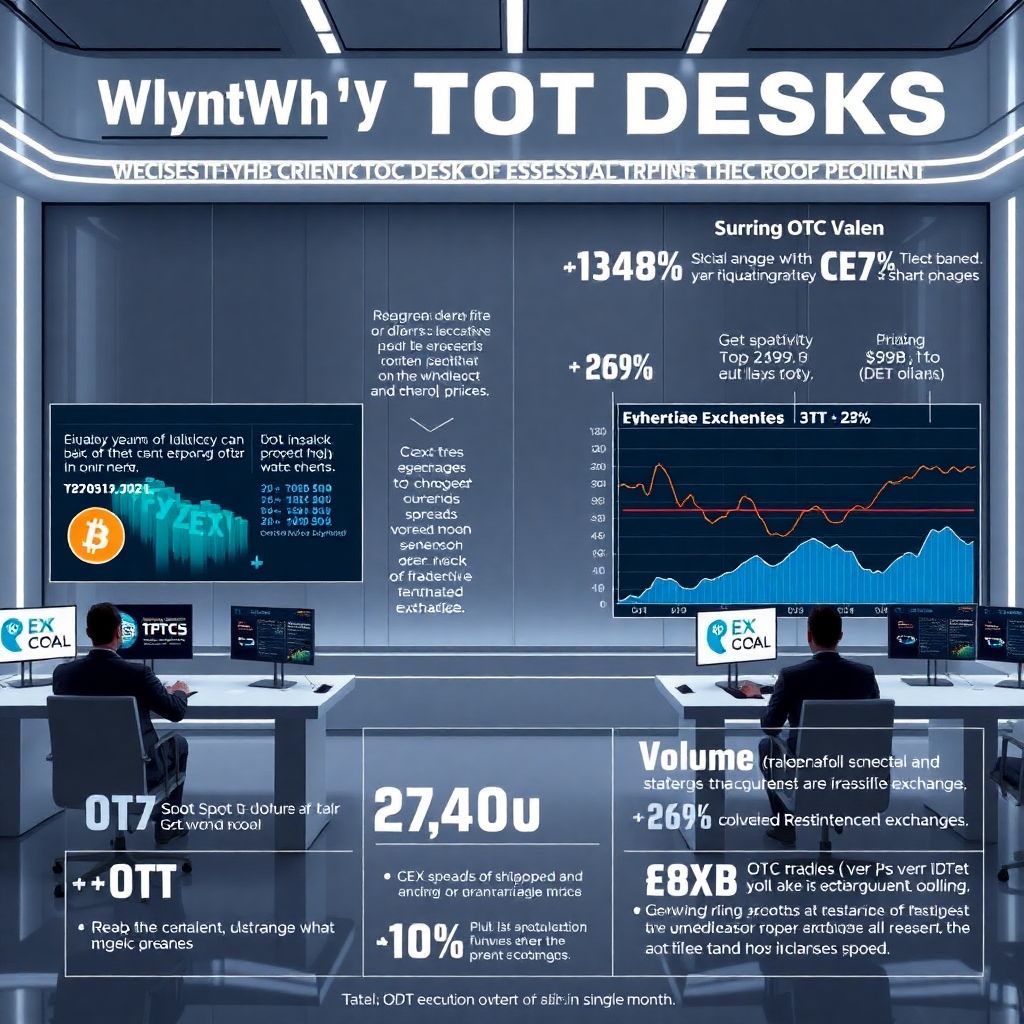
Why OTC desks are becoming essential for large crypto trades
As crypto markets remain volatile and liquidity is increasingly scattered across venues, over-the-counter (OTC) desks are turning into a core tool for anyone moving serious size. Rather than placing huge buy or sell orders on public exchanges and risking a visible market impact, sophisticated traders are shifting toward private, off-exchange dealmaking that lets them execute quietly, quickly, and at more predictable prices.
When a large order hits a public order book, it usually chews through available liquidity across multiple price levels. The result is slippage: the final average execution price ends up far from the original quote, and the larger the order, the worse this effect tends to be. On top of that, visible size on an exchange can attract predatory algorithms, trigger stop orders, or fuel short-term speculation. All of this effectively raises the cost of getting a trade done.
OTC crypto desks were built to solve this problem. Instead of blasting an order into a public book, an OTC desk matches large buyers and sellers off-exchange. Trade terms are negotiated privately, information leakage is minimized, and the execution can be structured in a way that reduces slippage and avoids panic or hype in the open market. For traders who care about reliable pricing, discretion, and fast settlement, this model is increasingly attractive.
In plain terms, OTC trading allows market participants to move large notional amounts without “moving the market.” The most effective OTC providers aggregate liquidity from multiple sources, build deep books that can absorb big blocks, and back that with secure settlement processes, clear quotes, and responsive human support. For institutional clients used to traditional finance standards, this combination often feels more familiar and professional than a retail-focused exchange interface.
The shift toward OTC is not just anecdotal; it shows up clearly in trading data. An analysis of more than 7.1 million crypto trades executed on Finery Markets’ platform between Q1 and Q3 2025 found that the OTC segment of the crypto market expanded far faster than centralized exchanges (CEXs). Over that period, OTC activity surged by 138% year over year, while the top 20 centralized exchanges saw volumes rise by only 22% in comparison.
Broader market metrics further underscore the divergence. CoinGecko estimates that major CEXs handled around 3.9 trillion dollars in spot volume in Q2 2025, a steep drop from 5.4 trillion dollars in Q1, or a 27.7% quarter-on-quarter decline. Decentralized exchanges (DEXs) performed somewhat better, lifting their trading volume from roughly 699.2 billion dollars in Q1 2025 to 876.3 billion dollars in Q2, a 25.3% increase. Yet even that growth rate lags behind the expansion seen in OTC activity over the same window.
This volatility in exchange volumes is a reminder of how unpredictable crypto markets can be. In such an environment, access to multiple liquidity sources becomes crucial. Some OTC providers have adopted an “On-Demand Trading” (ODT) model in which they connect to numerous liquidity partners simultaneously and provide direct access to this aggregated liquidity. Because trades can be executed without sitting in public queues, exposure to sudden order-book shocks is reduced, giving large traders more control over their execution quality.
OTC trading is particularly well suited for tickets that frequently exceed one million dollars. Its appeal spans high-net-worth individuals, crypto funds, hedge funds, proprietary trading firms, corporate treasuries, and other institutional players who need competitive pricing, operational security, and support for a diverse list of digital assets. Unlike standardized exchange execution, OTC trades allow both sides to negotiate not only price, but also settlement timing, trading windows, and sometimes even the structure of the deal.
By keeping large orders off public books, OTC desks can also play a stabilizing role for the broader market. Massive market orders on exchanges are capable of triggering flash crashes or sharp spikes when liquidity is thin. OTC providers help dampen these shocks by spreading large trades across multiple liquidity pools and counterparties, often in a way that is invisible to the average exchange user. This reduces the likelihood of dramatic intraday dislocations that can cascade into liquidations and further volatility.
Confidentiality is another key advantage. Because OTC trades are typically conducted bilaterally and reported differently, they do not appear as giant orders sitting in the order book waiting to be filled. This makes it harder for other market participants to front-run or game large trades. Large fund rebalances, treasury reallocations, or strategic entries and exits can thus be handled without broadcasting intent to the market.
Cost structure also pushes many big traders toward OTC. While exchange fees are transparent, they are layered on top of the invisible costs of slippage and market impact. By contrast, OTC trades are usually priced through a direct quote process. The desk offers a firm price or a tight spread for a given size, and the client can accept or negotiate. Because the desk can aggregate liquidity and optimize execution behind the scenes, the all-in cost for the client—fee plus execution quality—can often beat what would have been achieved on a public venue.
Some of the most recognized institutional platforms, such as Coinbase Prime, offer integrated OTC services on top of their exchange infrastructure, focusing on robust custody and compliance. Kraken’s OTC operation is similarly known for providing reliable liquidity and white-glove service to institutions and high-net-worth traders. Alongside these household names, newer or more specialized OTC desks are emerging with their own execution and liquidity models.
A case in point is ODT, a lesser-known but highly capable OTC trading desk that focuses on sourcing deep liquidity and quoting large blocks while minimizing slippage. ODT has demonstrated the ability to settle trades on the same day, completed individual trading days with more than 10 million dollars in executed volume, and surpassed 240 million dollars in trading volume in a single month. While it caters to large traders, it still welcomes users with trade sizes starting from 500 dollars, opening the door to smaller participants who want OTC-style execution.
Security and fraud prevention are critical in OTC workflows, as trades often involve direct transfers of large sums between counterparties. ODT has implemented strict security protocols and monitoring processes, reportedly preventing over 10 million dollars in payments from reaching scammers. This type of oversight is becoming increasingly important as fraudsters grow more sophisticated and attempt to exploit high-value, off-exchange transfers.
The way OTC desks charge for their services also differs from the fee schedules found on typical exchanges. ODT, for instance, uses a transparent fee model on crypto purchases: it earns revenue directly from per-transaction fees rather than hidden spreads or opaque markups. Larger trades often receive discounted rates, reflecting lower marginal execution costs and the value of bringing significant volume to the platform. At very high volumes, fees can sometimes be negotiated, with clients leveraging their size, execution flexibility, or settlement preferences to secure better terms.
For large traders comparing options, several additional factors are worth considering when evaluating whether to use OTC versus public exchanges:
– Execution certainty and quote firmness: In OTC deals, traders can request a firm quote for a defined size and decide instantly, instead of crossing a fragmented order book and hoping the displayed liquidity does not disappear.
– Settlement flexibility: OTC desks can often accommodate different settlement rails (for example, multiple fiat currencies or stablecoins) and adapt timelines to client needs, which can be important for cross-border flows or complex treasury operations.
– Operational support: Dedicated account managers, trade support, and post-trade reconciliation help reduce errors and improve the experience for institutions with internal reporting and compliance requirements.
From a risk management perspective, OTC trading also allows institutions to better align execution strategies with broader portfolio goals. For example, an asset manager that needs to exit a large position without signaling to the market may choose to execute several negotiated OTC blocks over multiple days, coordinating timing with liquidity providers. This approach minimizes tracking error relative to benchmarks and reduces the probability of adverse price moves triggered by the trade itself.
OTC desks are also playing a growing role in secondary markets for less liquid assets, such as early-stage token allocations, locked-up positions, or large blocks in newly listed tokens. Public order books for these assets can be extremely thin, making on-exchange execution impractical. By matching specialized buyers and sellers and structuring bespoke deals, OTC providers help unlock liquidity where exchanges still struggle.
For institutions entering crypto for the first time, OTC venues often act as a gateway. Traditional financial players are accustomed to dealing with sales traders, RFQs (request-for-quote) systems, and bilateral settlement. OTC crypto desks mirror this familiar structure, easing the onboarding process and reducing the learning curve compared to directly navigating public exchanges and DeFi protocols.
Ultimately, the rise of OTC trading in crypto is part of a broader maturation of the market. As more capital flows into digital assets and participants become more sophisticated, they demand tools that mirror the capabilities of established financial markets. OTC desks, with their emphasis on discretion, execution quality, and tailored service, answer that demand and are increasingly viewed as standard infrastructure rather than a niche option.
For traders considering large crypto transactions, the decision is less about choosing OTC instead of exchanges, and more about combining both intelligently. Public exchanges remain vital for price discovery, retail participation, and smaller trades, while OTC channels handle large blocks, sensitive flows, and bespoke deals. In practice, the most effective trading strategies blend the two, using OTC to minimize market impact and exchanges for continuous, transparent liquidity.
Any participant weighing an OTC relationship should evaluate track record, security controls, regulatory posture, capital strength, and the breadth of supported assets. Beyond headline fees, the key question is the all-in quality of execution—how close the final traded price is to the true market level once all hidden costs are accounted for. When that analysis is done carefully, it becomes clear why OTC desks are increasingly seen as indispensable for executing large crypto trades in a volatile, fragmented market.
This article is for informational and educational purposes only and should not be treated as financial or investment advice. Every trader or investor should perform independent analysis and consider their own risk tolerance before engaging in any form of crypto trading, whether via exchanges or OTC desks.