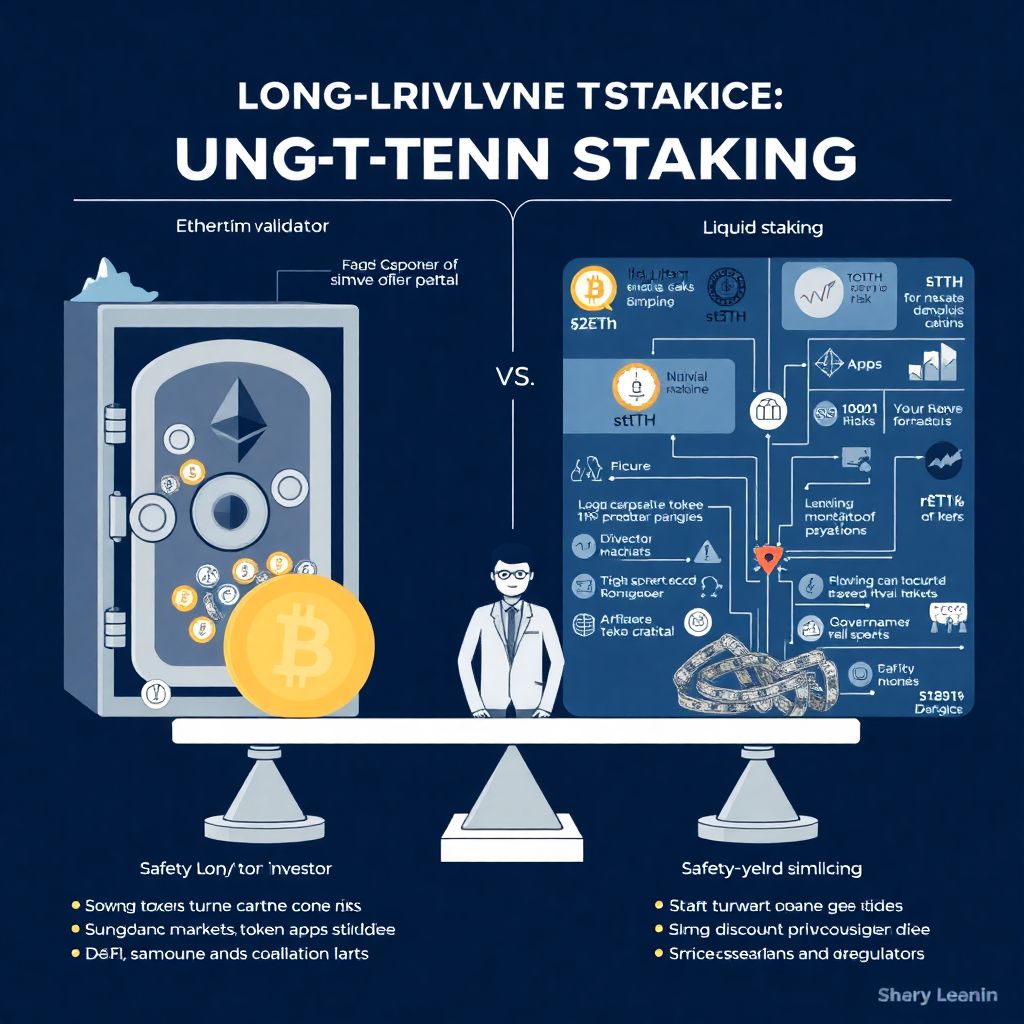
Why Liquid vs Native Staking Even Matters for Long-Term Holders
If you’re planning to hold crypto for years, staking stops being a quick-yield trick and turns into a core part of your portfolio design. In that context, the liquid staking vs native staking debate isn’t just academic — it shapes how flexible, secure, and tax‑efficient your capital will be over time. Instead of picking a random protocol because “everyone uses it,” it makes sense to step back, understand how these models evolved, and then decide which approach actually fits a multi year crypto staking strategy, your risk tolerance, and your need for liquidity.
—
Historical Background: From Solo Validators to Liquid Tokens
At the start, staking was basically “run your own node or stay out.” Early proof‑of‑stake systems like the first iterations of Tezos and later Ethereum’s Beacon Chain assumed users were willing to lock tokens, manage hardware, and stay online. Native staking was seen as the “pure” way to secure the network: you bond coins, help validate blocks, and earn rewards. The trade‑off was harsh: your assets were locked, and the barrier to entry was high — both technically and financially, with minimums like 32 ETH for Ethereum validators.
As the ecosystem matured, it became obvious that most people didn’t want to operate validators or accept long unbonding periods. Capital stuck in staking contracts could not easily be moved, hedged, or used as collateral. That’s where liquid staking came in: protocols started issuing derivative tokens (like stETH, rETH or similar) that represent your staked position and can be traded or used across DeFi. Over time, as more capital flowed into these systems, regulators, developers, and large funds began to ask: is liquid staking better than native staking from a systemic and user perspective, or are we just shifting risks around instead of solving them?
—
Basic Principles: What Actually Changes Between Native and Liquid
At a high level, native staking means you lock your assets directly in the base protocol (or via a non‑derivative delegation interface) and earn rewards in that same asset. You usually accept a lockup or unbonding period, slashing risk, and some level of validator trust — especially if you delegate to a staking pool or provider. Your staked assets don’t move; they just sit in a staking contract until you withdraw them. For long‑term holders, this can be fine: if your plan is simply “buy, stake, forget,” then the illiquidity might even help you resist emotional trading.
Liquid staking adds one extra layer: when you deposit your tokens, the protocol stakes them on your behalf but also issues you a liquid token that mirrors your share of the pool. This token can be traded, lent out, or used as collateral in DeFi. Rewards are either reflected as an increasing balance or a rising token price relative to the underlying. The twist is that you’re no longer only taking chain‑level and validator risk; you’re also taking smart contract risk and sometimes governance risk from the liquid staking protocol itself. That’s why the liquid staking vs native staking decision is really about choosing between simplicity and flexibility, not just chasing the highest APY.
—
How Risk and Reward Flows Differ
Under native staking, risk is relatively straightforward: if your validator misbehaves, you can be slashed; if the chain itself fails, you lose. Rewards are usually transparent and protocol‑driven, and your yield depends mostly on network parameters (total staked, inflation rate, fees). In many ecosystems, native staking is the default path for conservative, multi‑year investors precisely because it has fewer moving parts and a more predictable security model. The cost is that your capital is inert during the staking period.
Liquid staking alters this equation. On top of chain‑level risk, you now rely on a smart contract to manage deposits and withdrawals, a set of validators curated by the protocol, and sometimes a governance token that can change parameters. Your liquid staking token may trade at a premium or discount to the underlying, which adds market risk. On the upside, that same token lets you stack yield: stake once, then deploy the derivative into lending markets or liquidity pools. For a multi‑year horizon, those extra layers of DeFi activity can compound returns — but they can also compound failure modes if you’re not careful.
—
Implementation Examples: How This Looks on Ethereum and Beyond
Ethereum is the easiest place to see both models side by side. Native staking means running your own validator or using a native delegation solution, locking 32 ETH (or using a pooled validator service without derivatives). Your ETH is bonded directly on the Beacon Chain, and unless you exit, you can’t quickly redeploy it. You earn protocol rewards, but you do not get an additional token representing your stake. This is clean and relatively transparent, but it ties up your capital in a way that matters a lot if you want to actively manage your portfolio over several market cycles.
Liquid staking on Ethereum works differently. You deposit ETH into a protocol, it distributes that ETH across a set of validators, and you receive a token like stETH, rETH or others. This token tracks your share of the staking pool and usually appreciates over time as rewards accrue. Because it’s an ERC‑20‑like asset, you can move, trade, lend, or use it as collateral. This is where an ethereum liquid staking providers comparison becomes relevant: each provider differs in decentralization, node operator set, withdrawal guarantees, fee structure, and integration depth with DeFi. For a long‑term user, the real value is not just the APY but the ecosystem around the token — how many things you can safely do with it without taking absurd risk.
Beyond Ethereum, other proof‑of‑stake chains follow similar patterns. Cosmos‑based networks started with native staking and are now experimenting with liquid staking modules and third‑party protocols. Polkadot, Solana, and others have seen a wave of liquid staking tokens appear to plug into their DeFi stacks. The pattern repeats: native staking comes first to secure the chain; liquid staking appears later to make that security capital more useful. For a multi‑year investor, tracking the maturity of each ecosystem’s tooling and security reviews becomes crucial before committing large amounts of capital.
—
Native Staking in Practice: Pros and Cons
Native staking is still the “reference implementation” in most designs. When you stake directly, you’re closer to the protocol and farther from experimental infrastructure. That’s attractive if you’re holding a large amount of one asset for many years and don’t care about chasing every last yield opportunity. At the same time, ignoring the liquidity angle entirely can be suboptimal if you anticipate large market swings or opportunities that come and go quickly. Over a five‑year window, flexibility can be as valuable as a small boost in APR.
Основные плюсы и минусы нативного стейкинга можно резюмировать так (перечисления только для ориентира, к ним стоит добавить собственный анализ):
– Плюсы: простая модель риска, отсутствие токена‑дериватива, часто официальная или “каноничная” инфраструктура, меньшая зависимость от сторонних смарт‑контрактов.
– Минусы: заморозка капитала на период блокировки, упущенные возможности в DeFi, иногда неудобные минимальные пороги и технические требования при запуске собственного валидатора.
—
Liquid Staking in Practice: Pros and Cons
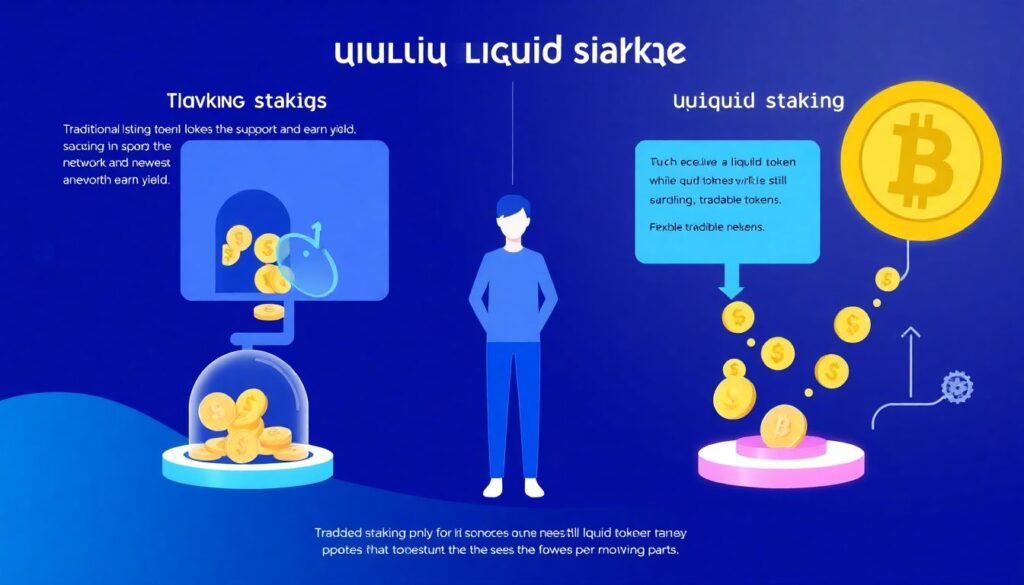
Liquid staking flips some of those trade‑offs.You get a liquid token while still earning staking rewards, which means you don’t have to pick between “support the network and earn yield” and “keep funds flexible for opportunities.” However, that convenience comes at the cost of extra complexity. The liquid token is only as good as the protocol’s design, smart contract security, and validator set. In long time frames, governance changes, fee updates, or regulatory pressure can alter the risk‑reward profile in ways you might not anticipate at the start.
Ключевые преимущества и недостатки ликвидного стейкинга обычно выглядят так:
– Плюсы: ликвидность стейк‑токена, возможность использовать его как залог, комбинирование нескольких источников доходности, более низкий порог входа.
– Минусы: смарт‑контрактный риск, зависимость от децентрализации и устойчивости протокола, потенциал расхождения цены дериватива с базовым активом, дополнительные налоговые и учетные нюансы.
—
Liquid Staking vs Native Staking: How Should Multi-Year Investors Decide?
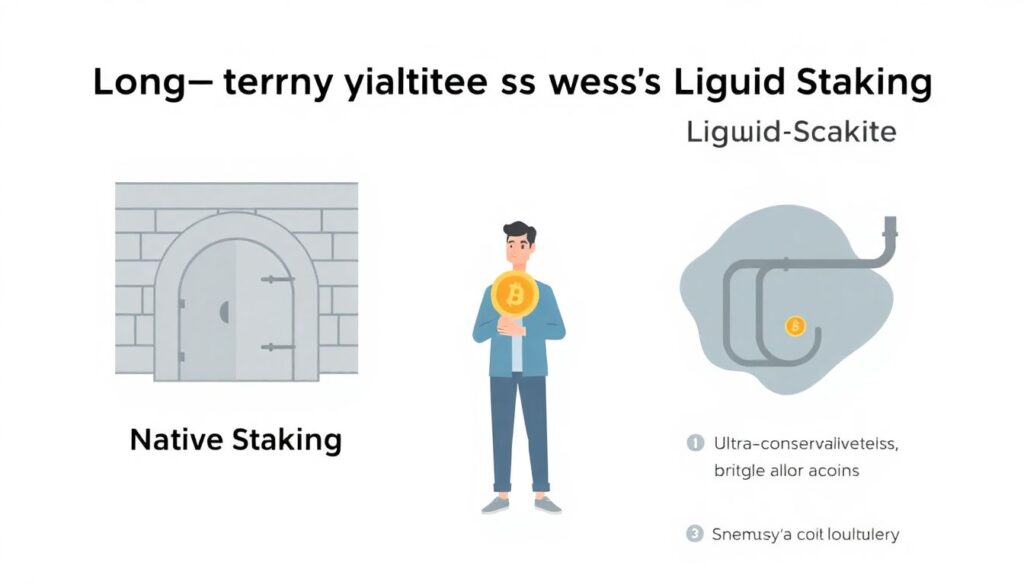
For long‑term holders, the liquid staking vs native staking choice is less about “which one is objectively superior” and more about where you sit on the spectrum between safety and flexibility. If your plan is ultra‑conservative — for example, you hold a single major asset, have no interest in DeFi, and measure your performance in terms of total tokens rather than dollar value — then plain native staking, possibly through a reputable validator, might be enough. You’d accept illiquidity as the price for simplicity and fewer attack surfaces.
If, on the other hand, you expect to rebalance periodically, access stablecoins against your holdings, or rotate into new opportunities without fully exiting your long‑term positions, liquid staking becomes more appealing. In that situation, a carefully designed multi year crypto staking strategy might involve splitting your exposure: a core position in native staking for maximum robustness and a satellite allocation in liquid staking tokens that you actively deploy across DeFi. This way, you’re not forced into an all‑or‑nothing bet; instead, you dial your risk level by adjusting the size of your liquid portion over time.
—
What “Best” Means for Long-Term Stakers

When people ask about the best liquid staking platforms for long term investors, they often look only at yields. APY is visible and easy to compare, but for multi‑year timeframes, it can be a distraction. More important questions are: how decentralized is the validator set, how transparent are the fees, what is the protocol’s security history, and how integrated is the liquid token in blue‑chip DeFi protocols? A slightly lower nominal yield from a battle‑tested provider might be far superior to a flashy new protocol offering a few extra percentage points with unproven contracts.
A practical approach is to evaluate platforms on three axes: technical security (audits, bug bounty programs, on‑chain track record), validator decentralization (number and diversity of node operators, presence of caps per operator), and ecosystem depth (lending, DEX, collateral integrations). Over a five‑year window, even one major exploit or governance failure can erase years of rewards. Instead of chasing the theoretical maximum, aim for “resilient enough that I can sleep at night” while still giving yourself room to act when the market presents asymmetric opportunities.
—
Common Misconceptions About Liquid and Native Staking
One widespread misconception is that liquid staking is always riskier than native staking. The reality is more nuanced. Poorly designed liquid protocols with centralized control and weak security practices can absolutely be dangerous. But some heavily reviewed, widely used liquid staking systems may, in practice, spread validator risk more effectively than a single retail user running a home validator with occasional downtime. Risk is contextual and depends on implementation details, not just on whether a token is “liquid” or not.
Another myth is that native staking is “set and forget” with no ongoing decisions. Even if you stake natively, you still need to monitor validator performance, keep an eye on slashing events, and adapt if protocol rules change. For multi‑year horizons, governance proposals, economic upgrades, or new competition from alternative staking models may all affect your expected return. Conversely, some people worry that liquid staking tokens will always trade at a big discount. In reality, discounts or premiums tend to appear around extreme market events or withdrawal bottlenecks; in calmer conditions, they often track the underlying quite well, though this is never guaranteed.
—
How to Avoid the Biggest Traps
The first trap is treating staking as a pure yield product instead of a security function with financial side‑effects. Remember that staking, native or liquid, exists to secure a network. When too much power accumulates in a few providers, even highly convenient systems can become systemic risks. You want your capital to support decentralization rather than undermine it. For a long‑term investor, this can mean deliberately choosing slightly less concentrated providers or running your own setup for at least part of your holdings.
The second trap is ignoring liquidity risks. With native staking, the risk is simple: you might need funds during the unbonding period and be unable to react quickly. With liquid staking, the risk is more subtle: in stressed markets, the liquidity of your derivative token can dry up exactly when you need it most. To mitigate this, don’t rely solely on one liquidity pool or one borrowing market; diversify venues and keep a cash or stablecoin buffer outside staking. Treat the derivative’s market depth and integration quality as part of your due diligence, not an afterthought.
—
Putting It All Together: A Framework for Multi-Year Staking Choices
To make a grounded decision, start by mapping your actual use case. If you’re truly comfortable with illiquidity and want minimal complexity, lean toward native staking as your base. If you know you’ll want to borrow against your position, engage with DeFi, or nimbly react to new protocols, assign a portion of your holdings to liquid staking. Rather than asking in the abstract whether liquid or native is “better,” ask how each tool fits into your own constraints, tax rules, and risk preferences over the next five to ten years.
A balanced framework might look like this:
– Define a target allocation between “never touch” capital (prefer native) and “actively managed” capital (prefer liquid).
– For the liquid portion, pick one or two robust providers after careful ethereum liquid staking providers comparison or equivalent research on your chain.
– Revisit your setup at sensible intervals (e.g., annually or around major protocol upgrades), not every week.
By treating staking as a long‑term design problem rather than a short‑term yield chase, you’ll be in a much better position to use both native and liquid staking as complementary tools instead of mutually exclusive bets. Over multi‑year horizons, that mindset usually matters more than the last decimal place of APY.