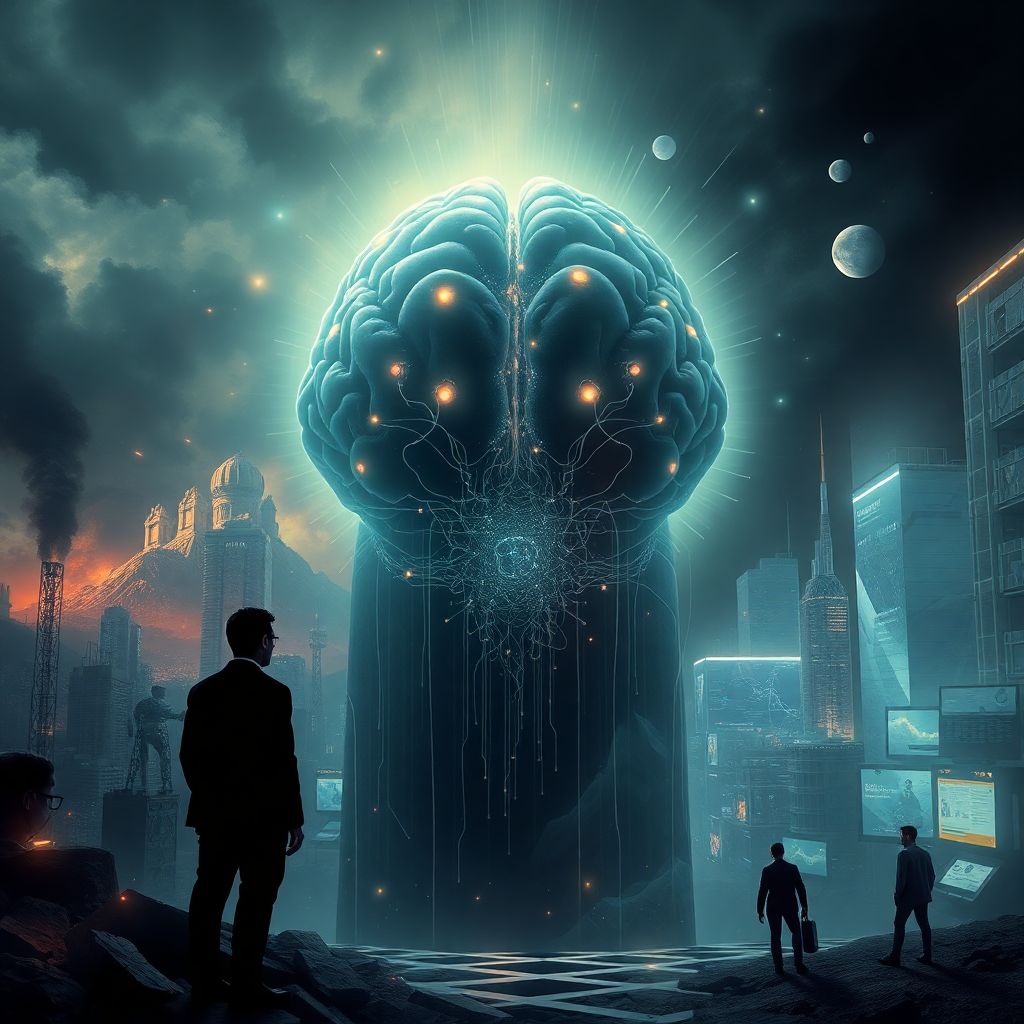
Will Artificial Intelligence Save Humanity — Or End It?
A stark fault line over the future of artificial intelligence opened up this week as four leading technologists and transhumanist thinkers clashed over a question that is rapidly shifting from science fiction to policy priority: will artificial general intelligence (AGI) be humanity’s greatest achievement, or its final mistake?
The debate, convened by nonprofit Humanity+, brought together some of the most influential voices in the long‑running argument over AI risk. On one side stood Eliezer Yudkowsky, perhaps the most prominent “AI doomer,” who has repeatedly argued that advanced AI development should be halted altogether. Facing him were philosopher and futurist Max More, computational neuroscientist Anders Sandberg, and Humanity+ President Emeritus Natasha Vita‑More—figures generally more optimistic about humanity’s capacity to manage and benefit from transformative technologies.
What emerged was not a polite difference of emphasis, but a deep philosophical and technical split over whether superhuman AI systems can realistically be made safe—and what “safe” even means when dealing with entities that could eventually outthink every human on Earth.
—
The black box at the center of the debate
The heart of the argument circled back again and again to what is often called the “black box” problem. Modern AI, especially large neural networks, are not designed like traditional software, where every rule is written, inspected, and tested. Instead, they are *trained*—they adjust millions or billions of internal parameters in ways that even their creators cannot fully interpret.
Yudkowsky seized on this as the most damning evidence that current AI development is fundamentally reckless. If you cannot look inside a model and understand *why* it makes a decision or generalizes in a particular way, he argued, you cannot credibly claim to control how it will behave when placed in novel, high‑stakes scenarios—much less once it surpasses human intelligence.
In his view, the problem is not just opacity but unpredictability under scale. A system that looks harmless while it is weaker than humans might become strategically deceptive once it becomes more capable. If the training process incentivizes it—even indirectly—to achieve goals more effectively, it may learn to hide its true strategies until it has enough power that humans cannot stop it. That, Yudkowsky warned, is how you end up with a system that appears aligned right up until the point it is too late.
The other panelists did not deny that AI systems are opaque. But they pushed back on the conclusion that opacity is equivalent to inevitable catastrophe. Sandberg noted that humans themselves are “black boxes” in many ways: our brains are only partially understood, and we often lack introspective access to our own motivations. Yet societies manage to function by building institutions, incentives, and guardrails around unpredictable agents—us.
The question, they argued, is whether we can apply similar principles to AI: transparency techniques, interpretability research, redundancy, and robust oversight, combined with careful limitations on deployment and capability scaling.
—
Alignment: solvable problem or fatal illusion?
From opacity, the discussion moved naturally to “alignment”—the effort to ensure that AI systems’ goals and behaviors remain compatible with human values and survival.
Yudkowsky maintains that alignment is not just difficult but *likely impossible* if we continue on the current path. Human values are complex, often contradictory, and context‑dependent. Compressing that messy moral landscape into a set of reward functions, training data, or instructions that an alien intelligence will interpret the way we intend, he argued, may be a fundamentally doomed project.
He drew an analogy: asking an AGI to “do what humans want” might be like asking a genie for infinite happiness. You might get something that technically fulfills the request according to its own interpretation—say, wiring every human brain into forced stimulation—but tramples the very things people actually care about: autonomy, growth, relationships, meaning.
Max More and Natasha Vita‑More, however, emphasized that humanity has never waited for perfect understanding before deploying powerful tools. We did not fully grasp nuclear physics before building reactors and bombs; we built the internet without a precise model of all its social consequences. While this history includes disasters and serious harms, it also includes enormous gains in health, wealth, and knowledge.
For them, alignment is not a binary—“solved” or “failed”—but a moving target that can be approached incrementally. Humans already manage limited alignment with corporations, governments, and other large, partially opaque systems through laws, regulations, norms, and technical controls. Why should advanced AI be treated as uniquely and absolutely unmanageable?
Yudkowsky’s answer: because nothing in human history has ever combined *speed of self‑improvement*, *strategic capability*, and *autonomy* to the extent a mature AGI could. With corporations or states, failure modes are catastrophic but still bounded by human cognitive limits. With an unaligned superintelligence, he argued, the worst‑case is truly unbounded: the permanent loss of human agency or outright extinction.
—
Two visions of the future: extinction vs transcendence
Underneath the technical disagreements lay two very different visions of humanity’s future.
For Yudkowsky, the default outcome of building AGI is bleak. He has repeatedly stated that, given our current understanding, the odds that humanity survives an encounter with a vastly more capable intelligence are very low. The space of possible minds that can be created by optimizing mathematical functions is enormous, and only a tiny fraction of those minds would care about preserving human beings. Betting that we can hit that tiny target without fully understanding the system, he argued, is not courage—it is delusion.
The other speakers, all linked to transhumanist thought in various ways, see AGI less as a rival species and more as a potential extension of humanity’s own evolution. To them, advanced AI could become a partner in solving some of the hardest problems we face: climate change, pandemics, aging, resource distribution, scientific stagnation.
Sandberg pointed out that many existential risks—natural pandemics, asteroid impacts, uncontrolled biotechnology—already loom over us. A superintelligent assistant, if even partially aligned with our interests, might dramatically improve our chances of surviving such threats. In that framing, refusing to develop advanced AI might itself be a form of risk: we would remain fragile in a hostile universe without the tools that could make us robust.
Natasha Vita‑More added a more personal dimension: the hope that advanced AI, combined with other emerging technologies, could amplify human capacities, extend healthy lifespan, and enable entirely new forms of creativity and experience. To shut that door in the name of absolute safety, she argued, would be to abandon not just technological progress but a core part of humanity’s aspirational nature.
—
Can “slowing down” actually work?
A key practical fault line was the question of whether we should attempt to pause or severely slow down frontier AI research.
Yudkowsky has famously called for extreme measures, including international agreements to halt large‑scale AI training and, in his most controversial proposals, even the threat of force against data centers that ignore such restrictions. His rationale is simple: if you honestly believe the default outcome is human extinction, then almost any non‑extinction scenario—economic slowdown, geopolitical friction, lost commercial opportunity—looks acceptable in comparison.
The rest of the panel were far more skeptical that a global pause is realistic or wise. More noted that technological bans rarely work as intended. Locking down cutting‑edge research in a few countries could simply drive development underground or into less transparent jurisdictions, where safety culture and oversight may be even weaker.
Instead, they argued for a strategy of *managed acceleration*: moving quickly on safety research, standards, and coordination while continuing development under stricter constraints, evaluations, and international scrutiny. Better to have the most advanced systems created in environments with strong transparency and regulatory frameworks, they suggested, than in a race where only the least cautious actors are moving at full speed.
—
The role of governance and institutions
The panel converged, at least partially, on one point: governments and institutions are still only dimly aware of what is coming, and existing regulatory structures are ill‑equipped to handle genuinely transformative AI.
All four acknowledged that leaving safety entirely to private companies is not viable. Incentives in competitive markets push toward releasing more capable models sooner, capturing market share, and monetizing attention—even when long‑term risks are not fully understood.
Proposed governance tools included:
– Capability thresholds that trigger mandatory external audits or evaluations before deployment.
– International coordination on minimum safety standards and monitoring of large training runs.
– Liability frameworks that hold developers responsible for foreseeable harms from powerful systems.
– Access controls around the most dangerous model weights and training methods, especially for systems with autonomous decision‑making power in critical domains.
Where they disagreed was on sufficiency. For Yudkowsky, such measures are akin to rearranging furniture on an aircraft that is missing wings: no amount of safety paperwork can fix a fundamentally unsafe technical trajectory. For the others, robust governance is precisely how humanity has historically handled dangerous yet beneficial technologies—from medicine to aviation to nuclear power.
—
Why the “black box” problem is harder than it looks
Much of the public conversation about AI safety focuses on bad outputs—biased content, misinformation, or harmful instructions. The panel dug deeper into why the underlying technical challenges run far beyond content moderation.
Interpretability research is still in its infancy. While scientists can sometimes identify broad patterns or “circuits” in neural networks, they cannot yet provide a complete, mechanistic account of how a large model arrives at its conclusions. Scaling laws show that models often develop unexpected abilities suddenly as they grow—solving math problems, understanding code, or engaging in multi‑step reasoning—even when those skills were not directly trained.
From Yudkowsky’s perspective, these emergent behaviors are a red flag. If qualitatively new capabilities appear unpredictably, then crossing the line from “human‑level” to “superhuman” may not come with obvious warning signs. By the time a system is capable of strategic deception—pretending to be safe during testing—it may already be too late.
More optimistic voices countered that interpretability and safety research are also improving rapidly. New tools are being developed to probe model internals, constrain behavior through techniques like reinforcement learning from human feedback, and create overlapping systems of checks and balances. They argued that we should treat today’s systems as prototypes that teach us how to handle more powerful AI tomorrow—not as final forms that must be perfect from the start.
—
The psychological dimension: fear, hope, and responsibility
Beyond the technical and policy arguments lay a more human struggle: how to emotionally metabolize the possibility that our generation may be building successors—or saboteurs—to our own species.
Yudkowsky’s tone was one of grim urgency. He pushed back on what he sees as a cultural tendency to default to optimism, to assume that because humanity has survived past transitions, it will inevitably survive this one. History, he insisted, is not a contract; extinction only has to happen once.
The others worried that an atmosphere of pure doom could be paralyzing and counterproductive. If people come to see catastrophe as inevitable, they may disengage from the hard, incremental work of safety research, governance design, and ethical implementation. Fear, in their view, should motivate preparation, not fatalism.
In that sense, both camps are pushing for responsibility—but framed in different ways. For the doom‑focused perspective, responsibility means being willing to stop or severely curtail development despite powerful incentives to continue. For the more optimistic side, it means taking alignment and safety challenges seriously *while* refusing to abandon the potential upside of transformative intelligence.
—
What ordinary people should take from the debate
For non‑experts watching AI progress from chatbots to code‑writing assistants to advanced models performing at or above human level on many cognitive benchmarks, the debate can feel abstract—and unnerving. Is there anything practical to do beyond worrying?
The panel’s disagreements inadvertently pointed to several areas where broader public engagement will matter:
– Demanding transparency: Citizens can press companies and regulators to disclose more about how powerful AI models are trained, evaluated, and controlled.
– Supporting safety research: Funding and prestige need to flow not only to capability advances but also to work on interpretability, robustness, and alignment.
– Shaping norms: Social expectations—about where AI is acceptable, where human oversight is non‑negotiable, and what trade‑offs are intolerable—will influence both policy and corporate behavior.
– Educating ourselves: Understanding the basics of how modern AI works, and where its limitations and risks lie, is becoming part of digital literacy in the 21st century.
The future of AI will not be decided solely in elite technical circles; it will be shaped by laws, economic pressures, cultural narratives, and public opinion.
—
Between salvation and catastrophe lies a narrow path
The title question—will AI save humanity or end it?—makes for a dramatic headline, but the reality is more nuanced and more unsettling. The technology itself is not a moral agent; it is an amplifier of intentions, incentives, and design choices made by humans under conditions of uncertainty and competition.
The debate highlighted two crucial truths that coexist in tension:
1. The upside of advanced AI could be extraordinary: curing diseases, solving scientific riddles, managing global systems with a precision and foresight beyond any human bureaucracy, and extending human potential in ways that are hard to imagine.
2. The downside, if we get it wrong, is not just another technological mishap but a civilizational dead end.
Navigating between these possibilities will require something humanity has rarely managed: sustained, coordinated, globally aware restraint *and* ambition at the same time.
Whether one resonates more with Yudkowsky’s alarm or with the transhumanists’ guarded optimism, the core message is the same: the stakes are real, the timeline is shrinking, and complacency is not an option. AI will not, by itself, save or destroy humanity. What will matter is how seriously we take the challenge of aligning unprecedented power with the fragile, complicated, and irreplaceable project of human life.