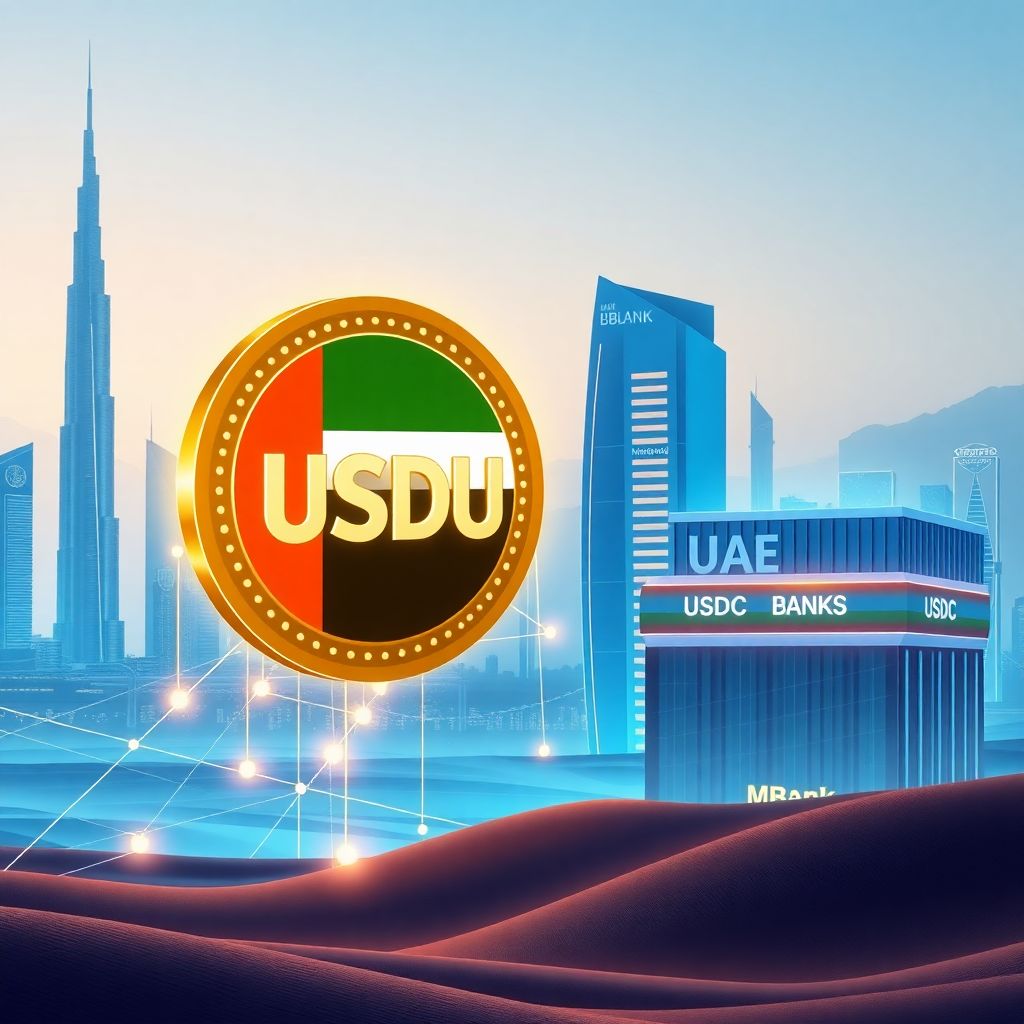
UAE launches first central bank–approved stablecoin, putting direct pressure on USDC in the region
The United Arab Emirates has taken a decisive step into the stablecoin arena with the debut of USDU, the first stablecoin formally approved by the country’s central bank. The move not only cements the UAE’s ambitions to be a global digital-asset hub, it also creates a direct regulatory challenger to Circle’s USDC on what is increasingly becoming its strategic turf in the Middle East.
USDU is issued by Universal Digital Intl Limited, which has become the first entity to receive authorization from the Central Bank of the UAE to issue what regulators classify as a Foreign Payment Token. Unlike many other stablecoins that operate under money-service or virtual asset frameworks, USDU is directly registered with the central bank itself — a status that immediately sets it apart in terms of legal clarity and settlement privileges.
The token is fully backed by U.S. dollars deposited in leading UAE financial institutions, including Emirates NBD, Mashreq, and Mbank. This structure positions USDU as the only stablecoin currently recognized for the settlement of digital-asset transactions under the UAE’s domestic regulatory regime. For banks, payment providers, and large corporates that must adhere strictly to local oversight, this distinction is more than symbolic; it defines what they can use in fully compliant on-chain settlement flows.
Circle, issuer of the widely used USDC stablecoin, has also been building a footprint in the UAE. In December, it obtained a license from Abu Dhabi Global Market (ADGM) to operate as a money services provider and expand its payments and crypto-related offerings across the UAE and the broader Middle East. That authorization gives Circle freedom to serve customers and integrate with local platforms but does not confer central bank registration.
This regulatory nuance matters. While USDC can circulate, be listed, and be used for payments within UAE-linked platforms, it does not currently enjoy the same official settlement status as USDU. For institutions operating at scale — banks, asset managers, and regulated fintechs — the presence of a central bank–approved alternative with explicit recognition as a payment and settlement token is likely to influence which stablecoin they prioritize.
To support adoption and connectivity, Universal Digital has entered into a partnership with Aquanow, a Dubai-based crypto infrastructure provider regulated under the emirate’s Virtual Asset framework. Through this collaboration, USDU is being integrated into trading, custody, liquidity, and payment rails, making it easier for exchanges, OTC desks, and fintech platforms to incorporate the token into their existing workflows.
The launch of USDU is not happening in a vacuum. It aligns with a broader national strategy in the UAE to position itself at the forefront of regulated digital assets and tokenized finance. Authorities have been steadily building a layered framework, spanning central bank oversight, financial free-zone regulations, and virtual asset regimes, to attract both traditional financial institutions and crypto-native companies looking for regulatory certainty.
At the same time, institutional interest in stablecoins is accelerating globally. Recent moves, such as Tether’s introduction of a stablecoin aimed at aligning more closely with stringent regulatory expectations and the rollout of tokenized cash or payment tokens by established financial institutions, underscore a shift: stablecoins are no longer seen purely as tools for traders but as potential backbone infrastructure for payments, treasury, and settlement.
USDU enters this environment with a deliberate focus on compliance, banking integration, and settlement use cases — in contrast to the more open, cross-border retail and DeFi orientation historically associated with many existing stablecoins.
A new kind of competitive battlefield for stablecoins
For years, the stablecoin race was largely defined by market capitalization, exchange listings, and liquidity. The rivalry between leading tokens like USDT and USDC played out on trading venues and in DeFi protocols. The UAE’s central bank–approved USDU adds another dimension to that competition: jurisdiction-specific regulatory status and access to core financial-market infrastructure.
By tying USDU to bank deposits inside the UAE and aligning it directly with central bank supervision, Universal Digital is appealing to a specific customer segment — regulated institutions that want to participate in on-chain finance without navigating legal gray areas. That makes USDU a potential default choice for local banks enabling digital-asset settlement, corporates moving tokenized value, or payment processors connecting traditional finance to blockchain networks.
USDC, backed by strong global brand recognition and a deep ecosystem, still has a significant advantage in terms of international usage and interoperability. However, without central bank registration, it may be less favored for use cases that require explicit alignment with UAE monetary and payment rules. The result is a dual-track environment: one token optimized for global liquidity and another optimized for domestic regulatory integration.
Why central bank approval changes the calculus
Central bank approval is a powerful differentiator in a market where regulatory risk has become one of the main concerns for both issuers and users of stablecoins. This kind of recognition typically implies:
– Clear rules on reserve management, reporting, and redemption
– Supervision aligned with broader monetary and payment-policy objectives
– Potential integration with domestic payment systems over time
– Higher comfort for banks to directly service and support the issuer and its clients
For institutional players, this can translate into lower perceived counterparty and regulatory risk. It may also ease internal compliance reviews when deciding which stablecoins to hold on balance sheets, use for client settlement, or integrate into new digital-asset products.
At the same time, central bank involvement often comes with stricter requirements: more conservative reserve policies, more intensive audits, and more limited use of riskier yield strategies. That could influence how competitive USDU is in purely yield-driven or speculative environments, especially when compared with tokens that are less tightly constrained.
Implications for the UAE’s digital-asset strategy
The unveiling of USDU reinforces the UAE’s ambition to become a jurisdiction where digital assets, tokenization, and real-world finance converge under clear, institution-friendly rules. What sets the country apart is not simply crypto-friendliness, but a deliberate attempt to blend innovation with state-level oversight.
By endorsing a stablecoin through its central bank, the UAE signals that it views tokenized fiat as a building block for its future financial infrastructure. This opens the door to a range of potential developments:
– Tokenized deposits and tokenized securities that settle in USDU
– On-chain trade finance instruments and cross-border payments routed via UAE banks
– Programmable cash use cases in supply chains, real estate, and corporate treasury
– Bridges between central bank–backed tokens and private digital-asset platforms
Such moves could strengthen the UAE’s position as a regional hub not only for crypto trading, but also for institutional-grade digital finance.
How USDU might be used in practice
In practical terms, USDU can serve several functions in the UAE’s digital-asset ecosystem:
1. Settlement asset for exchanges and brokers
Crypto exchanges and OTC desks operating under UAE regulations can use USDU as a base currency for trading pairs, settlement of client balances, and collateral for derivatives or lending products, with the comfort that the token is approved by the central bank.
2. Tool for corporate and institutional treasury
Corporates with operations or banking relationships in the UAE can hold USDU as a digital representation of U.S. dollars, facilitating faster internal transfers, payments to partners integrated with digital wallets, or movement between traditional and tokenized assets.
3. Bridge between banks and blockchain
Banks holding the underlying reserves can explore products such as instant on-chain transfers between clients, cross-border remittances settled in USDU, and integration with tokenization platforms to finance trade or real assets.
4. Infrastructure for tokenized financial products
Asset managers and fintechs building tokenized money market funds, notes, or revenue-sharing instruments could rely on USDU as the settlement and distribution currency for yields, redemptions, and secondary trading.
How this reshapes the regional stablecoin landscape
The Middle East has become a focal point for digital-asset regulation and adoption, and the launch of USDU underscores how regional hubs are beginning to favor regulated, domestically aligned solutions. As more jurisdictions consider their own approaches, several competitive dynamics could emerge:
– Local vs global stablecoins: Tokens like USDC and USDT will likely remain dominant for cross-border flows, but local, regulator-approved tokens may gain share in domestic payments, institutional finance, and integration with local banks.
– Interoperability vs compliance: Market participants may need to balance the benefits of using one global token for all activities against the advantages of using jurisdiction-specific tokens that reduce regulatory friction.
– Incentives for other regulators: Seeing the UAE’s model, other central banks may explore their own variants of licensed or approved stablecoins, potentially leading to a patchwork of “local” tokens that coexist with global ones.
Relationship with CBDCs and future payment models
USDU also raises questions about how privately issued, central bank–approved stablecoins might coexist with central bank digital currencies (CBDCs), should the UAE or its neighbors deploy them in the future. While a CBDC would be a direct liability of the central bank, USDU remains a claim on reserves held at commercial banks, even if its issuance is overseen by the central bank.
In practice, the two instruments could serve complementary roles:
– A CBDC might be optimized for retail payments, government disbursements, and core payment-system modernization.
– A private, approved stablecoin like USDU could focus on cross-border flows, institutional settlement, and integration with tokenized-assets platforms where specialized infrastructure and partnerships are needed.
How this balance evolves will depend on policy decisions, technology rollouts, and market uptake.
What institutions should watch next
For financial institutions and crypto businesses eyeing the region, several developments will be important to monitor:
– Whether other issuers apply for, or receive, central bank approval for competing stablecoins
– How quickly USDU is integrated into major exchanges, wallets, and DeFi or tokenization platforms that operate within or connect to the UAE
– Any updates from Circle on deepening its relationship with UAE regulators or pursuing more direct central bank engagement
– Emerging guidance on how banks can hold or use stablecoins on their balance sheets under UAE rules
The answers to these questions will help determine whether USDU becomes a niche, institution-focused tool or a foundational settlement asset across the region’s on-chain financial infrastructure.
A signal of where stablecoins are headed
The arrival of USDU as the UAE’s first central bank–approved stablecoin marks a turning point in how these instruments are perceived and regulated. Instead of existing wholly outside traditional monetary systems, at least some stablecoins are being brought directly under the umbrella of central bank oversight and local banking networks.
That shift suggests the next phase of stablecoin competition will be determined less by who can grow the fastest in unregulated spaces and more by who can fit most seamlessly into the evolving architecture of regulated finance. In that emerging landscape, the UAE has moved early — and USDU is its first test case.