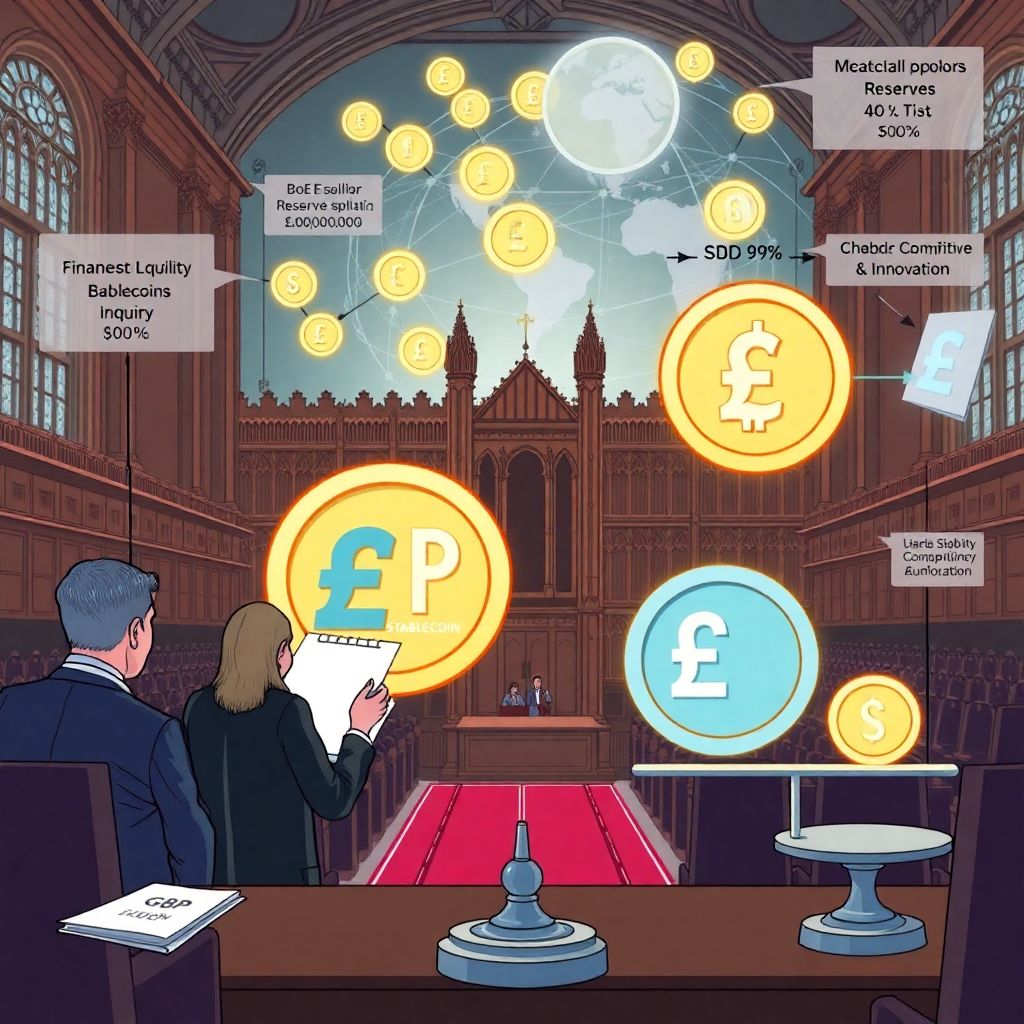
U.K. Parliament launches inquiry into stablecoin rules amid fears over caps and competitiveness
The U.K. Parliament has formally opened a wide‑ranging inquiry into stablecoins, signalling that lawmakers are not yet convinced the country’s proposed regulatory regime for the sector is fit for purpose.
On 29 January, the House of Lords Financial Services Regulation Committee (FSRC) announced that it is seeking evidence on how stablecoins are likely to grow, what risks and opportunities they present, and whether the current regulatory proposals from the Bank of England (BoE) and the Financial Conduct Authority (FCA) strike the right balance.
What the inquiry will examine
The FSRC’s terms of reference are broad. Lawmakers want to understand:
– How quickly stablecoins could scale in the U.K.
– What impact widespread use might have on monetary policy and the Bank of England’s control over the money supply.
– How stablecoins could affect the wider British economy, including the banking sector and credit markets.
– Whether Sterling‑backed stablecoins can realistically compete on a global stage dominated by U.S. dollar‑pegged tokens.
Committee chair Baroness Sheila Valerie Noakes DBE underscored that the review is not merely academic. It will specifically scrutinize whether the BoE and FCA’s proposed rules are “measured and proportionate” responses to the rapid development of the stablecoin market.
The committee has opened the door to expert and evidence‑based submissions, which will be accepted up to 11 March 2026. This timetable aligns with the government’s broader ambition to have a comprehensive regulatory framework for stablecoins in place by the end of the year.
Outline of the U.K.’s proposed stablecoin regime
In late 2025, the Bank of England set out its draft rules for Sterling‑backed stablecoins. A central feature of the framework is how issuers must hold and manage reserves.
The BoE proposed a 60/40 reserve structure:
– Up to 60% of reserve assets could be invested in short‑term U.K. government bonds, enabling issuers to earn interest.
– The remaining 40% would be held as deposits at the Bank of England itself, where no interest would be paid.
On top of that, the regulators suggested hard caps on how much stablecoin an individual or business can hold:
– A £20,000 limit for each individual user.
– A £10 million limit for each corporate or institutional holder.
These caps are intended as a safeguard against financial stability risks. Policymakers are particularly concerned about the possibility of large‑scale “deposit flight” from commercial banks into stablecoins, which could shrink banks’ deposit bases and, in turn, their capacity to extend credit to the real economy.
Why the caps are controversial
Supporters of digital assets argue that these restrictions, while well‑intentioned, may have the opposite effect of what the U.K. wants: instead of making the country a leader in digital finance, they risk turning it into an also‑ran.
Prominent crypto figures such as Stani Kulechov, founder of the DeFi protocol Aave, have publicly criticized the BoE’s proposals. From their perspective, capping both the amount users can hold and the interest‑earning potential of reserves could render GBP‑denominated stablecoins fundamentally uncompetitive, especially against U.S. dollar stablecoins that face no such limits.
In practical terms, critics say:
– Wealthy individuals, corporates, and institutional investors will bypass Sterling stablecoins entirely if they cannot use them at scale.
– Issuers deprived of full interest on reserves will struggle to build sustainable business models, especially if competitors abroad can monetize reserves more efficiently.
– The U.K. might end up with a heavily constrained, niche product that fails to attract significant on‑chain activity.
How the U.S. approach differs
The comparison with the United States is central to the debate. U.S. regulatory proposals, while still evolving, are widely seen as more permissive on two key points:
– There are currently no explicit caps on how much stablecoin value a user can hold.
– Issuers generally retain the ability to invest reserves in interest‑bearing assets, allowing them to earn yield on a much larger proportion of their backing.
For global markets, this difference is not just technical. It shapes where capital, innovation, and liquidity concentrate. If issuers can deploy reserves more flexibly in one jurisdiction than another, they are likely to build core operations — and list their flagship tokens — where the economics are more attractive.
Some industry participants therefore argue that the U.K. should adjust its rules to come closer to the U.S. model if it wants Sterling‑backed stablecoins to be more than a domestic curiosity.
The competitiveness question for Sterling‑based stablecoins
The scale of the challenge is evident in today’s market structure. At the time of writing, stablecoins pegged to the British pound rank only tenth among fiat‑backed offerings. Collectively, they represent about 261,000 dollars’ worth of supply out of a total stablecoin market of roughly 306 billion dollars. In percentage terms, that is well under 1% of global stablecoin circulation.
By contrast:
– U.S. dollar stablecoins account for around 99% of the market, making the dollar the overwhelmingly dominant on‑chain currency.
– Euro‑denominated stablecoins occupy a distant second place, but still far ahead of Sterling.
For U.K. policymakers, this raises a strategic dilemma. Tight rules might protect domestic financial stability, but they could also lock in the dollar’s on‑chain hegemony and prevent GBP‑based tokens from ever achieving meaningful scale.
Balancing stability, innovation, and monetary control
At the heart of the inquiry lies a difficult trade‑off: how to allow GBP‑denominated stablecoins to flourish without undermining the banking system or the Bank of England’s control over monetary conditions.
From the central bank’s perspective, there are several issues:
– If large sums migrate from bank deposits into stablecoins, commercial banks could see funding costs rise and lending capacity shrink.
– Widespread use of privately issued money‑like instruments might complicate the transmission of monetary policy and emergency liquidity measures.
– A sudden loss of confidence in a major stablecoin could trigger runs or contagion in financial markets.
On the other hand, if the U.K. overcorrects and imposes too many constraints, it risks:
– Deterring serious stablecoin issuers from setting up in the country.
– Pushing U.K. users toward offshore products beyond the reach of domestic regulators.
– Missing out on efficiencies in payments, settlement, and programmable finance that stablecoins can enable.
The FSRC inquiry is, in essence, an attempt to navigate these competing priorities and identify where the line should be drawn.
Potential outcomes and scenarios
Depending on the evidence and feedback it receives, the committee could push for different adjustments to the current proposals, including:
– Revising or phasing caps: Instead of fixed hard limits, caps could be gradually raised as the market matures, or applied only to certain riskier types of stablecoins.
– Tweaking the reserve split: The 60/40 ratio could be revisited, allowing a larger portion of reserves to be held in interest‑bearing instruments if certain risk controls are met.
– Differentiated treatment for systemic players: Stricter oversight and buffers could be imposed on very large issuers, with more flexible rules for smaller or emerging projects.
– Stronger disclosure and redemption rules: Rather than constraining size, regulators might focus on transparency, audit standards, and robust, same‑day redemption obligations to maintain confidence.
Any such changes would aim to reduce the likelihood of bank deposit flight while making Sterling‑based stablecoins more commercially viable.
Strategic implications for the U.K. financial sector
For the City of London and the broader financial industry, the shape of stablecoin regulation is not a marginal issue — it will influence where innovation clusters and which jurisdictions become hubs for tokenized assets, on‑chain securities, and digital‑native financial infrastructure.
If the U.K. manages to craft a regime that:
– Protects consumers and financial stability,
– Provides clear, predictable rules for issuers and intermediaries, and
– Avoids rigid constraints that handicap GBP stablecoins,
it could position itself as a leading venue for regulated digital asset activity in Europe and beyond.
But if the final framework is viewed as too restrictive, international issuers may focus on more permissive markets, and Sterling could remain a fringe currency in the digital asset ecosystem, overshadowed by the dollar and, increasingly, by the euro and emerging Asian currencies.
What this means for users and businesses
For individuals and companies, the outcome of the inquiry will influence:
– Which GBP‑based stablecoins are available under U.K. law.
– How much they can hold and use in day‑to‑day transactions or treasury operations.
– Whether Sterling tokens can be used at scale in decentralized finance, cross‑border payments, or trade finance.
If caps remain low, large corporates might find Sterling stablecoins of limited use for major transactions or on‑chain liquidity management. Conversely, more flexible rules could encourage businesses to integrate GBP tokens into their payment flows, hedging strategies, and on‑chain services.
The broader policy debate
Ultimately, the stablecoin inquiry is not just about one asset class; it is part of a broader national conversation about how the U.K. intends to compete in a world where money, credit, and capital markets are increasingly mediated by software and public blockchains.
Key questions that the inquiry will force policymakers to confront include:
– Should the U.K. accept a dominant U.S. dollar presence in digital markets as inevitable, or actively promote Sterling on‑chain?
– How much risk of innovation and capital moving abroad is acceptable in the name of domestic financial stability?
– Could a well‑regulated GBP stablecoin ecosystem complement, rather than threaten, the traditional banking sector?
The answers will shape not only the future of stablecoins in the U.K., but also the country’s broader role in the emerging digital financial order.
For now, what is clear is that Parliament is not content to rubber‑stamp the initial regulatory proposals. The FSRC’s work over the coming months — and the submissions it receives — will be crucial in determining whether the U.K. becomes a cautious follower or a calibrated leader in the regulation of Sterling‑backed stablecoins.