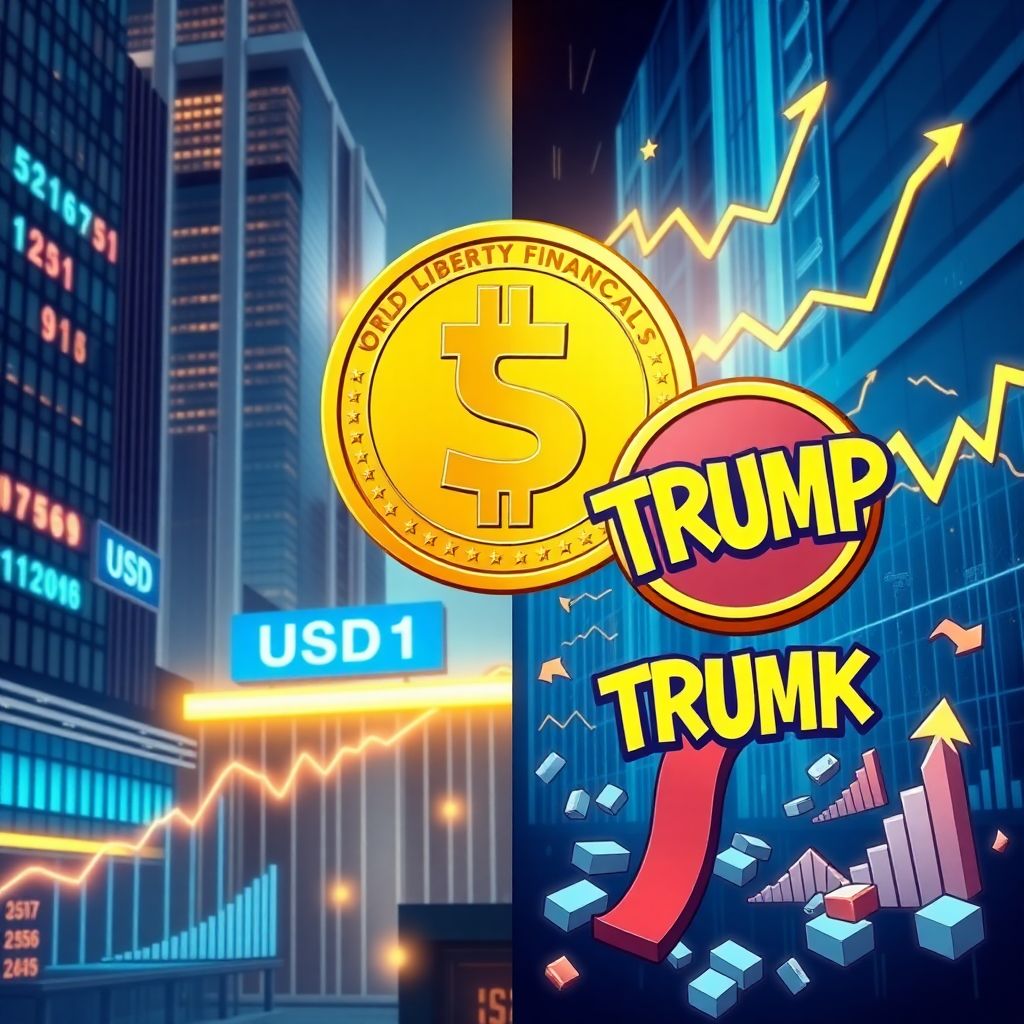
Trump-Branded Stablecoin USD1 Blows Past $5B as Official TRUMP Meme Coin Craters
A Trump-affiliated stablecoin has quietly turned into a heavyweight of the crypto markets, while the U.S. President’s flagship meme token has imploded in value—underscoring how fast capital is rotating from hype-driven bets into yield-bearing, institution-ready assets.
World Liberty Financial’s dollar-pegged stablecoin USD1 has surged beyond $5 billion in market capitalization this week, making it the fifth-largest stablecoin globally less than a year after its debut, according to market data aggregators. That puts the token in the same conversation as long-established dollar-pegged players despite its relatively recent launch.
Over roughly the same stretch of time, the Solana-based Official Trump (TRUMP) meme coin has suffered a brutal reversal. After briefly touching an all-time high in the neighborhood of $75, the politically branded token has plunged more than 93%, currently changing hands around $4.66. For early buyers who failed to take profits near the peak, the drawdown has been catastrophic.
USD1’s rapid climb comes amid a broader shift in market sentiment. Rather than chasing hyper-volatile meme coins tied to political personalities or internet culture, a growing base of users and institutions is looking for stablecoins that combine dollar exposure, on-chain composability, and regulated, yield-generating structures. USD1 sits squarely in that narrative.
World Liberty Financial positions USD1 as a U.S.-built, institution-grade stablecoin designed to scale into real-world finance, not just crypto speculation. The token is marketed as being backed by dollar-linked reserves and integrated into a broader suite of financial products aimed at banks, asset managers, and fintech platforms. The pitch is clear: this is a Trump-linked asset built for balance sheets and treasuries, not meme-fueled pump-and-dumps.
That branding stands in sharp contrast to Official Trump (TRUMP), which was launched as the “official” meme coin associated with the U.S. President and quickly became a magnet for speculative trading. Fueled by election-year headlines, social media buzz, and short-term traders, TRUMP’s price rocketed in the months following its launch—before liquidity dried up, the hype cycle turned, and latecomers were left holding heavy bags.
The diverging trajectories of USD1 and TRUMP highlight two very different use cases for politically branded tokens. On one hand, TRUMP behaves like a classic meme coin: high volatility, thin fundamentals, a price chart driven by sentiment rather than cashflows. On the other hand, USD1 is structured to attract steady, longer-term capital from trading firms, on-chain lenders, and institutions seeking predictable returns and low counterparty risk.
Behind USD1’s momentum is a broader macro trend: yield-bearing, “institution-friendly” stablecoins are becoming a preferred parking spot for capital in crypto. These tokens often sit on top of U.S. Treasury bills, money market instruments, or other conservative assets, passing some of that yield back to holders or to platforms that integrate them. In a high-rate environment, the difference between holding a yield-bearing stablecoin and a zero-yield one is material—especially for institutional desks managing hundreds of millions of dollars.
For traders and DeFi protocols, the appeal is straightforward. A stable peg to the dollar reduces price risk, while embedded yields or revenue-sharing structures can boost returns without requiring exposure to volatile tokens. As more lending platforms, exchanges, and on-chain funds plug USD1 into their strategies, the token’s market cap has swelled, reinforcing a feedback loop of liquidity and adoption.
By contrast, TRUMP offers no intrinsic yield and no clear cashflow model. Its value is almost entirely derived from narrative: the strength of the Trump brand, media cycles, election coverage, and online enthusiasm. When those narratives are at peak intensity, inflows can be explosive. But when attention fades or macro conditions shift, liquidity can evaporate, and prices can collapse quickly—exactly what has played out since the token’s meteoric rise to around $75.
The collapse of TRUMP from its high to roughly $4.66 is a sharp reminder of how unforgiving the meme coin market can be. A drawdown of over 93% effectively wipes out most paper gains for anyone who didn’t sell near the top, and it can take years—or a fresh hype cycle—for such tokens to approach previous highs again, if they ever do. For many, these coins function more like lottery tickets than investments.
At the same time, the success of USD1 illustrates that political branding alone is not enough to define a token’s destiny. What matters more for longevity is product–market fit: the ability to solve real problems for real users. In USD1’s case, that means offering a dollar-pegged asset that institutions can comfortably hold, use for settlements, post as collateral, or integrate into programmable financial products.
The “built in America, designed for real-world scale, and adopted by serious institutions” messaging from World Liberty Financial is more than just marketing language; it’s a deliberate attempt to differentiate USD1 from the Wild West image that still clings to much of the crypto industry. By anchoring the token in regulatory-ready language and traditional financial structures, the project is trying to sit at the intersection of crypto innovation and conventional compliance frameworks.
For institutional players—from hedge funds and market-makers to neobanks and payment processors—the calculus is changing. They are less interested in short-lived speculative manias and more focused on infrastructure: stable rails for payments, cross-border settlements, and programmable collateral. Tokens like USD1, which promise robust reserves, predictable behavior, and potential yield, fit snugly into that emerging toolkit.
Retail users, too, are starting to rethink their approach. After multiple boom-and-bust cycles in meme coins, many smaller investors are experimenting with rotating part of their portfolios into stablecoins that can earn yield through lending protocols, staking derivatives, or tokenized T-bill strategies. While risk is never eliminated—stablecoins carry smart contract, market, and regulatory risks—these products can offer a more measured risk–reward profile than chasing the next 100x meme.
The juxtaposition of a booming Trump-branded stablecoin and a collapsing “official” Trump meme coin also says something about the maturing state of politically themed crypto. Early cycles were dominated by pure speculation on tokens using politicians’ names and likenesses with little structure behind them. Now, projects are attempting to wrap political branding around more sophisticated, revenue-generating financial primitives. USD1 is one of the most visible examples of that evolution.
Looking ahead, the key questions for USD1 will center on transparency, resilience, and regulation. Maintaining a multi-billion-dollar peg requires robust reserve management, clear disclosures, and stress-tested infrastructure. Any controversy around backing, governance, or regulatory compliance could quickly erode confidence, especially among the institutional users that USD1 is courting.
As for TRUMP, its fate will likely remain tied to media cycles and political milestones. Election debates, legal developments, or major policy shifts could briefly reignite interest and volatility. But unless the token evolves beyond pure meme status—by adding utility, governance functions, or integration into larger ecosystems—it may struggle to reclaim its former highs in a market that is growing more sophisticated with each cycle.
In the end, the split performance of USD1 and TRUMP encapsulates a broader realignment in crypto. Speculation is far from dead, but capital is increasingly rewarding tokens that offer clear utility, institutional compatibility, and sustainable economics. As World Liberty Financial’s USD1 crosses the $5 billion milestone, it sends a clear signal: the future of politically branded crypto may look less like casino chips—and more like financial infrastructure.