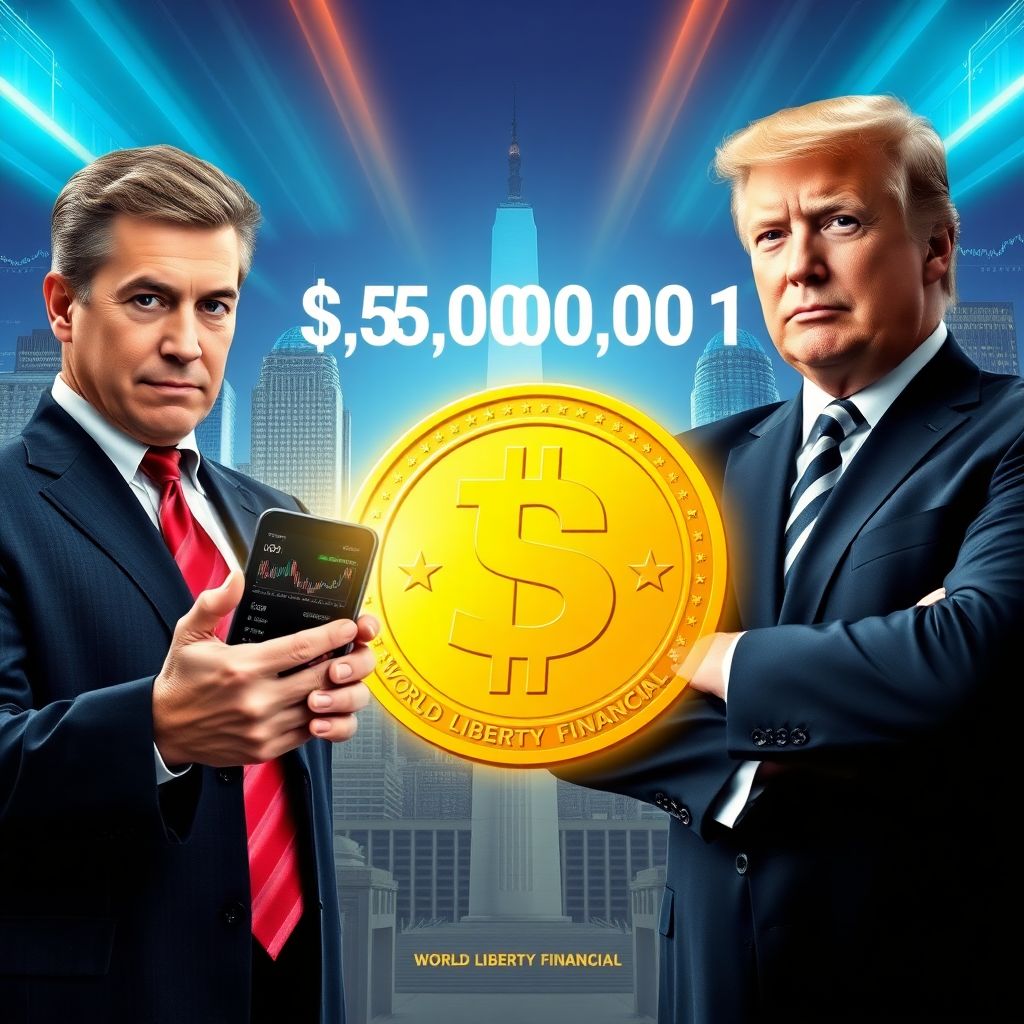
Trump-aligned USD1 stablecoin blasts past $5 billion as family doubles down on crypto
Donald Trump Jr. is celebrating a new benchmark for the Trump family’s fast‑growing digital finance venture, after the USD1 stablecoin rocketed to a market capitalization above $5 billion in under a year.
The dollar-pegged token, issued by World Liberty Financial, has rapidly climbed the rankings to become the fifth‑largest stablecoin in circulation, surpassing offerings such as PayPal USD and Ripple USD. Both Donald Trump Jr. and his brother Eric Trump, co-founders of World Liberty Financial, have framed the milestone as proof that USD1 is gaining traction with major players in traditional and digital finance alike.
Trump Jr. marked the moment by posting a screenshot of market data from CoinMarketCap on X, describing USD1 as “built in America,” optimized for “real‑world scale,” and “adopted by serious institutions.” Eric Trump amplified the same message, positioning the token as a flagship asset in a rapidly expanding crypto empire associated with the Trump name.
Behind the public victory lap is a deliberate push by the Trump family to lock in a prominent role in the next phase of digital finance. World Liberty Financial has installed USD1 at the core of its decentralized finance (DeFi) platform, where users can lend, borrow, and earn yield on digital assets. In this model, USD1 functions not only as a medium of exchange, but also as a key piece of infrastructure for the company’s broader financial products.
The company’s ambitions, however, go well beyond DeFi tools. World Liberty Financial has applied for a U.S. national banking license, a move that would place it under federal oversight while potentially granting it the authority to issue and custody dollar-backed digital currency at scale. If approved, that license could give the Trump-aligned firm a pivotal role in the growing stablecoin economy and cement a new, regulated revenue stream tied directly to the Trump brand.
This aggressive expansion strategy underscores how fully the Trump family has embraced crypto as both a political and commercial frontier. Donald Trump Jr. has evolved into a high-profile crypto advocate and operator, promoting USD1 and broader digital asset adoption as part of a narrative about American innovation, financial sovereignty, and resistance to what he portrays as overreach by traditional banking and regulatory systems.
Yet USD1’s rapid ascent has not unfolded without friction. The token drew intense scrutiny after it was used to close a $2 billion transaction between Abu Dhabi-based MGX and Binance. Senator Elizabeth Warren raised alarms over the deal, suggesting the possibility of a quid pro quo arrangement involving the Trump family and Binance founder Changpeng “CZ” Zhao, who was later pardoned by President Donald Trump. The suggestion was that favorable treatment could have been exchanged for business advantages involving USD1 and World Liberty Financial.
Zhao has firmly denied those allegations, characterizing the use of USD1 in the MGX–Binance transaction as a simple payment mechanism rather than an investment or strategic stake in World Liberty Financial. According to Zhao, the stablecoin served as a practical settlement layer, not a vehicle for influence or hidden ownership. Despite his rebuttal, the episode has sharpened debate about the intersection of politics, regulation, and privately issued digital dollars.
What is clear is that USD1 has become a powerful symbol of the Trump family’s broader influence in crypto. Its multi‑billion‑dollar capitalization reflects not just speculative interest, but also rising institutional comfort with tokenized dollars, DeFi platforms, and blockchain-based financial infrastructure. As more established firms integrate stablecoins into their operations, tokens like USD1 can become gateways to both mainstream adoption and large-scale capital flows.
In many ways, USD1 is emerging at a pivotal moment for stablecoins. Dollar-pegged tokens have evolved from niche trading tools into foundational plumbing for global crypto markets, supporting remittances, payments, and on‑chain liquidity. With USD1, the Trump family is attempting to plant its flag squarely in this infrastructure layer—precisely where long-term fees, float, and influence tend to accumulate.
From a business perspective, the strategy is straightforward: position USD1 as a “regulated, American-made” alternative to offshore or less transparent stablecoins, then build a suite of lending, borrowing, and yield products around it. If users and institutions park billions of dollars in USD1, World Liberty Financial can benefit from interest on reserves, transaction fees, and DeFi protocol economics, turning political brand power into recurring financial income.
Politically, the move is more complex. A Trump-branded dollar token inevitably raises questions about conflicts of interest, especially when public policy, regulatory enforcement, or international negotiations could impact the stablecoin’s prospects. The MGX–Binance deal and the subsequent criticism from Senator Warren illustrate how quickly commercial transactions tied to USD1 can become fodder in larger battles over financial regulation, corporate power, and the boundaries of presidential authority.
Regulators are already grappling with how to oversee stablecoins in general—debating reserve requirements, disclosure standards, and whether issuers should be treated more like banks, payment companies, or something entirely new. If World Liberty Financial secures a national banking license, it could become one of the most closely watched case studies in how a politically prominent, crypto-native financial institution navigates federal scrutiny.
For institutional investors, USD1’s rise also reflects a broader recalibration. After years of hype cycles around volatile tokens, many funds and corporations are shifting attention toward “boring” but essential infrastructure: stablecoins, tokenized treasuries, and DeFi rails that can plug into existing financial systems. In that landscape, USD1 competes not only with legacy giants but also with a new wave of regulated, yield-generating digital dollars pitched to corporations, fintechs, and asset managers.
Retail users, meanwhile, are weighing USD1 against other stablecoins based on perceived safety, transparency, and political alignment. For some, the Trump brand is a draw, a signal of cultural and ideological identity layered on top of a financial product. For others, that same branding heightens perceived risk, as any political shock, investigation, or change of administration could spill over into market sentiment around the token.
There is also a geopolitical layer to consider. As governments debate central bank digital currencies and tighter rules for privately issued stablecoins, tokens like USD1 are competing to become de facto rails for digital dollars worldwide. By branding USD1 as “built in America” and courting “serious institutions,” World Liberty Financial is implicitly arguing that U.S.-affiliated private stablecoins should dominate global flows instead of alternatives tied to foreign jurisdictions or less transparent operators.
At the same time, the Trump family’s deepening involvement in crypto is likely to intensify partisan divides over digital assets in Washington. Supporters may frame USD1 and World Liberty Financial as champions of financial freedom and American competitiveness, while critics are likely to focus on potential money laundering risks, regulatory arbitrage, and the optics of a politically powerful family profiting from a shadow banking system built on blockchains.
In the background, the DeFi ecosystem that USD1 plugs into is itself maturing. Early experiments in high-yield farming and speculative lending are giving way to more conservative, institution-friendly protocols designed around risk management, collateral quality, and regulatory compliance. For World Liberty Financial, this transition is an opportunity to pitch USD1 as the backbone of a safer, more structured DeFi stack—while still benefiting from on-chain efficiency and global access.
How sustainable USD1’s growth will be depends on several factors: market trust in its reserves and governance, the outcome of its banking license application, evolving U.S. stablecoin legislation, and the broader macro environment for risk assets. A prolonged downturn or a major regulatory crackdown could slow adoption, while clear rules and successful integrations with banks and fintechs could accelerate it.
What is undeniable for now is the scale and speed of USD1’s expansion. In less than a year, a Trump-backed token has amassed billions in circulating value, climbed into the top tier of global stablecoins, and become central to a network of DeFi services and high-profile deals. That trajectory cements the Trump family as not just political actors with opinions on crypto, but as direct participants and beneficiaries in the architecture of digital finance.
As stablecoins move further into the mainstream and institutional players continue to test tokenized dollars, USD1’s story will serve as a bellwether for how far—and how fast—politically branded financial products can spread. Whether viewed as a bold bet on the future of money or a risky fusion of politics and finance, the Trump family’s USD1 experiment has already reshaped the conversation around who profits from the next generation of dollar power.