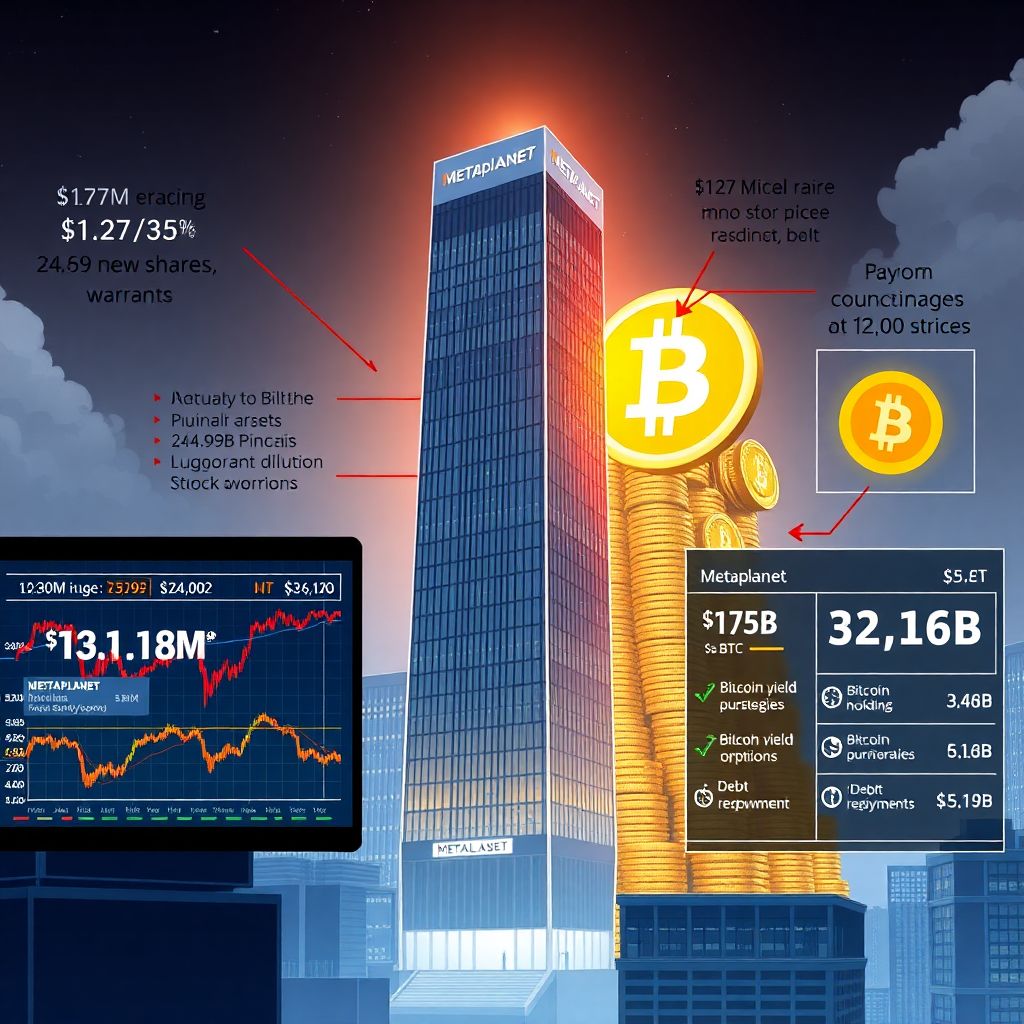
Metaplanet approves $127 million raise to double down on Bitcoin as stock slips on dilution worries
Metaplanet Inc. has signed off on an aggressive new financing round worth roughly $127 million, aiming to turbocharge its transition into a Bitcoin-focused treasury vehicle. The market, however, reacted cautiously: shares slid around 3.5% on the day of the announcement as investors digested the impact of fresh equity issuance and the prospect of near-term dilution.
How the capital raise is structured
The Tokyo-based company plans to issue 24.53 million new shares at ¥499 apiece through a third-party allotment, bringing in about ¥12.24 billion (around $127 million at current exchange rates). Alongside the primary issuance, Metaplanet is also creating a series of stock acquisition rights (warrants) that could inject substantially more capital if exercised in the future.
These warrants are set with an exercise price of ¥547 per share. If the stock trades above that level, the company can tap additional funding at higher valuations, effectively staggering the dilution over time and rewarding the firm if the market buys into its Bitcoin-centric thesis. If the share price fails to clear that bar, dilution is largely contained to this initial batch of newly issued stock.
Where the money is going
Metaplanet’s plans for the new capital are heavily skewed toward Bitcoin. The company intends to deploy approximately ¥14 billion (about $115 million) into direct Bitcoin purchases over a 12‑month window stretching from February 2026 to February 2027. This is designed to expand what Metaplanet frames as its core balance-sheet asset and anchor its identity as a “Bitcoin treasury company.”
Another ¥1.56 billion is earmarked for generating yield and income from Bitcoin-related strategies. That includes derivatives and options-based approaches that could, in theory, help smooth volatility or add incremental returns on top of simple “buy and hold.” While details are still relatively high-level, the allocation suggests Metaplanet is not only betting on Bitcoin’s long-term appreciation, but also exploring more advanced financial engineering around its holdings.
A further ¥5.19 billion will be used to pay down existing credit facilities. By retiring earlier borrowings, Metaplanet aims to preserve or restore its capacity to leverage debt again in the future if needed. In other words, part of the new equity bolsters the balance sheet and extends financial flexibility, even as most of the proceeds are funneled directly into Bitcoin.
From traditional company to “Bitcoin treasury” vehicle
This latest move is a continuation of a strategic pivot the company began in April 2024, framed internally as the “21 Million Plan” and “555 Million Plan.” Under this new blueprint, Metaplanet positions itself less as a conventional operating business and more as a publicly traded proxy for Bitcoin exposure, echoing the playbook popularized by Strategy Inc.
That transformation has already led to explosive growth in its digital asset holdings. According to the firm, its Bitcoin stash surged from 1,762 BTC at the end of 2024 to 35,102 BTC by the close of 2025. On a Bitcoin basis, the company reported a 568% yield over that period, underscoring how aggressively it has been accumulating and how central BTC has become to its corporate identity.
For shareholders, this shift effectively means owning equity in a highly leveraged Bitcoin balance sheet: company performance, valuation, and risk profile are now tightly intertwined with the fortunes of the world’s largest cryptocurrency.
Who is backing the deal?
The offering has been placed by Cantor Fitzgerald with a group of offshore institutional investors, including Anson Opportunities Master Fund, Alyeska Master Fund, and Brookdale Global Opportunity Fund. These buyers are providing capital but are not taking on strategic roles or committing to long-term ownership.
To manage potential overhang concerns, Metaplanet has agreed to a 30‑day lock-up on additional share issuances, limiting its ability to dilute investors again in the immediate term. The new investors also secured rights to participate in similar financings over the following year, ensuring they can maintain or expand their positions if Metaplanet continues to raise funds using the same model.
Mirroring Strategy Inc.’s Bitcoin accumulation model
The overall structure closely tracks the approach used by Strategy Inc., which has repeatedly issued equity and warrants to fund large-scale Bitcoin purchases. The idea is straightforward: raise capital from public markets, convert it into BTC, and give shareholders a way to ride Bitcoin’s potential upside through a regulated, listed vehicle.
Metaplanet’s warrants serve a dual function. They give the company the option to pull in more capital if its strategy pays off and its shares trade higher, while also signaling to the market that dilution will be more manageable if sentiment sours. Still, the current price tells its own story: Metaplanet’s stock is trading below both its one‑month and six‑month moving averages, meaning the new investors are entering at a discount compared with recent trading ranges.
Market reaction and technical backdrop
While the stock is firmly off its recent peaks, it remains more than 80% higher than its November lows. That rally reflects growing interest in Metaplanet as a quasi‑Bitcoin proxy, even if the most recent financing announcement triggered a bout of profit-taking and concern over shareholder dilution.
Traders are closely watching key technical levels. Resistance is clustered in the $3.80–$4.00 zone, an area where sellers have previously stepped in. On the downside, a decisive move below $2.80 would damage the current bullish structure and could drag the price toward the mid‑$2 range, where prior support might be tested again. For short-term market participants, these levels are likely to shape sentiment as the financing and subsequent Bitcoin purchases unfold.
Why investors worry about dilution—even in a bullish Bitcoin story
The tension at the heart of Metaplanet’s strategy is clear: to accumulate more Bitcoin, it must issue more equity, spreading the company’s value across a larger share base. If Bitcoin’s price rises substantially, existing shareholders may ultimately come out far ahead, even with dilution. But in the near term, each new share issued chips away at the claim of current holders on the firm’s assets and potential profits.
Investors therefore have to take a view on several factors at once:
– How aggressively Metaplanet will continue raising equity.
– Whether management can time Bitcoin purchases effectively, or at least avoid catastrophic peaks.
– How efficiently the company can manage its derivative and options strategies without incurring outsized risks.
Those who believe in a strong multi‑year Bitcoin bull market may see the dilution as a necessary cost of scaling exposure. More cautious shareholders might question whether repeated equity issuance is sustainable, especially if market conditions or regulatory attitudes toward crypto in Japan turn less favorable.
The risk–reward profile of a “Bitcoin treasury company”
By leaning into its role as a Bitcoin treasury vehicle, Metaplanet is effectively trading traditional business diversification for a single, concentrated macro bet. This comes with notable advantages: the company can market a clear, simple thesis to investors and tap into global demand for listed Bitcoin exposure. In an environment where some institutional portfolios still face structural hurdles to buying spot Bitcoin directly, such a stock can serve as a workaround.
On the other hand, the downside is equally straightforward. A prolonged Bitcoin downturn, or even a deep cyclical drawdown, would hit Metaplanet’s balance sheet hard. Because the firm is using equity and, at times, credit to build its position, drawdowns could translate into pressure on both its market valuation and its financing options. The more Bitcoin dominates the asset side of the balance sheet, the more sensitive the company becomes to crypto cycles.
How income strategies may shape returns
The planned ¥1.56 billion allocation to Bitcoin-related income strategies is one of the more nuanced aspects of Metaplanet’s plan. Derivatives and options can be used to generate yield—through covered calls, cash-secured puts, or structured products—but they also introduce additional layers of risk and complexity.
If executed prudently, such strategies could help offset the costs of capital, smooth volatility, or provide extra returns during sideways markets. However, poorly structured derivatives exposure can magnify losses in turbulent conditions. Shareholders will likely scrutinize disclosures around risk management, counterparty selection, and the size of any leveraged positions as these income strategies roll out.
Debt management and future flexibility
Allocating over ¥5 billion to repay existing credit facilities reflects a desire to de‑risk the balance sheet while still keeping the option of leverage open. In practice, this move reduces immediate financing strain and can improve covenant headroom, which is critical for a company whose underlying asset is as volatile as Bitcoin.
If market conditions become favorable—both for Bitcoin and for Metaplanet stock—the company could later decide to re‑draw on credit lines or structure new borrowing backed by its expanded BTC holdings. Maintaining that capacity is an important strategic lever: it allows management to pivot between equity and debt depending on cost, market appetite, and the broader macro backdrop.
What this means for different types of investors
For long-term Bitcoin believers, Metaplanet offers a high-beta, equity-based way to gain exposure to BTC, with potential upside from both the underlying asset and the company’s capital markets strategy. The trade-off is amplified volatility, recurring dilution risk, and reliance on management’s timing and financial engineering.
Shorter-term traders are likely to focus on the technical levels, the post-raise supply overhang, and the pace at which new Bitcoin purchases are executed. If Metaplanet’s buying coincides with major moves in the Bitcoin market, the stock could become a proxy for leveraged sentiment swings.
More conservative investors, meanwhile, may view the pivot with skepticism, especially those who initially bought Metaplanet for non‑crypto reasons. For them, the company’s identity shift represents a fundamental change in risk profile, business model, and long-term predictability.
The bigger picture: strategy over spot price
Ultimately, the future of Metaplanet’s “Bitcoin treasury” experiment will hinge less on any single day’s Bitcoin price and more on the coherence and discipline of its strategy. Key questions include:
– Can the company maintain access to capital without alienating existing shareholders?
– Will it build robust risk management around derivatives and borrowing?
– And can it communicate clearly enough to keep investors aligned through inevitable Bitcoin cycles?
The newly approved $127 million raise is a decisive step in that direction. It signals that Metaplanet is willing to endure short-term dilution and share price volatility in pursuit of a large, long-term Bitcoin position. Whether the market ultimately rewards that conviction will depend on both the trajectory of Bitcoin itself and how skillfully the company navigates the financial and regulatory landscape that surrounds it.