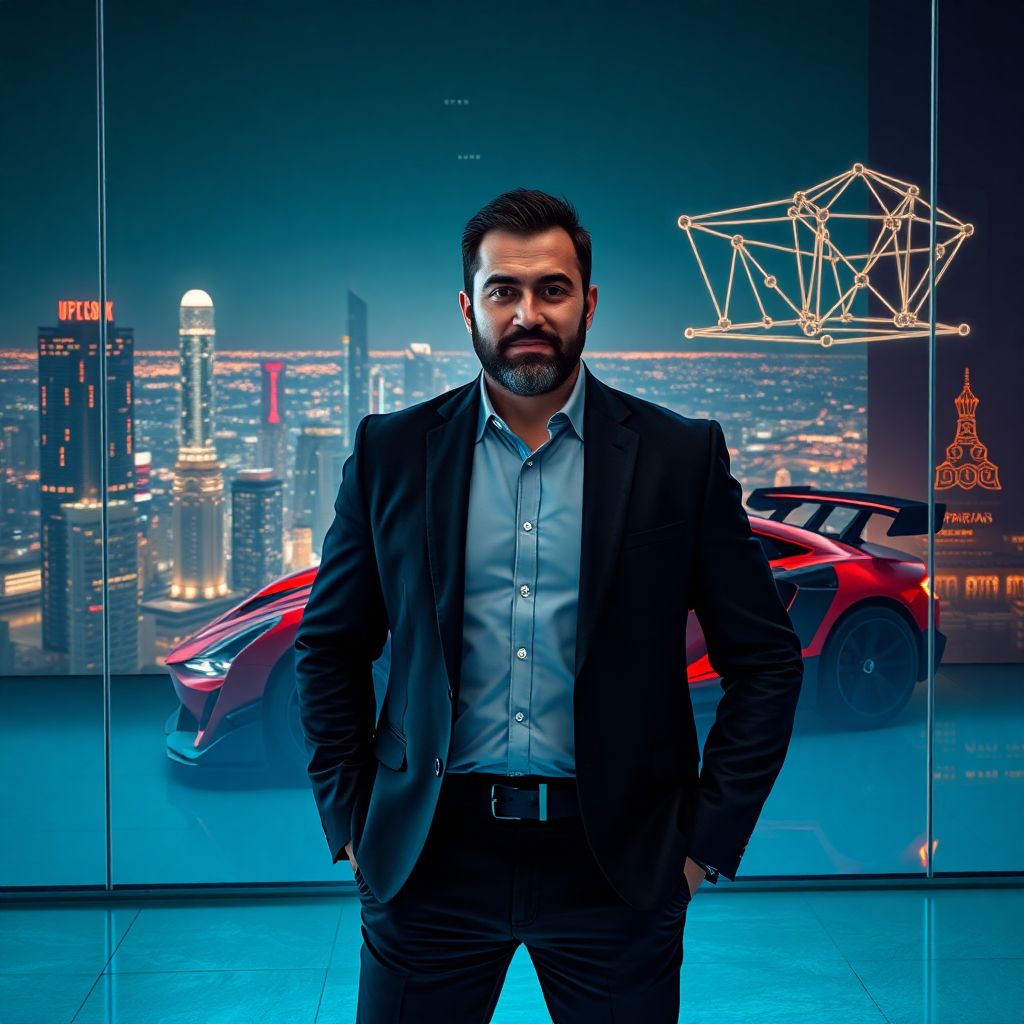
At an estimated personal fortune of $1.7 billion, Gurhan Kiziloz sits in a category that most founders never reach—not just in wealth, but in power. He doesn’t simply run a large company; he owns an entire economic engine outright. No venture funds, no institutional shareholders, no boardroom full of people who can overrule him. In a landscape where most billion‑dollar founders have quietly become very well‑paid employees, Kiziloz remains something far rarer: an unanswerable owner.
That distinction became brutally clear with what is arguably the boldest marketing move of 2025. It wasn’t conceived during a months‑long strategic review. It didn’t crawl through layers of legal approvals. It did not have to survive risk committees or investor phone calls. It existed for one reason: Gurhan Kiziloz decided it would.
The centerpiece of that decision was a MANSORY Jesko Spartans Edition—a bespoke, one‑of‑a‑kind hypercar worth several million dollars. In any conventional corporation, suggesting such a car be purchased and then given away to a random user of a crypto casino would be career suicide. It would be labeled wasteful, irresponsible, a breach of fiduciary duty. In many boardrooms, it would be the kind of stunt that gets a CEO quietly replaced.
Kiziloz is immune to that kind of punishment. There is no supervisory board to rein him in, no group of venture capitalists capable of voting him out. The typical mechanisms of corporate discipline simply do not apply to him. That absence of oversight—combined with total equity ownership—is what makes him a “sovereign founder,” a status almost extinct in modern capitalism.
To grasp how unusual this is, you have to look at how most “unicorn” stories really end. On the surface, unicorn founders are idolized: their companies are said to be worth billions, they grace magazine covers, they keynote conferences. But underneath those headlines is the reality of dilution. By the time a startup reaches Series C, Series D, and beyond, early investors, growth funds, and option holders have carved the company into dozens of pieces. The person who started it all often ends up owning 10–15%—if they are lucky.
Those founders are wealthy on paper, but constrained in practice. They measure every decision against stock price reactions. They worry about “down rounds” that could erase their reputations. They must lobby directors for buy‑in. In theory they lead; in reality, they negotiate. Their calendars are filled with investor relations calls instead of unencumbered strategy sessions.
Gurhan Kiziloz took a different path. He built Nexus International from the ground up without touching external capital. No seed round, no Series A, no late‑stage private equity. He bootstrapped a gaming enterprise all the way to roughly $1.2 billion in yearly revenue. That means no slices were sold along the way. He doesn’t hold a minority stake in a flashy unicorn; he fully owns a giant that throws off real cash.
This is more than a vanity statistic. Owning 100% of a profitable business changes the equation entirely. On a purely mathematical basis, that can make him more liquid and more strategically flexible than founders whose companies may carry higher headline valuations but are controlled by funds. Kiziloz doesn’t have to optimize for quarterly earnings calls; he can optimize for whatever time horizon he chooses.
That difference showed up starkly in Nexus International’s 2025 performance. The company fell short of its internal revenue goal of $1.45 billion. More importantly, profits declined by 7%. In a listed company, a mid‑single‑digit drop in profit would be a crisis. Analysts would downgrade the stock. Activist investors would start circling. The CEO would be expected to issue statements, promise a turnaround, perhaps even announce layoffs to prove they were “serious about efficiency.”
For Kiziloz, the 7% decline was not a failure to prevent—it was a cost he deliberately chose to incur. He effectively burned $200 million of near‑term profit to aggressively expand Spartans.com and to accelerate development of his Layer‑1 blockchain initiative, BlockDAG. It was not an accident; it was a deliberate reallocation of earnings away from immediate comfort and toward future control.
That is the logic of an owner, not a caretaker. A diluted CEO fights to preserve margins because their position depends on short‑term optics. A sovereign founder is willing to compress margins to build a fortification others cannot easily attack. By redirecting so much profit into expansion and infrastructure, Kiziloz signaled that he is playing a much longer game—aiming for dominance in 2030 instead of applause in 2025.
What makes this even more striking is where and how he operates. Kiziloz is building far from the cultural and regulatory gravitational pull of Silicon Valley or the City of London. That geographic distance has translated into strategic independence. He has assembled an ecosystem that doesn’t simply mirror what other gaming or crypto companies are doing; it diverges from it structurally.
Nexus International is not just an online gaming operation. Through Spartans.com, Kiziloz controls a major crypto casino platform. But his ambition extends beyond running a high‑volume front‑end experience. With BlockDAG, he appears to be aiming at the rails underneath the entire operation—a Layer‑1 blockchain that could, in theory, process bets, handle settlement, enable on‑chain loyalty systems, and support a broader financial and gaming infrastructure. Vertical integration is the underlying thesis: from the user’s wager to the final confirmation on the ledger, all roads would lead through his stack.
This strategy is exceptionally capital‑intensive and inherently risky. Building a Layer‑1 blockchain is not akin to launching a token or spinning up a simple sidechain. It demands deep technical teams, security audits, long‑term incentive design, and community adoption. Many well‑funded projects have tried and failed. Yet, where his competitors would need to cobble together investor syndicates and spend months pitching, Kiziloz can move from idea to execution by fiat of a single decision.
That’s what could be called the “100% premium.” When a founder owns every share, they unlock a speed of action that no board‑regulated structure can match. Other billionaires spend weeks preparing decks to justify nine‑figure investments. Kiziloz can approve similar sums in an afternoon. There is no capital committee. There is only his conviction and the liquidity generated by his own companies.
This level of autonomy, however, comes with its own obligations. Without outside investors, there is no external brake pedal. The same freedom that allows daring bets could also magnify the impact of misjudgments. In that sense, sovereign founders carry both the upside and the downside alone. Kiziloz’s decision to pour $200 million into Spartans.com and BlockDAG is a textbook example of this duality: if it works, the rewards accrue exclusively to him; if it fails, he has no one else to blame—or to bail him out.
What sets Kiziloz apart is that he appears comfortable with that trade‑off. His marketing play with the MANSORY Jesko Spartans Edition underscores this disposition. Traditional marketing teams obsess over attribution models and incremental returns. They rarely authorize stunts that could backfire or be misunderstood by regulators or the public. Yet, Kiziloz leaned into a high‑visibility, high‑risk giveaway as a way to cement Spartans.com in the minds of users worldwide. The message was clear: this is not just another promotional campaign, but proof that his platform is willing to operate on a different scale.
From a strategic perspective, the combination of a headline‑grabbing marketing move and deep infrastructure investment serves a dual purpose. On the surface, the hypercar giveaway drives user acquisition, social buzz, and brand differentiation. Underneath, the build‑out of BlockDAG aims to create a technical moat. If Spartans.com can one day run on its own high‑performance, secure chain, Nexus International would control both the customer relationship and the core settlement layer. Competitors relying on third‑party infrastructure would be locked into someone else’s rules and fees; Kiziloz would write his own.
This approach mirrors playbooks previously seen in other industries. Tech giants that once only offered software now own data centers, chips, and in some cases even undersea cables. By pushing into the “plumbing” of their sector, they reduced dependencies and captured more value. Kiziloz appears to be attempting a similar move in online gaming and crypto: migrating from being just a front‑end operator to becoming a full‑stack ecosystem owner.
The implications for the broader industry are significant. As regulation around online gaming and crypto tightens, most competitors are forced into defensive postures—hiring compliance teams, trimming risky campaigns, and steering clear of anything that might alarm conservative investors. A sovereign operator with substantial capital reserves can do the opposite: lean into regulation by designing infrastructure that anticipates it and use bold marketing to consolidate market share while others play safe.
His 2025 financial choices suggest that he sees downturns or margin pressure not as threats, but as windows of opportunity. When profit growth slows, conventional executives cut innovation budgets. Kiziloz increased his. He turned a dip in earnings into fuel for expansion—effectively wagering that the best time to sprint is when everyone else is catching their breath.
There is also a cultural dimension to his model. Companies partially owned by institutions are subject not only to financial expectations but also to reputational norms. Certain campaigns are deemed “off‑brand” for large asset managers. Certain markets or products are labeled too controversial. By contrast, Kiziloz has far more room to define what is acceptable for his own brand. That is why a hypercar giveaway at a crypto casino—something a public company would likely avoid—is viable for him.
Yet, this freedom does not absolve him from the realities of technology and user behavior. BlockDAG will have to prove it can attract developers, process transactions reliably, and resist security threats. Spartans.com must retain users in an environment where loyalty is fluid and new platforms appear constantly. Owning 100% of a business does not guarantee 100% success; it only guarantees 100% exposure to the consequences.
What makes Gurhan Kiziloz such a singular figure is that he embraces that exposure. He has engineered his corporate structure and his capital base in a way that maximizes agency. In an age where most visionary founders gradually surrender control to investors in exchange for scale, he has inverted the trade: he sacrificed external capital in order to preserve absolute control, and then proved he could reach scale anyway.
That is why describing him merely as “wealthy” misses the point. Many people have amassed sizable net worths. Far fewer have both the capital and the unilateral authority to reshape their industries according to their own timelines. Kiziloz does. His 2025 playbook—a willingness to slash profits, deploy extreme marketing, and sink vast sums into proprietary infrastructure—illustrates what happens when a billionaire entrepreneur not only holds the pen, but also owns every page in the ledger he is writing on.