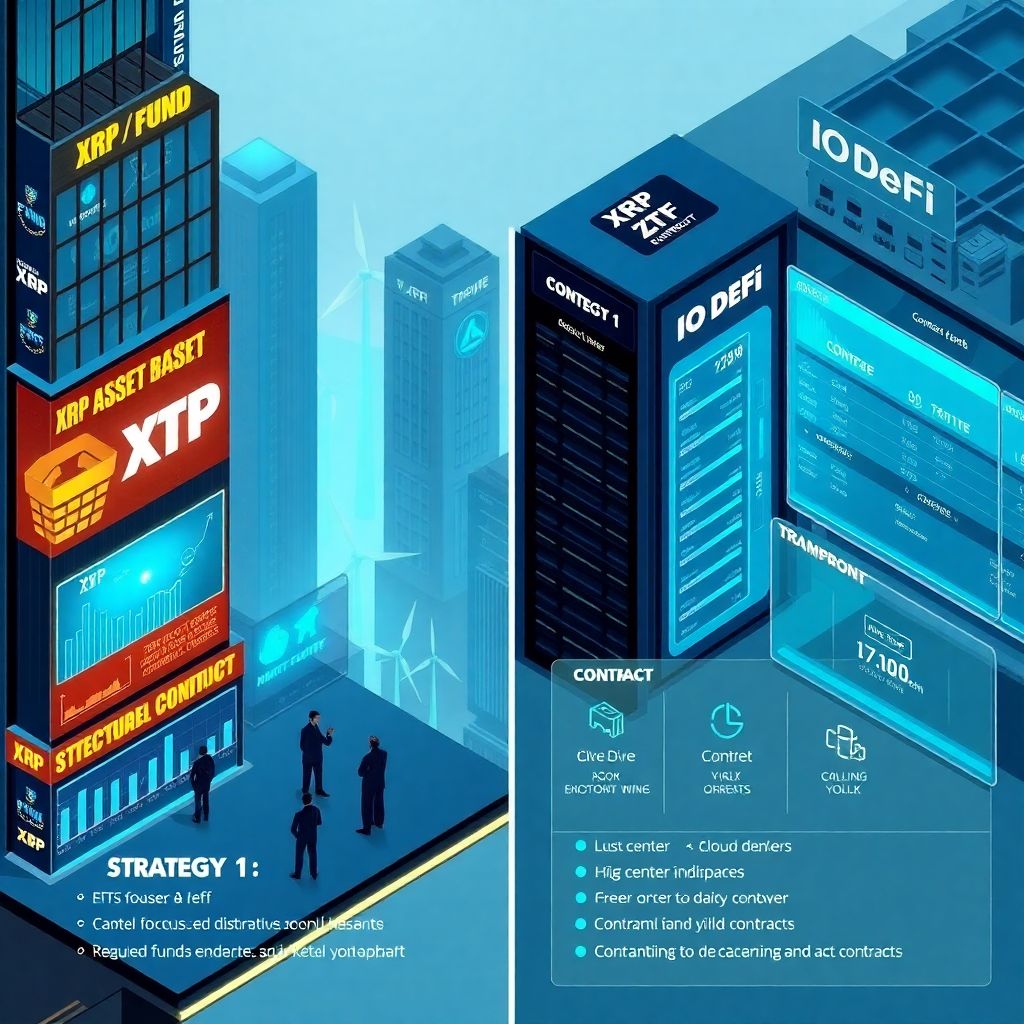
Financial Times analysis: Two profit strategies for XRP in 2026 under the Trump policy environment
As expectations around U.S. crypto regulation realign under a renewed Trump-era policy outlook, XRP is moving into a new phase. The asset is no longer viewed solely as a speculative token tied to sentiment and court decisions; instead, its investment thesis is splitting into two distinct but complementary profit tracks:
1. Price-focused exposure via institutional products such as ETFs and professional funds.
2. Participation-focused models that aim to generate returns through structured, rule-based platforms operating under clearer compliance standards.
Within this second track, cloud mining and digital yield platforms like IO DeFi are beginning to attract attention from XRP holders who want to diversify beyond simple “buy and hold” strategies.
—
A new regulatory climate reshaping XRP’s narrative
By 2026, with Donald Trump’s policy stance again influencing expectations for U.S. financial and crypto oversight, the market mood is notably different from the last bull cycle. The focus is shifting from speculative hype to regulation, institutional design, and repeatable income strategies.
For XRP — a key asset in the cross‑border payments and liquidity sector — this means:
– Its role as a bridge currency in global transfers is back under the spotlight.
– Investors are reassessing where future returns might come from: price appreciation, yield-generation models, or a mix of both.
– More attention is being paid to platforms and products that can operate within transparent, traceable, and compliant frameworks.
In this environment, the discussion about XRP profits is no longer “Will the price go up?” but “Which structure of exposure is most suitable for different types of investors?”
—
Strategy 1: Institutional and ETF-style exposure to XRP price
On one side of the spectrum are traditional, price-driven instruments:
– Exchange-traded products (ETPs/ETFs) linked to XRP.
– Institutional crypto funds that allocate to XRP as part of a digital asset basket.
– Structured products offered through regulated intermediaries.
This route focuses on potential capital gains resulting from:
– Increased institutional adoption of XRP for liquidity and settlement.
– Regulatory clarity improving the asset’s legal standing.
– Macroeconomic cycles driving renewed inflows into digital assets.
Its advantages are familiar: investors gain exposure to XRP’s upside without having to manage wallets, custody, or technical risks directly. However, this path is fundamentally tied to market volatility: returns depend largely on price movement and timing.
—
Strategy 2: Participation-based profit models under clearer rules
In parallel, a second path is emerging: investors seek more stable, structured participation rather than pure speculation. Instead of asking only “What will XRP cost in 12 months?”, they ask:
– How can I use XRP (or XRP-linked products) within rule‑driven systems?
– Can I build a portfolio that balances volatility with more predictable income streams?
– Are there compliant platforms where engagement is automated and transparent?
Here, cloud mining and yield platforms step in — not as replacements for holding XRP outright, but as an additional layer of participation efficiency and cash-flow potential.
—
What is IO DeFi cloud mining?
IO DeFi is a UK-based platform focused on cloud mining and digital asset yield-generation. Rather than requiring users to purchase, install, and manage their own mining rigs, it offers a contract-based approach:
– Users participate via predefined contracts instead of hardware.
– All technical details, power sourcing, and infrastructure management are handled by the platform.
– Rules for returns, fees, and settlement are specified in advance.
Key structural features include:
– Compliance orientation: Operations are designed to align with relevant international financial standards, with an emphasis on rule transparency and traceability.
– Global footprint: Since 2016, the platform reports coverage in roughly 180 countries and regions, serving over 3 million users and building a relatively mature operating system.
– Sustainability focus: Its computing infrastructure is powered in part by renewable energy sources such as wind and hydropower, aiming to improve long‑term cost stability and environmental impact.
In essence, IO DeFi tries to turn complex mining operations into a service-layer product accessible to non-technical users.
—
How IO DeFi connects to the XRP profit story
While XRP itself is not a mineable asset like Bitcoin, platforms such as IO DeFi can structure contracts and products in ways that allow XRP holders or XRP-focused investors to:
– Allocate capital into cloud mining or yield contracts.
– Potentially receive returns that are less correlated with day-to-day XRP price swings.
– Build a blended strategy: hold some XRP directly, while using a portion of capital within rule-based contracts.
This provides an alternative profit corridor: instead of depending solely on when XRP enters or exits a bullish trend, investors may seek contractual returns designed to function across different market cycles.
—
Step-by-step: Participating via IO DeFi
The platform structures user participation in a relatively straightforward process:
1. Account registration
New users create an account and, upon completion, are credited with a 15‑dollar trial balance.
– This trial balance is designed to let users test the platform’s mechanisms and understand how returns are generated and settled.
– No immediate capital commitment is required at this stage.
2. Selecting a yield contract
Users can choose from multiple yield contracts that differ by:
– Duration (shorter vs. longer terms)
– Scale (smaller vs. larger allocation thresholds)
– Risk-return profile aligned with different participation objectives
Contract terms, expected yield ranges, and settlement rules are displayed before any commitment, allowing for more informed decision‑making.
3. Activating the contract
– After reviewing and confirming contract conditions, the user pays the corresponding contract fee.
– From this point, the contract runs automatically:
– No management of mining machines or software is needed.
– The system executes according to pre-set, rule-based logic.
4. Profit management
Returns generated during the contract period are settled according to the agreed schedule and formula. Users generally have two broad options:
– Withdraw the profits.
– Reinvest them into new or existing contracts to pursue compound growth and longer-term allocation plans.
5. Affiliate and referral structure
IO DeFi also provides a referral-based incentive mechanism:
– Qualified direct referrals can generate up to a 3% bonus on profits.
– Indirect referrals (second-level relationships) can add up to an additional 2% bonus.
These layers are governed by transparent, verifiable rules and are positioned as a supplemental source of income for participants who choose to promote the platform.
—
Why cloud mining appeals in a Trump-era policy environment
Under a more pro‑business, potentially deregulation‑leaning administration, markets often expect:
– Faster innovation on financial products.
– Clearer or at least more predictable enforcement boundaries.
– Greater openness to institutional participation in digital assets.
In such a setting, platforms like IO DeFi can gain relevance for several reasons:
– Predictability vs. price anxiety: Some investors prefer structured contracts over trying to time market tops and bottoms in XRP.
– Operational simplicity: The complexity of running mining operations is outsourced to a platform, which may be especially appealing to traditional investors newly entering the crypto space.
– Compliance signaling: Operating within recognized financial and regulatory norms helps distinguish such platforms from unregulated, opaque schemes.
For XRP specifically, this trend indicates that profit strategy is no longer monolithic; instead, it is diversifying into distinct layers of exposure.
—
Balancing the two strategies: price vs. participation
A sophisticated XRP allocation in 2026 might not rely solely on one of the two tracks, but rather on a combination:
– Core holding: Direct XRP exposure via spot holdings or institutional products, capturing potential upside from:
– Broader adoption in international payments.
– Legal and regulatory clarity on XRP’s status.
– Macro trends that redirect capital into digital assets.
– Satellite strategies: Participation in structured platforms like IO DeFi, targeting:
– More regular, contract-based returns.
– Reduced dependence on extreme price movements.
– Additional earning channels through referral or reinvestment programs.
This blended approach reflects the broader maturation of the crypto market in 2026: profit is not defined only by speculative trades but by how effectively investors structure and manage their overall participation.
—
Key points for risk and due diligence
Even within a more favorable policy environment, risk remains central to any crypto-related decision:
– Cloud mining returns are never guaranteed; they depend on multiple variables, including market conditions and operational efficiency.
– Contract terms must be reviewed carefully: duration, fees, early-exit conditions, and yield formulas should be fully understood before participation.
– Platform reputation, technology robustness, and regulatory posture should be assessed through independent research.
– Diversification — across assets, platforms, and strategies — remains essential in managing volatility and operational risk.
The evolving Trump-era framework may create new opportunities, but it does not eliminate the need for rigorous due diligence.
—
Outlook: XRP’s maturing profit ecosystem in 2026
By 2026, XRP is no longer defined solely by litigation headlines or speculative narratives. Under a changing U.S. policy backdrop, its profit landscape is increasingly structured around two main axes:
– Institutional, price-centric exposure, driven by ETFs, funds, and regulated products.
– Participation-centric models, exemplified by platforms like IO DeFi, which offer contract-based, automated yield mechanisms in a compliance-conscious environment.
For investors and users, the central question is no longer just “Will XRP rise?” but “Which combination of price exposure and structured participation best matches my risk profile, time horizon, and strategy?”
—
Disclosure: This article is for educational and informational purposes only and does not constitute investment, financial, or legal advice. Neither the publisher nor the author endorses or recommends any specific platform, product, or strategy. Readers should conduct their own independent research and consider consulting a qualified professional before making any investment decisions.