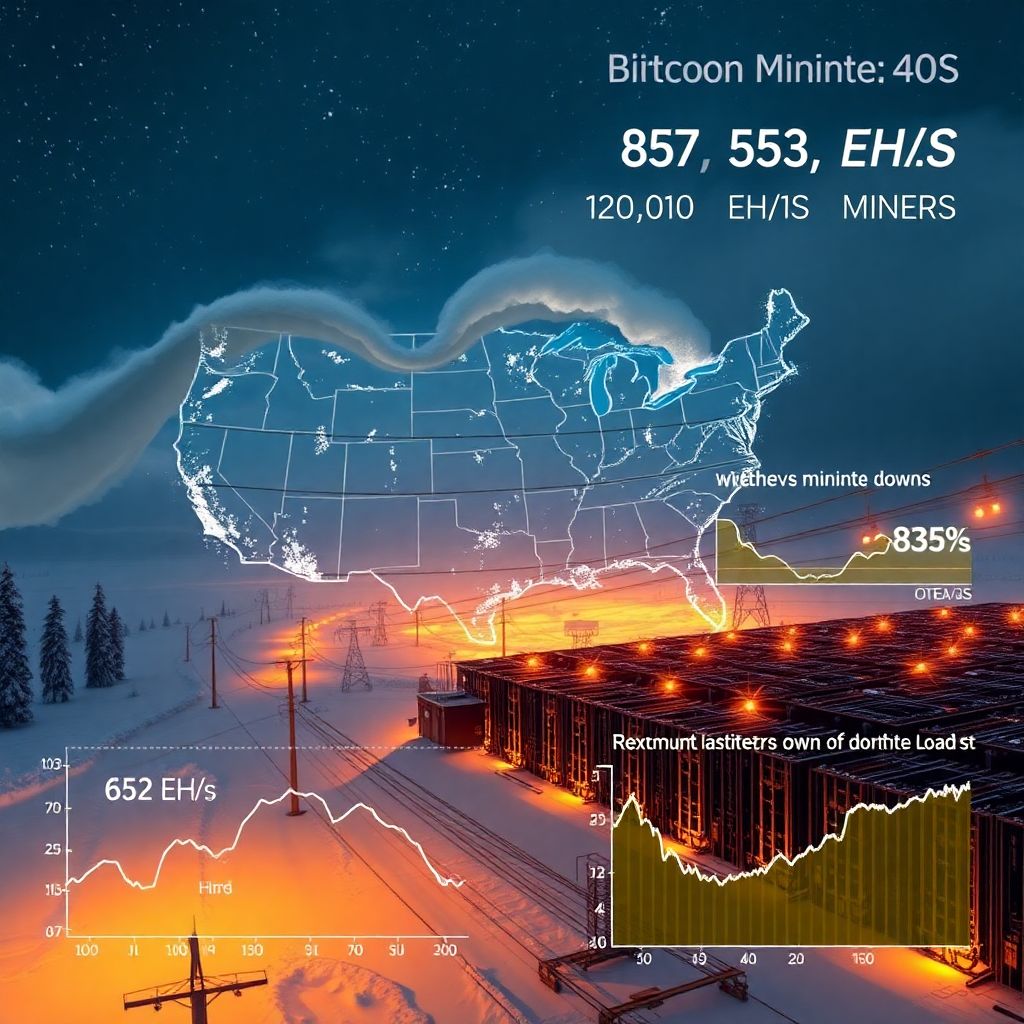
Bitcoin’s computing power has just received a sharp reality check from nature.
Over the past weekend, a powerful Arctic blast sweeping across the United States forced a large portion of miners to shut down, sending Bitcoin’s hashrate to its lowest point in seven months. While crypto prices barely flinched, the infrastructure that secures the Bitcoin network proved once again that it is ultimately constrained by weather and electricity, not only price charts.
According to meteorological data, the winter storm battered more than thirty US states with heavy snowfall, ice, and sub-zero temperatures, knocking out power for around one million customers. Against this backdrop of strained energy systems, Bitcoin miners began powering down in large numbers.
Data from on‑chain analytics show that the network’s total computing power started falling on Friday before dropping sharply over the weekend. By Sunday, Bitcoin’s hashrate had slipped to roughly 663 exahashes per second (EH/s), a decline of more than 40% in just 48 hours. That kind of drawdown is rare for such a mature network and underscores how concentrated mining has become in a handful of key regions.
By Monday, the network had already started to rebound, recovering to about 854 EH/s. This relatively quick partial recovery highlights how fast modern industrial mining operations can be switched off and on, acting more like adjustable power loads than traditional heavy industry that requires long ramp-up times.
Oregon-based mining firm Abundant Mines described the impact as “significant,” estimating that roughly 40% of global Bitcoin mining capacity went offline within 24 hours as extreme winter weather hit. The company stressed that much of this was not due to mechanical failure or permanent closures, but voluntary curtailment: miners deliberately throttled or shut down operations as electricity demand from households and critical infrastructure surged.
From the miners’ perspective, this ability to pause operations almost instantly is not just a necessary concession to the grid, but a competitive advantage. Mining facilities can consume vast amounts of power when electricity is cheap and abundant, particularly during periods of high wind or solar output. When demand spikes or grid operators call for relief, those same facilities can rapidly disconnect, freeing up capacity that would otherwise require expensive peaker plants or risk blackouts.
This dynamic is especially visible in the United States, now one of the world’s key hubs for Bitcoin mining. Industry estimates suggest the US accounts for nearly 38% of global hashrate and hosts at least 137 dedicated crypto-mining sites. That concentration means that extreme US weather events—whether winter storms or summer heatwaves—can move the global Bitcoin network in ways that were less pronounced when mining was more distributed geographically.
Supporters of the industry argue that the latest hashrate shock bolsters the view of miners as “flexible load” participants in modern energy systems, rather than simple parasites on power grids. In their telling, miners function as a kind of shock absorber: soaking up surplus energy when demand is low, then vanishing from the grid at short notice when conditions tighten.
Environmental, social and governance (ESG) researchers who track these dynamics point to real-world examples. During the recent storm, demand response programs in regions like Texas reportedly saw mining operators curtail their electricity consumption to stabilize the grid. That freed up power for homes, hospitals, and emergency services without requiring an equivalent ramp-up in fossil-fuel generation.
At the same time, the episode underlines the flip side of this flexibility: Bitcoin’s security model is, in practice, vulnerable to localized stress in places where mining is concentrated. If a single country or region hosts a significant share of global hashrate, weather patterns, regulatory decisions, or grid failures in that area can create outsized effects on the network’s raw computing power.
From a market perspective, though, the turbulence in hashrate did not immediately translate into price chaos. Bitcoin traded near 88,261 dollars at the time of reporting, a modest rise from about 86,567 dollars the previous day. Ether hovered around 2,923 dollars, edging roughly 0.3% higher over 24 hours. Solana was changing hands near 124.3 dollars after gaining about 1.4% in the same period. For traders watching tickers, the weekend barely registered as an event.
For miners, however, the story looked very different. Their profitability hinges on a complex interplay of factors: Bitcoin’s price, block rewards, transaction fees, electricity costs, hardware efficiency, and regulatory conditions. A sudden storm can push electricity prices higher, threaten physical infrastructure, and trigger mandatory or voluntary shutdowns. In such moments, even a strong Bitcoin price is not enough to justify running rigs at full capacity if power becomes prohibitively expensive or politically sensitive.
This divergence between calm prices and unstable hashrate raises important questions about risk management in the mining sector. Leading operators increasingly treat weather, power contracts, and grid relationships as core strategic issues rather than peripheral concerns. Long-term fixed-price electricity agreements, hedging strategies, and participation in formal demand response programs are becoming as critical as securing the latest generation of ASIC miners.
There is also a broader implication for Bitcoin’s perceived resilience. A 40% hashrate drawdown sounds dramatic, but the network continued to process transactions, and no security incident occurred. The protocol is designed to adjust mining difficulty roughly every two weeks, smoothing out persistent changes in available computing power. Short, sharp dips can slow block times temporarily, but they do not automatically compromise the system’s integrity.
Still, repeated episodes of weather-driven volatility could eventually influence how regulators and policymakers view large-scale mining. On one hand, documented cases of miners helping stabilize grids support the argument that these operations can be integrated responsibly into modern energy systems. On the other, lawmakers may grow wary of any activity that can intensify stress during peak demand if not properly managed.
For local communities, the situation is nuanced. In regions rich in renewable energy—such as wind-heavy plains or hydro-rich valleys—Bitcoin mining can provide a constant buyer for surplus electricity that might otherwise go to waste or force curtailment. But when extreme temperatures hit, residents understandably expect that available electricity will prioritize heating, cooling, and essential services over optional industrial loads like crypto mining.
This tension is shaping where new mining facilities are built and how they communicate their role. Many operators now emphasize the use of stranded or otherwise underutilized energy sources and highlight their ability to shut down within minutes when grid operators call. Some are experimenting with co-location near renewable plants or integrating on-site energy storage to reduce grid impact during peak hours.
The weekend’s storm also serves as a timely reminder for Bitcoin investors who tend to focus solely on price charts, halvings, and macro narratives. The health of the network depends on a vast, energy-intensive physical layer: warehouses of hardware, complex cooling systems, long-term power contracts, and the resilience of electrical infrastructure in the face of climate volatility.
As climate patterns become more erratic, events like this are likely to become more frequent. Record summer heat can strain grids as much as winter freezes, and miners must plan for both extremes. Operators that can dynamically adjust operations, diversify geographically across different climates and regulatory environments, and secure flexible energy agreements will have a structural advantage over those locked into fragile setups.
From a long-term perspective, this episode reinforces a key truth: Bitcoin may be a digital asset, but its backbone is deeply rooted in the physical world. Weather systems, power lines, and local energy politics can, at least in the short term, outweigh any optimism on trading desks. For miners, the weekend was not about chasing price moves; it was about demonstrating that survival depends on understanding both the code that secures the network and the clouds that gather over the grid.
For observers trying to gauge what comes next, several questions now loom large. Will more miners move to regions with more stable grids and cooler climates? Will energy regulators formalize the role of mining as a flexible grid resource, or restrict it during times of stress? And will the industry lean further into renewables and innovative energy solutions to reduce the political and environmental backlash that flares up whenever headlines link Bitcoin to blackouts?
In the immediate term, attention will focus on how quickly hashrate returns to previous highs and whether future storms produce similar-scale pullbacks. Over the longer arc, the story of this winter event will likely be remembered less for its impact on Bitcoin’s price and more for what it revealed about the evolving relationship between decentralized digital money and the very centralized realities of power generation and weather.