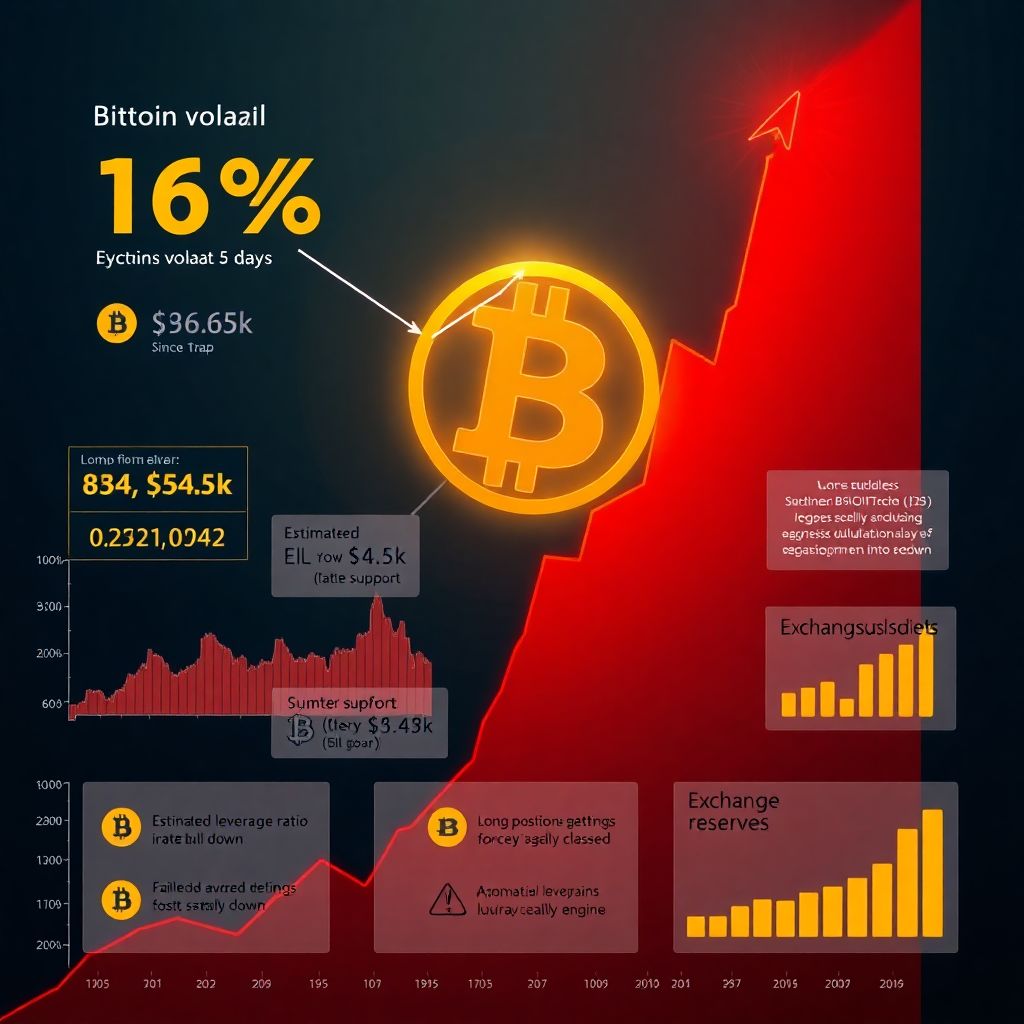
Bitcoin drops 16% in 5 days: Massive market stress ahead?
Bitcoin’s latest pullback has shaken traders’ confidence, as what looked like a textbook long setup turned into a painful bull trap. The locally strong support zone near 84.5k dollars, widely viewed as an “ideal” entry level, collapsed almost immediately, catching overleveraged participants on the wrong side of the move.
Over the past week, selling pressure on Bitcoin [BTC] has intensified sharply. On Wednesday, 28 January, the asset climbed to a local peak near 90.6k dollars. In less than five days, that short-lived rally reversed, wiping out roughly 16.8% of BTC’s value and triggering a wave of liquidations across the derivatives market.
Derivatives data paints a picture of a market that has been steadily losing speculative steam for months. According to figures tracking futures and perpetual positions, overall Open Interest (OI) has been trending lower since September 2025, signaling a gradual retreat of leveraged traders. While there was a brief burst of optimism at the start of the year, that uptick quickly faded after mid-January as the broader downtrend in OI resumed.
This sustained decline in Open Interest is more than a technical curiosity; it points to growing fatigue and doubt among Bitcoin speculators. Fewer participants are willing to bet aggressively on a decisive rebound, and many appear to be either reducing risk or leaving the market altogether. When combined with the heavy liquidation waves seen since October, the message is clear: traders who tried to ride a sharp recovery with high leverage have repeatedly been punished.
The current drop has revived a crucial debate in the market: are we witnessing the clear confirmation of a bear-market phase, or is this simply a brutal liquidity grab designed to flush out excessive leverage before a more sustainable move higher? The intensity of the recent deleveraging suggests that, at the very least, the market is rapidly approaching a “max pain” zone where weaker hands are forced to capitulate.
One of the key gauges of this stress is the Estimated Leverage Ratio (ELR). This metric compares an exchange’s Open Interest in a given coin with the size of that coin’s reserves held on the platform, offering a snapshot of how aggressively traders are using borrowed capital. Between 26 and 29 January, Bitcoin’s ELR climbed from 0.220 to 0.242, indicating a noticeable increase in leverage even as prices hovered around a critical support region.
During that period, BTC moved within a volatile band: it traded near 86k dollars, briefly pushed up to around 88k, and then slipped to about 84.6k by 29 January. The rising ELR amid this choppy price action shows that traders were piling on leverage precisely as Bitcoin was retesting a significant historical support area that dates back to 22 November 2025. In other words, many market participants bet heavily that this level would hold — and those bets are now under serious pressure.
Crucially, exchange reserves also increased over this timeframe. That means more BTC was being moved onto exchanges, where it can be more easily sold. When reserves rise at the same time as Open Interest, any spike in OI becomes even more meaningful: not only are there more leveraged positions, but there is also more spot supply ready to hit the market. This combination tends to amplify both downside risk and liquidation cascades.
Crypto analyst Axel Adler Jr. has described the current backdrop as a period of “extreme deleveraging.” Throughout the last week, Open Interest has fallen in step with — or even faster than — the price itself, dropping well below its 90‑day average by the end of the week. Such behavior is characteristic of a forced unwinding of leverage rather than a gradual, voluntary reduction of risk.
Supporting this view is the Open Interest Momentum Index, whose readings have slipped into zones associated with moderate to extreme deleveraging. These levels typically appear during phases of forced leverage compression and aggressive position closing, often driven by margin calls and automated liquidation engines rather than discretionary selling alone. The market, in effect, is being cleaned out of its most vulnerable leveraged actors.
Despite this severe shakeout, it is important to note that the derivatives market has not been completely wiped. Funding rates on perpetual futures — which indicate whether long or short positions are paying the other side — have remained positive. Positive funding suggests that long positions, while reduced, still outnumber shorts in dollar terms, and that some traders continue to bet on a rebound rather than a prolonged crash.
This detail matters because it keeps the door open for a technical price bounce. After such intense deleveraging, markets often stage relief rallies as selling pressure subsides and short-term traders buy perceived discounts. However, a durable trend reversal would likely require more than just a short squeeze or reactionary buying. For a sustained recovery, Open Interest needs to stabilize, and ideally, it should begin to increase in a healthier, less one-sided manner.
In the near term, Bitcoin’s behavior around the 84k–85k dollar region remains crucial. If this zone, which recently failed as “perfect support,” is reclaimed and defended on higher time frames, it could signal that the recent move was primarily a liquidity hunt rather than the start of a deeper structural downtrend. Conversely, continued rejection below this area would reinforce the bearish case and could encourage another leg lower as remaining bulls lose conviction.
From a risk‑management perspective, the current market offers a useful lesson in the dangers of high leverage during uncertain conditions. Many traders treated the 84.5k area as a near‑guaranteed bounce level, layering on leveraged longs without sufficient room for volatility. The swift reversal and subsequent wipeout underline how quickly “obvious” support can fail when sentiment is fragile and liquidity is thin.
Longer‑term investors might interpret the ongoing deleveraging in a more constructive light. Periods of aggressive position flushing often pave the way for eventually healthier trends, as speculative excess is removed and prices begin to reflect more organic supply and demand rather than leverage-driven swings. Historically, some of Bitcoin’s most powerful rallies have emerged after similarly painful clean‑up phases, though timing such turns has always been notoriously difficult.
Macro conditions and broader risk appetite will also shape what happens next. If global markets are tilting toward risk‑off behavior, with investors shying away from volatile assets, Bitcoin may struggle to attract sustained new capital despite appearing “oversold” on some technical indicators. On the other hand, a renewed hunt for yield and risk could help BTC stabilize more quickly once this deleveraging wave runs its course.
Traders and investors watching from the sidelines should focus not only on price, but also on whether key derivatives metrics begin to normalize. Signs that Open Interest is flattening rather than collapsing, that funding rates are moving toward neutral, and that exchange reserves are no longer climbing aggressively would all hint at a more balanced market. Until then, sharp intraday rallies could still be part of a broader, volatile downtrend rather than a genuine change of direction.
For now, the market sits at an inflection point: Bitcoin has suffered a rapid 16%+ drawdown in under a week, leverage is being aggressively cleared out, and sentiment is tilting cautious to outright fearful. Whether this marks the late stages of a liquidity purge or the early chapters of a more entrenched bear market will depend on how price, Open Interest, and leverage metrics interact over the coming days and weeks.
Anyone considering trading or investing in Bitcoin in such conditions should recognize that digital assets carry a high level of risk. Volatility can be extreme, leverage can magnify both gains and losses, and past price behavior does not guarantee future outcomes. Each participant should independently evaluate their risk tolerance, time horizon, and strategy before entering the market or adjusting existing positions.