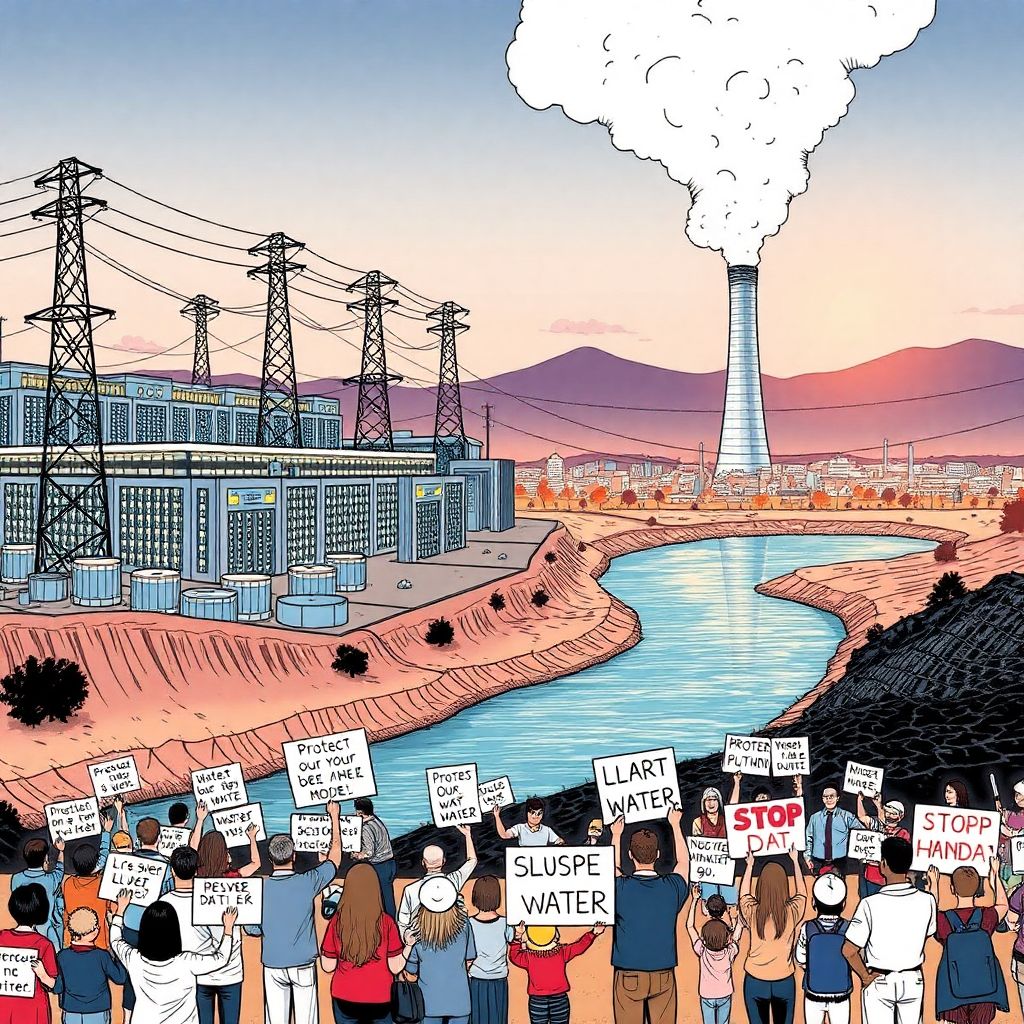
Experts are sounding the alarm that a growing backlash against data centers could significantly slow the rollout of the infrastructure needed to power artificial intelligence.
Across the United States, massive AI-focused data centers are rising on the outskirts of cities and in rural areas—often drawn by cheap land, access to power, and local tax incentives. But the same projects that tech firms see as essential to the “next industrial revolution” are increasingly being met with skepticism, delays, or outright resistance from the people who live nearby.
A new report from the Brookings Institution warns that conflicts over energy consumption, water usage, tax breaks, and environmental impact are turning into major obstacles for data center development. The authors argue that unless this tension is addressed systematically, the buildout of AI infrastructure could slow dramatically, putting at risk the pace of innovation that many companies and policymakers are counting on.
According to the report, the core problem is a widening gap between the national and global narratives around AI and the local realities of hosting the physical machines that make it possible. At the macro level, data centers are framed as engines of economic opportunity and technological leadership. On the ground, residents often see higher electricity demand, industrial-scale buildings, noise from cooling systems, truck traffic, and rising pressure on already-stressed power grids and water supplies.
The study notes that data centers are now both “controversial and critical.” On one hand, they provide the computational backbone for AI models, cloud services, and digital platforms that underpin the modern economy. On the other, their rapid proliferation is straining local infrastructure and testing public patience. The authors warn that if enough communities refuse to host new facilities—or impose moratoria and strict restrictions—the broader digital transition could stall, limiting access to advanced AI capabilities and slowing growth in related sectors.
One of the primary flashpoints is energy use. AI-specific data centers, packed with high-performance chips for training and running large models, can draw extraordinary amounts of electricity. In some regions, a single large campus may consume as much power as a small city. Utility companies then face the challenge of upgrading transmission lines and generation capacity, sometimes at a pace far beyond what was previously forecast. For residents, this raises concerns about higher electricity bills, reliability of service, and the climate impact of increased fossil fuel generation if renewables cannot keep up.
Water consumption is another growing concern. Many data centers rely on water-based cooling to prevent servers from overheating, which can mean millions of gallons of water per day in hot or dry climates. In areas already affected by drought or competing agricultural and residential needs, directing scarce water resources toward tech infrastructure can become a political and moral flashpoint. Communities want clear assurances that water usage will be minimized, recycled where possible, and not prioritized over basic public needs.
Tax abatements and financial incentives are also under heightened scrutiny. For years, states and municipalities have offered generous property tax breaks, sales tax exemptions on equipment, and infrastructure subsidies to attract data center investment. While these packages may bring construction jobs and some ongoing employment, critics argue they often yield fewer long-term, high-paying positions than advertised, especially compared to other types of industrial or commercial development. The Brookings report suggests that residents are increasingly asking whether the public is getting a fair return on these deals—or simply subsidizing corporate balance sheets.
Environmental and land-use impacts round out the list of major flashpoints. Large data campus footprints can reshape rural landscapes, require significant grading and construction, and introduce 24/7 industrial activity into previously quiet areas. Additionally, the lifecycle climate impact of data centers—linked to the carbon intensity of the local grid, construction materials, and equipment turnover—is becoming part of broader debates over how seriously governments and companies are taking decarbonization commitments.
To navigate this growing resistance, Brookings researchers highlight one tool in particular: binding community benefit agreements (CBAs). These are formal, enforceable contracts negotiated between project developers and local stakeholders that spell out concrete commitments—such as local hiring quotas, environmental safeguards, infrastructure investments, noise or traffic mitigation, and direct financial contributions to community projects.
The report argues that CBAs are no longer optional goodwill gestures; they are becoming a practical necessity if companies want their projects approved on time and without damaging public trust. By making benefits explicit and legally binding, CBAs can shift negotiations away from vague promises and toward measurable outcomes. This, in turn, may help defuse opposition rooted in skepticism about corporate follow-through.
However, designing effective community benefit agreements is complex. The authors stress that CBAs must be tailored to local conditions and shaped by meaningful input from a broad range of residents—not just a small circle of political or business elites. For example, in a water-stressed region, communities may prioritize strict limits on water use, mandatory investments in water recycling, or support for local conservation programs. In areas facing underemployment, the focus might be on apprenticeships, workforce training, and clear pathways for local workers into technical and maintenance roles at the facilities.
There’s also a timing challenge. Many of the biggest tensions emerge late in the permitting process, after companies have already invested heavily in site selection and preliminary design. At that point, both sides feel pressure: developers want to avoid costly delays, while residents may feel they are being rushed into concessions. Brookings recommends engaging with local stakeholders early—long before construction permits are filed—to build transparency around energy demand, environmental impact, and economic benefits, and to allow enough time for robust negotiation of CBAs.
Technological advances could also play a role in easing some of the friction. More efficient chips, advanced cooling methods that rely less on freshwater, smarter workload distribution across multiple sites, and closer integration with renewable energy projects could all reduce the physical and environmental footprint of AI data centers. Policymakers and companies, the report suggests, should prioritize and incentivize these innovations as part of any broader strategy for scaling AI infrastructure sustainably.
From a policy standpoint, the Brookings authors call for clearer national and regional frameworks that align AI infrastructure planning with climate goals, grid modernization, and regional development strategies. Today, many data center decisions happen piecemeal—site by site, deal by deal—without a cohesive vision of where facilities should cluster, how they should connect to the grid, or how risks and benefits should be shared fairly across regions.
They warn that leaving these issues entirely to ad hoc, local negotiations invites a patchwork outcome: some areas will approve projects on generous terms with minimal safeguards, while others will block them entirely. That fragmentation could limit the overall efficiency and resilience of the AI infrastructure network and ultimately slow the technology’s deployment.
For AI companies and cloud providers, the message is straightforward: social license is now a core part of the infrastructure equation. It is no longer enough to secure land and utility hookups; long-term political and community acceptance must be treated as a strategic asset on par with capital expenditure and chip supply. Firms that build a track record of transparent impact reporting, credible environmental commitments, and robust community agreements are more likely to see smoother permitting and fewer public confrontations.
Communities, in turn, face their own strategic choices. Outright rejection of all data center development may protect local resources in the short term but could also mean missing out on infrastructure upgrades, tax base diversification, and technology-related job pipelines. The report suggests that the most effective community stance may be one of hard-nosed negotiation rather than simple opposition: demanding clear benefits, strict environmental standards, and enforceable mechanisms to hold companies accountable.
The broader implication is that the AI revolution is not just a story of algorithms and chips—it is also a story of land, power lines, water systems, and local politics. If these tangible constraints and social dynamics are ignored, even the most advanced models will run up against very physical limits. If they are managed thoughtfully, however, data centers can become anchors for smarter grids, new green energy projects, and more inclusive regional development.
Ultimately, the Brookings report frames the current backlash not only as a risk but also as an opportunity. The friction around data centers is forcing governments, companies, and residents to confront deeper questions about who benefits from technological change, who bears the costs, and how those trade-offs should be governed. The pathway to continued AI infrastructure growth, the authors conclude, will depend on whether those questions are answered with genuine power-sharing and long-term planning—or with short-term deals that fuel even more distrust down the line.