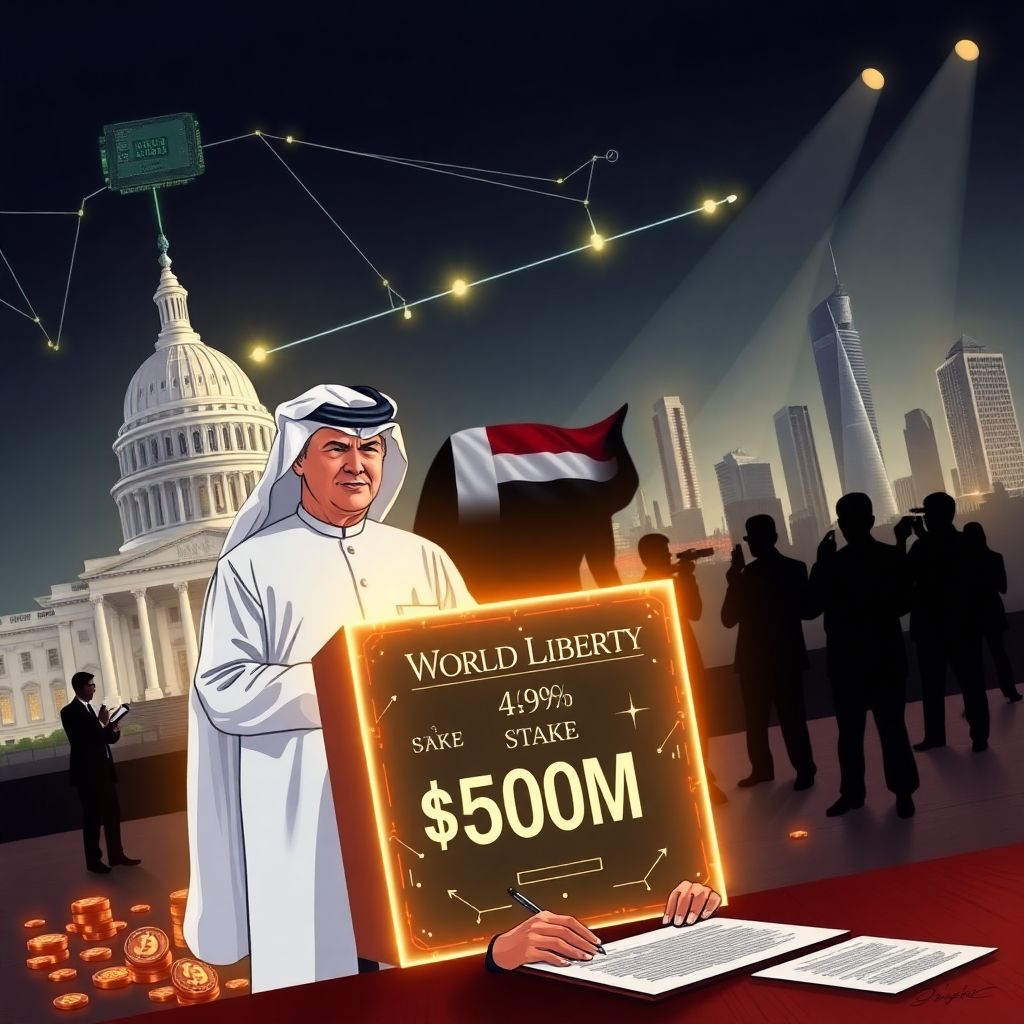
UAE Royal’s Alleged Stake in Trump Crypto Venture Raises Fresh Ethics Storm
A financial vehicle backed by a member of Abu Dhabi’s ruling elite allegedly committed half a billion dollars to a crypto venture tied to Donald Trump just days before a major U.S. policy shift benefiting the United Arab Emirates, according to reporting based on transaction documents and people familiar with the deal.
The arrangement centers on World Liberty Financial, a crypto and decentralized finance project linked to the Trump family. Four days before Donald Trump’s presidential inauguration, an entity associated with Sheikh Tahnoon bin Zayed Al Nahyan, the UAE’s national security adviser and one of the country’s most powerful financiers, agreed to acquire a 49% stake in the firm for 500 million dollars.
The primary agreement was reportedly signed by Eric Trump on behalf of World Liberty Financial, underscoring how tightly the venture is woven into the Trump family’s private business network. A substantial portion of the proceeds from the transaction allegedly flowed to entities controlled by the Trump and Witkoff families, rather than remaining inside the operating company.
What has turned an eye‑catching investment into a full‑blown political controversy is the timing. After the deal was struck, the Trump administration moved to approve expanded UAE access to advanced U.S. artificial intelligence chips—technology that had been subject to restrictions under the Biden administration. The juxtaposition of a massive foreign investment and a favorable policy reversal has fueled allegations that the UAE investment functioned as a “disguised gift” or a back‑door quid pro quo.
Critics argue that the optics are difficult to ignore: a foreign government–linked investor secures a major equity stake in a business personally tied to a president, and soon afterward that government wins a coveted carve‑out on sensitive dual‑use technology. Even if no explicit trade‑off can be proven, ethics experts stress that the appearance of potential influence is in itself corrosive to public trust.
Ethics lawyers and former government officials point to the U.S. Constitution’s Foreign Emoluments Clause, which prohibits federal officeholders from accepting “any present, emolument, office, or title” from foreign states without congressional consent. While modern presidents frequently operate through corporate structures and family entities, the core legal question remains whether an investment routed through private business vehicles but clearly linked to foreign state power can be considered an impermissible benefit.
Supporters of Trump and of the deal contend that the transaction was a straightforward private investment in a high‑risk, high‑reward sector. They argue that sophisticated foreign investors have long targeted U.S. real estate, technology, and financial platforms, and that the UAE has been an active player in global crypto and fintech markets. From this point of view, the 49% stake and 500 million dollar price tag are simply a reflection of the perceived future value of World Liberty Financial and its association with a globally recognized brand.
Yet specialists in anti‑corruption and national security say this is precisely why such arrangements demand close scrutiny. When the sitting president or a leading political figure is also the beneficiary of large foreign capital infusions, the line between commercial dealmaking and statecraft can blur dangerously. Policy decisions—such as the loosening of AI chip export controls—may come under suspicion even if they were, on paper, justified by strategic or economic rationales.
The involvement of Sheikh Tahnoon bin Zayed raises additional questions. Beyond his role as national security adviser, he oversees sprawling investment empires across banking, energy, telecommunications, and emerging technologies. His investment vehicles are widely seen as extensions of the UAE’s sovereign interests. An equity stake of nearly half in a Trump‑linked crypto enterprise thus places a powerful foreign security chief in a position to benefit directly from a business closely associated with a former and potentially future U.S. president.
World Liberty Financial itself has marketed a vision at the intersection of crypto speculation, decentralized finance, and political branding. The project seeks to capitalize on Trump’s name recognition and his supporter base, positioning digital tokens and blockchain‑based products as tools for financial independence and ideological expression. That blend of politics, money, and emerging technology has already drawn regulatory and ethical scrutiny; adding foreign state‑aligned capital to the mix heightens concerns over who ultimately holds influence in such ventures.
The crypto component is not incidental. Digital asset platforms can provide opaque channels for moving wealth across borders, often with fewer disclosure requirements than traditional finance. Regulators worry that when political figures and their families are deeply involved in such ventures, foreign interests can obtain both financial leverage and informational advantages with limited transparency. If those figures also retain or seek public office, the risk of policy being shaped—even subtly—by private obligations increases.
Legal analysts note that directly proving corruption in these circumstances is notoriously difficult. U.S. law generally requires evidence of an explicit exchange: an official act performed in return for something of value. In many high‑level cases, what is most visible is not a signed agreement but a pattern of favorable decisions following major financial engagements. That pattern may never rise to the standard of criminal bribery, but it can still fall squarely within the realm of unethical behavior and abuse of public office.
Even absent a criminal case, congressional investigators or ethics watchdogs could push for more disclosure. They might seek the full terms of the share purchase agreement, internal communications surrounding the AI chip decision, and any other dealings between Trump‑linked entities and UAE‑backed investment arms. Lawmakers could also demand clearer separation between any future administration’s policymaking apparatus and the Trump family’s digital asset businesses.
For the UAE, the controversy reflects the risks inherent in its strategy of using state‑aligned capital to buy into strategic technologies and political networks worldwide. While such investments can yield significant geopolitical leverage, they can also invite backlash and suspicions of interference. Being seen as securing favorable U.S. technology access through personal business relationships could complicate the country’s efforts to portray itself as a responsible and transparent global partner.
For the United States, the affair fits into a broader debate over how to police financial conflicts of interest at the highest level of government. Existing ethics norms rely heavily on voluntary divestment, blind trusts, or clear separations between public office and private ventures. When a political figure simultaneously builds a branded crypto empire and maintains influence over national security–relevant technology exports, those guardrails may no longer be sufficient.
The crypto industry, too, is facing uncomfortable questions. Many in the sector have embraced high‑profile political alliances as a way to gain mainstream acceptance and fend off harsh regulation. But when those alliances draw in foreign sovereign money and intersect with contested public policy, they risk reinforcing perceptions that crypto is a conduit for opaque influence and elite enrichment rather than innovation.
Going forward, several scenarios are possible. Regulators could push for stricter disclosure rules for political figures involved in digital assets, including detailed reporting of foreign equity stakes. Legislators might revisit conflict‑of‑interest statutes to explicitly address crypto holdings and offshore investment vehicles. Ethics bodies could recommend that any senior officeholder with significant exposure to foreign‑funded crypto projects recuse themselves from decisions involving those countries’ access to sensitive technologies.
At a minimum, the reported UAE stake in World Liberty Financial highlights a structural vulnerability: when political power, family business, foreign sovereign capital, and lightly regulated technologies converge in the same arena, the boundary between legitimate investment and undue influence becomes dangerously thin. Whether or not any laws were technically broken, the episode underscores how easily public confidence can erode when private enrichment and national decision‑making appear to move in lockstep.