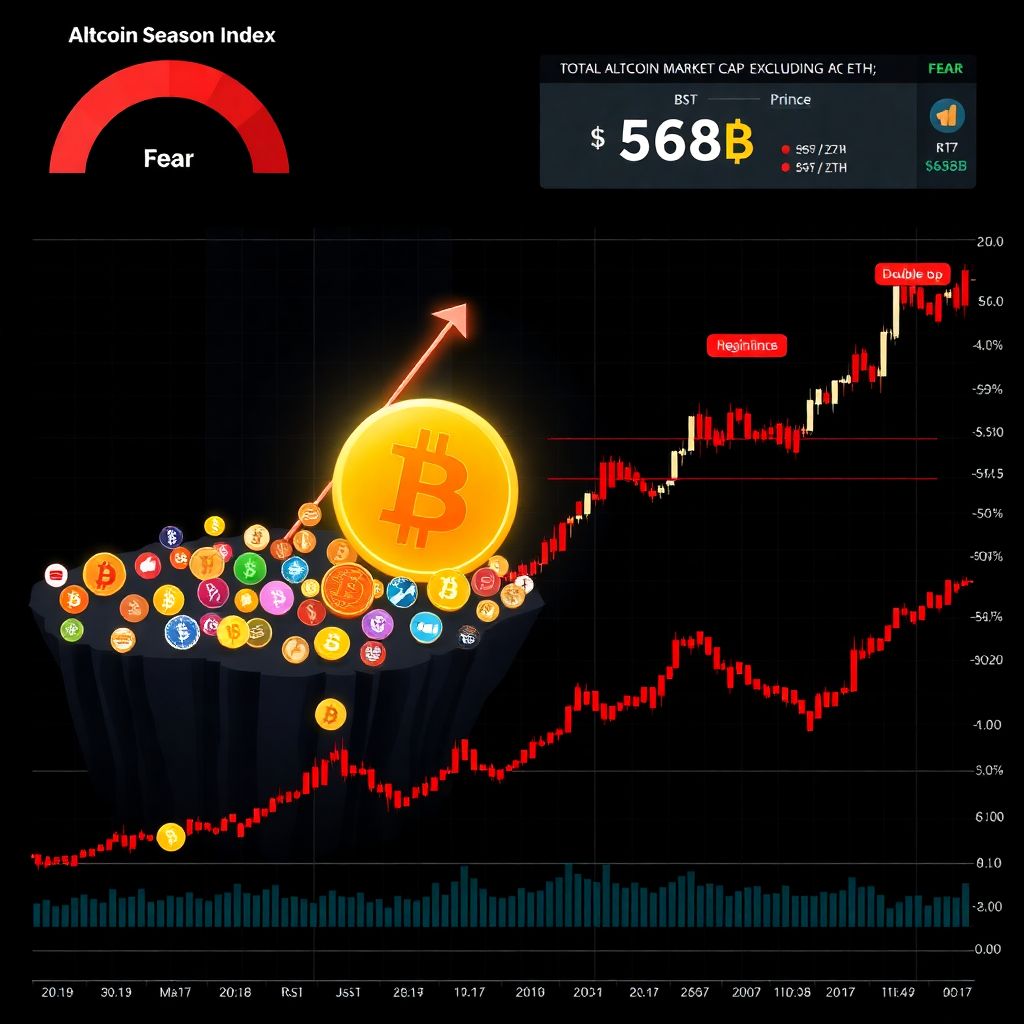
Altcoin Season in jeopardy as technical signals turn sharply bearish
The outlook for altcoins has deteriorated notably, with several key metrics pointing to a prolonged period of underperformance relative to Bitcoin. The Altcoin Season Index, a widely watched gauge that compares the performance of major alternative cryptocurrencies to Bitcoin (BTC), has slid to 15 – its lowest reading of the year – and the trend suggests the weakness may deepen in the weeks ahead.
Bitcoin dominance climbs as altcoins falter
The latest leg down in the Altcoin Season Index coincides with a renewed surge in Bitcoin dominance. As capital rotates back into BTC, most altcoins have struggled to attract sustained buying interest and remain under pressure. In market environments where Bitcoin outperforms, high‑beta altcoins tend to lag as traders seek perceived safety in the largest and most liquid crypto asset.
Market data for the last 90 days shows how narrow the field of winners has been. Only a small group of tokens managed to post significant gains, while the broad altcoin complex stayed in the red. One standout exception was Pippin token, which soared more than 2,300%, making it the top performer among major tokens over that period. Alongside it, a cluster of privacy‑focused coins – including Zcash, Dash, Monero, and Merlin Chain – also delivered notable upside, bucking the broader downtrend.
Heavy losses for many altcoins
On the other side of the spectrum, a number of well‑known altcoins suffered steep drawdowns. Tokens such as DoubleZero, Story, MYX Finance, Immutable, and Pudgy Penguins were among the worst performers, each losing over 60% of their value in the same 90‑day window. These declines far exceeded the pullback in Bitcoin, underlining how vulnerable altcoins have become in the current macro and market context.
This underperformance has played out against a backdrop of waning risk appetite across the entire crypto sector. The Crypto Fear and Greed Index has slumped into the “fear” territory at 25, signaling that sentiment has shifted decisively away from speculation and toward capital preservation. In such conditions, traders typically reduce exposure to higher‑risk assets, and altcoins are usually the first to be sold.
Deleveraging after a massive liquidation event
The pressure on altcoins intensified after the sharp market shock on October 10, when more than 1.6 million traders were liquidated, wiping out around 20 billion dollars in value. That event triggered a rapid and aggressive deleveraging cycle. Open interest in derivatives markets has been falling since, indicating that leveraged traders have been closing positions or being forced out by margin calls.
This unwinding of leverage has had a particularly negative effect on altcoins, which are generally considered riskier and more volatile than Bitcoin. When markets turn and leverage gets flushed out, altcoins often experience exaggerated price swings compared to BTC, as traders rush to exit crowded positions and market makers pull back liquidity.
Altcoin weakness amplified by Bitcoin’s decline
Adding to the bearish tone, Bitcoin itself has come under pressure. Historically, when Bitcoin trends lower, altcoins tend to fall even more sharply. The current environment has been no exception. As BTC slid, altcoins failed to act as a defensive hedge and instead accelerated to the downside, deepening the underperformance captured by the Altcoin Season Index.
This relationship is rooted in market structure: Bitcoin is still viewed as the “reserve asset” of the crypto ecosystem. When BTC rises, some capital may spill over into smaller tokens. But when it drops, risk tolerance usually collapses, and traders dump altcoins first while clinging to or exiting Bitcoin later.
A troubling double‑top in altcoin market capitalization
Technical analysts are increasingly focused on a worrying pattern in the aggregate valuation of altcoins. On the three‑day chart, the total market capitalization of all cryptocurrencies excluding Bitcoin and Ethereum fell from about 1.19 trillion dollars in October to roughly 825 billion dollars. More importantly, this chart appears to have completed a double‑top formation around 1.16 trillion dollars, with a key neckline sitting near 658 billion dollars.
A double‑top is typically regarded as a bearish reversal pattern. It forms when price fails twice at a similar high, signaling that buyers are no longer strong enough to push the market to new peaks. The neckline represents the last major support level between the two tops; if price breaks below it, the pattern is confirmed and often leads to accelerated selling.
In the current setup, the altcoin market cap has already dropped beneath the 38.2% Fibonacci retracement level measured from the previous major rally. This suggests that the corrective phase is not just a shallow pullback but may be evolving into a deeper, more prolonged downturn.
Moving averages and momentum indicators favor the bears
Additional technical signals reinforce the negative outlook. The combined altcoin market cap now sits below both the 50‑day and 200‑day Exponential Moving Averages (EMAs), a classic indication that sellers remain firmly in control of the trend. When price trades under these long‑term moving averages, rallies tend to be sold into rather than extended.
Momentum indicators tell a similar story. The Relative Strength Index (RSI) has been trending lower for months, reflecting persistent selling pressure and a lack of strong bounce attempts. The Moving Average Convergence Divergence (MACD) indicator is also on a downward trajectory, pointing to weakening momentum and the absence of a clear bullish divergence that might hint at a bottom.
Key downside levels: 50% retracement and the neckline
Based on this technical structure, the most probable scenario is that altcoins continue to drift lower as sellers target the 50% Fibonacci retracement level near 739 billion dollars in total market cap. This area may offer temporary support, but if it fails to hold, the market could slide further toward the neckline around 658 billion dollars.
A decisive break below the neckline would likely confirm the double‑top pattern and signal the potential for an even steeper capitulation phase. That could translate into another leg down for many altcoins, especially those with weaker fundamentals, low liquidity, or heavy reliance on speculative narratives.
What this means for traders and investors
For active traders, the current environment favors caution and disciplined risk management. High volatility, thinning liquidity, and broad risk aversion can create sharp intraday reversals, making it dangerous to chase short‑lived rallies in illiquid altcoins. Position sizing, tight stop‑losses, and a clear plan for adverse moves are crucial.
Longer‑term investors may prefer to wait for signs of stabilization before increasing exposure to altcoins. These signs could include a sustained improvement in market sentiment, a rebound of the Altcoin Season Index from extreme lows, a recovery of altcoin market cap back above key moving averages, or evidence of accumulation in on‑chain data for major projects. Until then, portfolio allocations tilted more heavily toward Bitcoin or stablecoins may offer a more defensive stance.
How altcoin cycles typically evolve
Historically, altcoin seasons do not begin in isolation; they often follow periods of strong Bitcoin performance. A common pattern is that Bitcoin rallies first, drawing in new capital. Once BTC consolidates near highs and volatility compresses, traders search for higher returns in smaller assets, sparking rotational flows into altcoins.
In contrast, the current picture is almost the opposite. Bitcoin has lost momentum, macro uncertainty remains elevated, and risk indicators are flashing caution. Without a solid base of confidence built on a stable or rising BTC price, it becomes difficult for an enduring altcoin season to take shape. Short speculative bursts may occur, but they are less likely to turn into a broad, sustained altcoin rally.
Sectors and narratives that could show relative strength
Even in a broadly bearish phase, some segments of the market may perform relatively better than others. The recent outperformance of privacy coins like Zcash, Dash, and Monero highlights how specific narratives – in this case, transaction privacy and censorship resistance – can attract capital despite a weak overall backdrop.
Other narratives that could see selective interest include real‑world asset tokenization, decentralized infrastructure (such as data availability and scaling solutions), and projects with clear revenue models or strong cash flows. However, relative strength in a bear‑leaning environment does not guarantee absolute gains; it may simply mean falling less than the rest of the market.
Risk management considerations for the months ahead
With altcoin season at risk and bearish technical patterns emerging, a more defensive strategy may be warranted:
– Focus on liquidity: Favor assets with deep order books and high trading volumes to reduce slippage.
– Prioritize fundamentals: Projects with real users, sustainable tokenomics, and clear value propositions are more likely to survive extended downturns.
– Avoid excessive leverage: Recent liquidation events show how quickly leveraged positions can be wiped out when volatility spikes.
– Plan for multiple scenarios: Consider both a continued grind lower and the possibility of sharp relief rallies that may be better suited for short‑term trades than long‑term entries.
Looking forward: what could change the picture for altcoins?
For the tide to turn in favor of altcoins, several factors would likely need to align: stabilization or recovery in Bitcoin, improvement in macroeconomic conditions and risk sentiment, a slowing of deleveraging in derivatives markets, and fresh catalysts such as major protocol upgrades, regulatory clarity, or adoption‑driven narratives.
Until those drivers appear more clearly, the dominant signals remain bearish. The combination of a falling Altcoin Season Index, a potential double‑top in market capitalization, weakening momentum indicators, and ongoing risk aversion suggests that altcoins could face more pain before any sustainable recovery emerges.