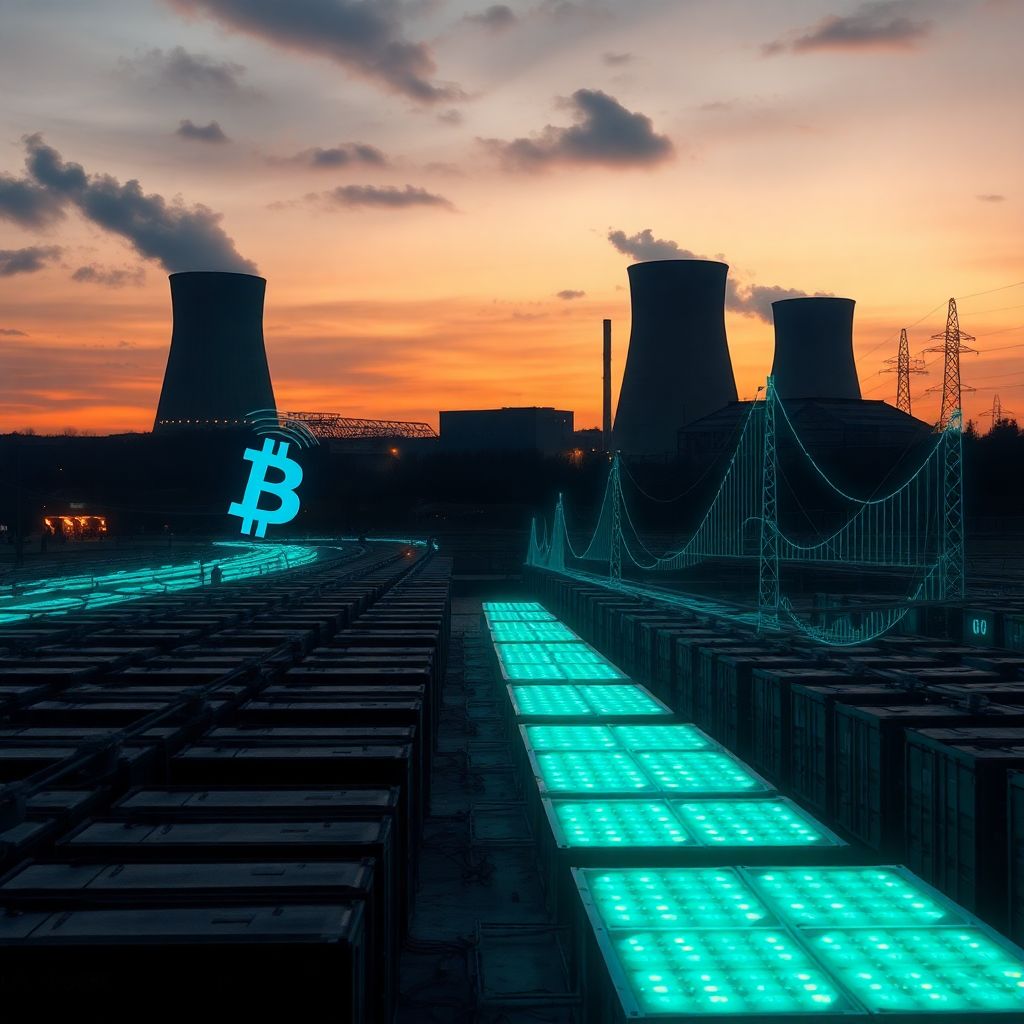
Zaporizhzhia’s Nuclear Power For Crypto Mining? Putin Alleges US Plans
Russian President Vladimir Putin has reportedly claimed that the United States is exploring the idea of tapping the Zaporizhzhia nuclear power plant’s electricity for cryptocurrency mining and for supplying power to Ukraine. The comments, attributed to him by Russian media, add an unusual twist to already sensitive negotiations around one of Europe’s most strategically important energy assets.
According to a report citing Russian business outlet Kommersant, Moscow and Washington are said to be discussing some form of joint control or cooperation over the Zaporizhzhia nuclear facility. The plant, located in southeastern Ukraine, is the largest nuclear power station in Europe and, before the war, supplied more than 20% of Ukraine’s electricity.
That changed dramatically in 2022, when Russian forces seized the complex. Since then, the plant has stopped producing power for the grid, becoming instead a flashpoint in the broader conflict and a constant source of concern for nuclear safety experts worldwide. Any conversation about its future use—whether for conventional power generation, crypto mining, or otherwise—now unfolds against this tense backdrop.
Putin’s alleged comments were made during a meeting with senior business figures on Christmas Eve. He reportedly suggested that the United States is interested not only in harnessing the plant to restore electricity flows to Ukraine, but also in diverting some of its nuclear-generated power toward crypto mining operations. While no detailed plans have been made public and Washington has not confirmed such intentions, the claim highlights how digital asset infrastructure is increasingly being drawn into geopolitical narratives.
Crypto mining, most famously associated with Bitcoin, is a process that requires significant computational and electrical resources. Specialized hardware competes to solve complex cryptographic problems, and the winner earns the right to add the next block to the blockchain, receiving newly issued coins and transaction fees as a reward. This “proof-of-work” mechanism has turned large-scale mining into a quasi-industrial activity that follows cheap and abundant energy wherever it can be found.
One reason nuclear power periodically appears in crypto mining debates is the sector’s need for stable, around-the-clock electricity. Unlike intermittent renewables such as wind and solar, nuclear plants provide steady baseload power. Mining operations are also relatively flexible: they can be modular, containerized, and quickly relocated or scaled up and down. That combination has led some energy strategists and mining firms to explore whether idle, stranded, or excess capacity—such as unused power in remote regions—could be monetized by running mining rigs.
Over the past three years, global Bitcoin mining capacity has expanded rapidly. The total network hashrate, which measures the aggregate computing power securing the Bitcoin network, has increased nearly fivefold. This surge reflects both technological improvements and the relentless hunt for lower-cost electricity, from hydropower and natural gas flaring to, in some discussions, nuclear energy. Against that backdrop, the idea of pairing a large nuclear facility like Zaporizhzhia with crypto mining, while controversial, is not technically far-fetched.
Yet, from a practical standpoint, restarting Zaporizhzhia for any purpose is far from straightforward. By late 2022, all six of the plant’s reactors had been shut down. Five of them are reportedly in a cold shutdown state, meaning their temperature and pressure have been reduced and they are not producing power. One reactor was kept in hot shutdown to generate steam needed for essential nuclear safety systems, but even that does not equate to readiness for grid-scale power generation.
The International Atomic Energy Agency (IAEA) has repeatedly warned that the safety situation at the plant remains precarious. In a statement earlier this year, IAEA Director General Rafael Mariano Grossi stressed that none of the six reactors can be safely restarted while active military hostilities continue to threaten the site and its supporting infrastructure. Damage to external power lines, nearby shelling, and uncertainty over staffing and maintenance have all contributed to persistent concern among nuclear regulators.
This means that any hypothetical plan—whether to power Ukrainian cities or to run rows of crypto mining machines—would first have to overcome a long list of technical, regulatory, and security hurdles. Safety inspections, repairs, stable oversight, and a clear chain of command would all be prerequisites. In practice, as long as the conflict remains unresolved, most experts consider a return to normal operations highly unlikely.
There is also a broader debate about whether using nuclear energy for crypto mining is politically or ethically acceptable, especially in a war zone. Critics argue that prioritizing mining could divert attention and resources from restoring reliable electricity to civilians or rebuilding critical infrastructure. Supporters, on the other hand, claim that mining can act as a temporary “buyer of last resort” for surplus power, stabilizing revenues and making large energy projects more financially viable in the long run. In Zaporizhzhia’s case, however, even reaching the stage where such trade-offs could be rationally debated would require a secure and demilitarized environment—something that does not yet exist.
At the geopolitical level, Putin’s assertion that the US is interested in leveraging Zaporizhzhia for crypto mining can also be read as part of a broader information battle. By linking Washington to a contentious and energy-hungry industry, Moscow may be trying to frame Western intentions as opportunistic or speculative, rather than humanitarian or infrastructure-focused. Without transparent, verifiable details from either side, it is difficult to separate strategic messaging from genuine policy proposals.
For the cryptocurrency ecosystem, the story is a reminder of how deeply mining and energy policy are intertwined. Governments increasingly view large mining operations through the lenses of grid stability, industrial strategy, sanctions, and climate commitments. Some countries have courted miners with favorable regulations and cheap power, while others have cracked down over fears of excessive energy use or financial opacity. A nuclear plant in a conflict zone, discussed in the same breath as Bitcoin, brings those tensions into especially sharp relief.
If Zaporizhzhia were ever safely reactivated, a more conventional scenario would likely involve using its output to stabilize Ukraine’s electricity system and support reconstruction efforts. Only once basic civilian and industrial needs were met would questions about supplementary uses—such as data centers or mining facilities—be politically palatable. In many post-conflict recovery strategies, reliable power is viewed as a foundation for broader economic revival, from manufacturing to digital services.
Technically, pairing nuclear plants with high-density computing is not new. Around the world, data centers are increasingly being built near large power stations to minimize transmission losses and secure long-term power contracts. Crypto mining is simply one of the more specialized forms of such computing. Proponents argue that if designed responsibly, mining could be integrated into a broader digital infrastructure strategy, sharing facilities with cloud computing, AI workloads, or traditional data processing.
For now, though, such ideas remain theoretical when it comes to Zaporizhzhia. The immediate priority for international nuclear authorities is preventing any incident that could release radiation or compromise the plant’s safety systems. That involves maintaining external power supplies, ensuring trained staff can access the site, and keeping heavy fighting as far away as possible. Until those conditions are reliably met, the plant’s massive generating potential will remain mostly a symbol of what has been lost rather than a resource that can be fully utilized.
In the wider crypto market, the news has not dramatically altered short-term price dynamics. At the time of writing, Bitcoin is trading near 88,600 dollars, up about 1.3% over the past 24 hours. Traders remain more focused on macroeconomic conditions, regulatory developments, and network-level indicators than on speculative long-term energy projects in a war zone. Still, the Zaporizhzhia story illustrates how the search for cheap, secure power will continue to shape where and how Bitcoin and other proof-of-work networks are mined in the years ahead.
Ultimately, whether Zaporizhzhia’s reactors ever contribute power to crypto mining will depend on three intertwined factors: the outcome of the war, the political bargains struck between Russia, Ukraine, and Western states, and evolving global attitudes toward the environmental and geopolitical footprint of proof-of-work cryptocurrencies. Until those pieces fall into place, talk of using Europe’s largest nuclear plant as a mining hub remains, at best, a distant and highly controversial possibility.