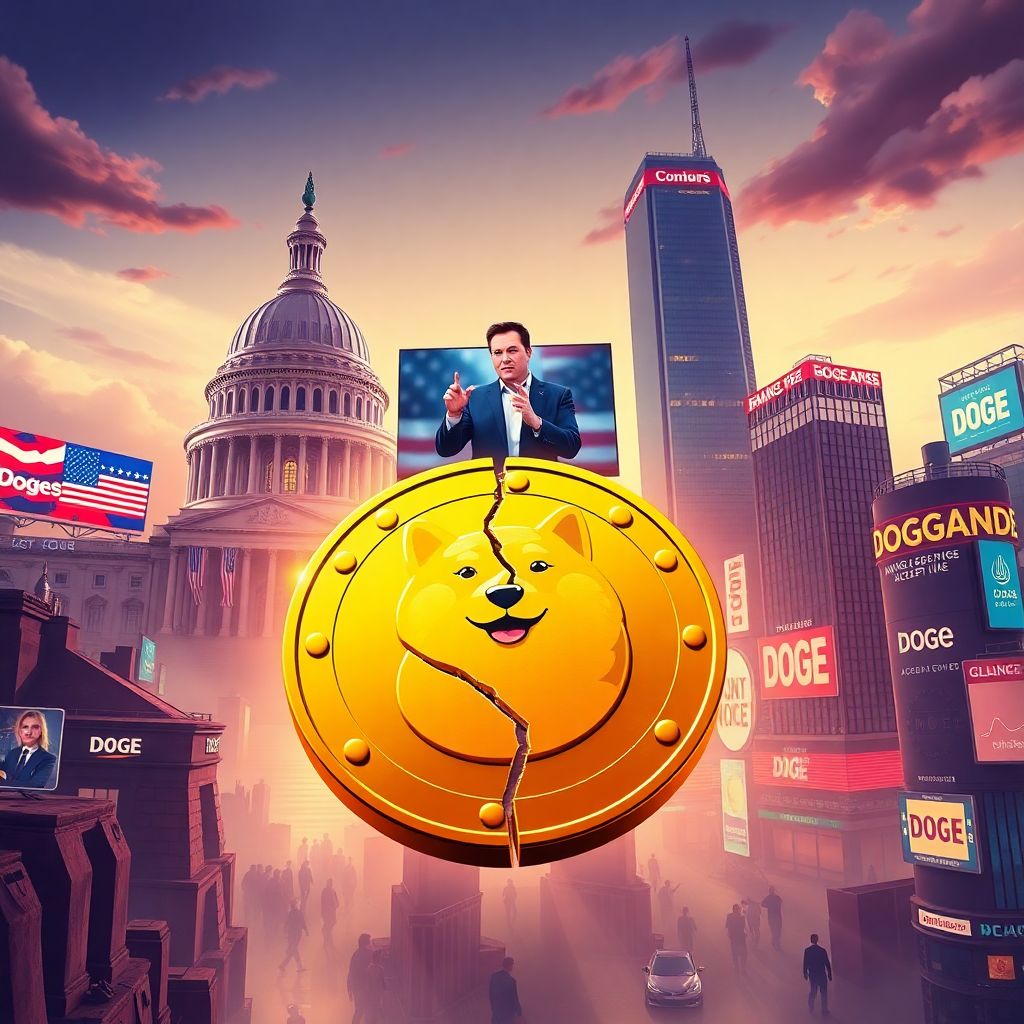
The Year in Dogecoin 2025: From Meme Coin to Political Football
Dogecoin may have started as an internet meme, but in 2025 it became something far more contentious: a political symbol, a corporate asset, and a test case for how far a joke currency can be pulled from its roots before it breaks.
Over the course of the year, DOGE was name-checked by politicians, adopted by traditional companies for their balance sheets, and even lent its branding to a controversial U.S. government initiative fronted by Elon Musk. Yet for all the noise and attention, Dogecoin’s price performance told a very different story.
By December 15, 2025, DOGE had surrendered virtually all the gains it had made earlier in the year, trading roughly 65% below where it had been 12 months prior. The coin failed to set a new all‑time high, frustrating long‑term believers who expected the institutional rush and political spotlight to translate into a sustained rally. Instead, Dogecoin ended the year in an uncomfortable limbo: less of an underdog grassroots project, not quite a serious blue‑chip asset, and heavily polarizing in the public arena.
Dogecoin Enters the Political Arena
The turning point for Dogecoin’s political relevance came when its name and imagery were co‑opted for a U.S. government initiative branded around “efficiency” and cost‑cutting. The program, fronted and heavily promoted by Elon Musk, positioned itself as an effort to modernize and streamline federal operations using digital tools and innovative funding models.
The choice to associate this initiative with Dogecoin was immediately divisive. Supporters argued that it was a bold acknowledgment of decentralized culture and a sign that policymakers were finally taking digital assets seriously. Critics saw it as a stunt—political theater wrapped in meme aesthetics—and bristled at the idea of a public policy program informally borrowing the identity of a community‑driven cryptocurrency without any formal governance input or consent.
The controversy only grew as Dogecoin’s logo and brand references appeared in speeches, presentations, and unofficial campaign materials. For many early Dogecoin users, seeing their favorite meme coin tied to partisan debates felt like a betrayal of its apolitical, irreverent origins.
Elon Musk’s Expanding Influence
Elon Musk has long been intertwined with Dogecoin culture, but 2025 marked a new phase. Rather than just tossing out price‑moving tweets, Musk became directly associated with a government initiative that, intentionally or not, blurred the line between public policy and crypto branding.
His involvement amplified Dogecoin’s visibility in traditional media and among voters who had never held a digital asset in their lives. Yet this expanded reach came with a cost: Dogecoin began to be perceived not as a neutral, internet‑native joke about money, but as a symbol aligned with a specific tech‑driven, efficiency‑obsessed political worldview.
For traders, Musk’s proximity remained a double‑edged sword. Every public appearance or statement about technology, infrastructure, or “efficiency” sparked speculation about its implications for DOGE, but over time markets reacted less dramatically. The novelty of Musk‑linked hype appeared to fade, and 2025 showed that branding power alone could not push Dogecoin to new highs.
Dogecoin Goes Corporate
While the political saga grabbed headlines, another major shift unfolded quietly in boardrooms. This was the year that a wave of traditional businesses began experimenting with Dogecoin as part of their financial and marketing strategies.
Several publicly listed companies disclosed DOGE holdings as a small share of their treasury reserves—less for its hard‑money characteristics and more as a symbolic bet on internet culture. Others accepted Dogecoin payments for products and services, using it as a way to appeal to younger, tech‑savvy consumers and to differentiate themselves in a crowded marketplace.
Some brands went further, rolling out limited‑time promotions, loyalty rewards, and campaign tie‑ins that revolved around Dogecoin. For corporate marketers, DOGE became a shorthand for being “in touch” with online culture—even if the actual transaction volumes remained modest compared to more established digital assets.
The Price: Hype Without a Peak
Despite the swirl of institutional and political attention, Dogecoin’s price refused to cooperate with the narrative of inevitable success. After moments of optimism and short‑lived rallies, DOGE ended the year roughly 65% lower than where it had been a year earlier, erasing its 2025 gains.
The failure to break a new all‑time high hit the community hard. Many expected that the combination of corporate adoption, rising mainstream awareness, and the unprecedented U.S. initiative bearing its name would create a perfect storm for price appreciation. Instead, speculative waves tended to fade quickly, and liquidity often migrated to trendier meme coins or more “serious” projects offering staking yields and complex DeFi integrations.
This gap between visibility and valuation underscored an uncomfortable reality: notoriety and relevance do not automatically translate into sustainable market demand. Dogecoin was increasingly famous, but not necessarily more useful or scarce, and the market priced it accordingly.
Identity Crisis: From Grassroots Meme to Institutional Asset
In earlier years, Dogecoin’s charm lay in its simplicity: a light‑hearted, inflationary coin with a passionate, volunteer‑driven community and a culture centered on fun, tipping, and generosity. In 2025, that identity came under strain.
Institutional holders, corporate campaigns, and political branding all pulled DOGE away from the chaotic, bottom‑up energy that had defined it. Long‑time users questioned whether the project was still “the people’s coin” or if it had become just another speculative asset leveraged by the powerful for attention and profit.
The irony was hard to miss: Dogecoin had become more “serious” in the eyes of governments and companies, but that seriousness did not bring the prosperity many expected. Instead, its grassroots ethos weakened just as its financial performance stagnated.
Builders Stay Optimistic About 2026
Despite the turbulent year, developers and core contributors remained publicly optimistic about Dogecoin’s technical and ecosystem prospects heading into 2026. Their argument was straightforward: attention cycles are temporary, but infrastructure improvements can create lasting value.
Work continued on improving transaction efficiency, exploring scalability options, and enhancing wallet support. Developer discussions increasingly focused on making Dogecoin more practical for everyday payments and micro‑transactions rather than chasing speculative features.
There was also renewed interest in tools that could support Dogecoin‑based tipping, commerce integrations, and user‑friendly onboarding flows. The goal was to reduce reliance on celebrity tweets and political noise, and instead make DOGE a reliable, enjoyable way to move small amounts of value online.
Dogecoin as a Cultural Asset, Not Just a Coin
One of the key lessons of 2025 was that Dogecoin’s value cannot be measured only in charts and price levels. It has become a cultural asset—a meme, a symbol, a shorthand for a particular kind of internet humor and anti‑establishment sentiment.
That cultural capital explains why both public institutions and private companies tried to tap into Dogecoin’s brand. For many people, DOGE represents the idea that finance can be fun, absurd, and democratic all at once. Even when the price declines, that narrative remains powerful.
The challenge for 2026 and beyond is to harness that cultural energy in a way that strengthens the ecosystem rather than diluting or exploiting it. If Dogecoin can reconnect its brand with practical, user‑driven use cases, it may be able to move beyond the boom‑and‑bust cycle that has defined much of its history.
The Political Risk: When a Meme Becomes a Weapon
Dogecoin’s entanglement with a high‑profile government initiative also exposed a new type of risk: political polarization. Once a coin becomes associated with a particular political figure or ideology, it risks alienating half of the potential user base.
Throughout 2025, different groups tried to claim DOGE as “theirs”—whether as a symbol of tech‑driven governance, a critique of establishment finance, or a general banner of internet rebellion. This tug‑of‑war muddied the coin’s identity and raised tough questions for its community: should Dogecoin remain as politically neutral as possible, or embrace its newfound role as a tool of political expression?
How the ecosystem answers that question in 2026 will shape not only adoption, but the tone and inclusivity of the project itself.
A Test Case for Meme Coins Growing Up
Beyond Dogecoin alone, 2025 served as a case study for what happens when a meme coin tries to grow up in public. Other projects watched closely as DOGE navigated government branding, corporate balance sheets, and market fatigue.
On the one hand, DOGE proved that a meme asset can achieve real institutional recognition and cultural relevance far beyond the crypto niche. On the other, the year highlighted the limits of hype: institutional deals and political headlines are not magic bullets for sustainable price appreciation or ecosystem health.
For newer meme coins aspiring to follow in Dogecoin’s footsteps, the message is clear: visibility is only the first step. Without technical progress, genuine utility, and a resilient culture, attention alone will not deliver long‑term success.
Looking Ahead: Can 2026 Deliver the “Explosive” Growth?
Dogecoin’s builders and many of its most committed supporters are betting that 2026 will look very different from 2025. They expect that the infrastructure built quietly in the background—developer tools, integrations, more robust wallets, and potentially new layers of functionality—will finally give DOGE a foundation that matches its fame.
Whether that prediction plays out will depend on several factors:
– Can the project regain its grassroots energy while navigating institutional and political interest?
– Will real‑world usage, not just speculation, start to matter more for valuation?
– And can Dogecoin remain a symbol of inclusive internet culture instead of a pawn in partisan battles?
What is clear after 2025 is that Dogecoin is no longer just a punchline. It has become a contested space where politics, commerce, and online culture collide. The coming year will show whether the original meme coin can turn that chaos into durable growth—or whether it will remain a cautionary tale about what happens when a joke becomes too serious for its own good.