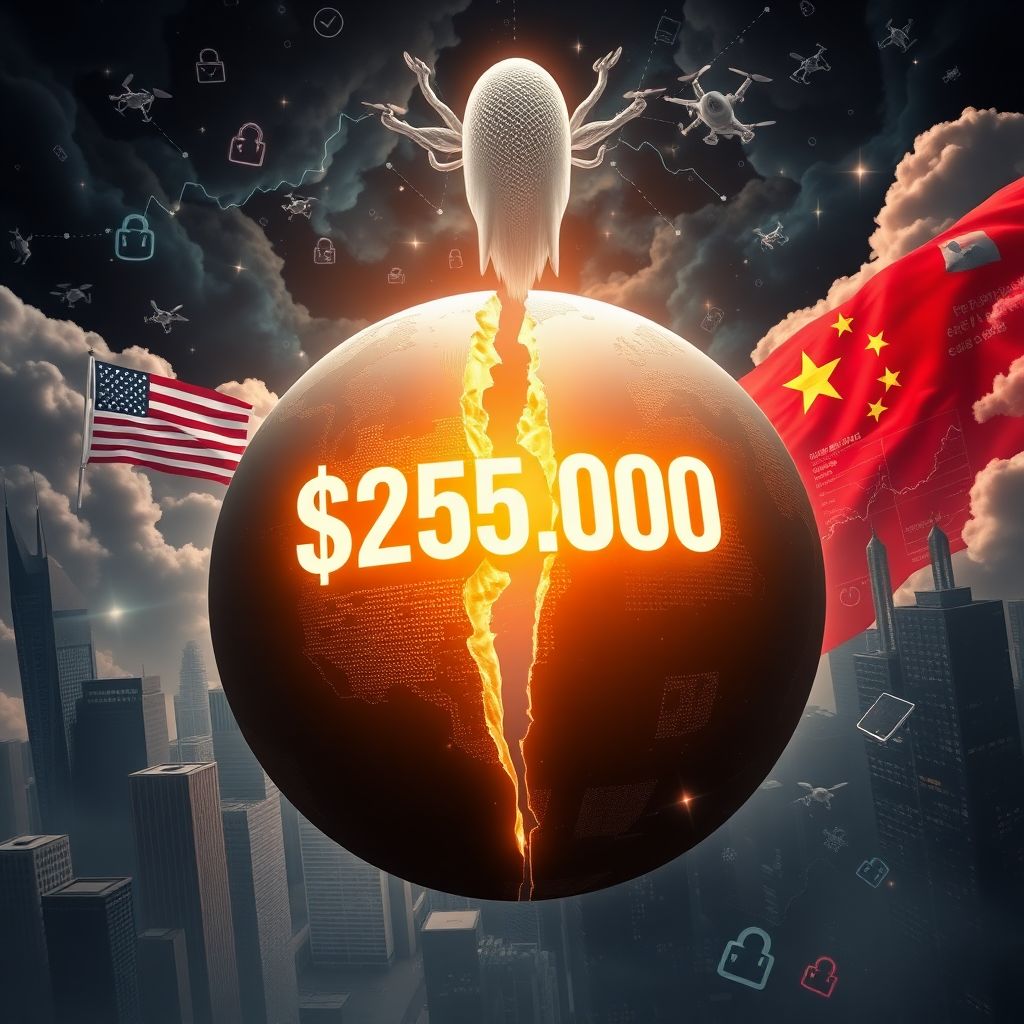
Emerge’s 2025 Story of the Year: How the AI Race Fractured the Global Tech Order
The unraveling of the old tech order in 2025 can be traced back to a single, staggering number: $256,000.
That was the sum a little-known, year-old Chinese startup called DeepSeek said it had spent to train an AI model that, on paper, rivaled the performance of systems built by OpenAI—the same OpenAI that reportedly burned through hundreds of millions of dollars to reach a similar level of capability.
When DeepSeek’s app quietly landed in Apple’s store in January, the financial world did not stay quiet. Within a single trading day, Nvidia—the undisputed king of AI chips—saw about $600 billion in market value evaporate. It was the largest one-day market-cap destruction in history.
More than a spectacular trading event, that crash signaled a deeper shift. It suggested that the fundamentals of the AI race—who controls compute, who sets the rules, who captures value—might be changing far faster than regulators, corporations, and even governments expected.
—
From Trade War to Tech Shock
Throughout the early 2020s, the narrative was that the US–China rivalry was a “trade war” dressed up in tech language: tariffs, export controls, and blacklists aimed at restricting China’s access to cutting‑edge semiconductors and advanced manufacturing tools.
DeepSeek’s claim shattered a central assumption underpinning that strategy: that raw compute at scale—and the Western companies that produced it—would remain the main bottleneck for state‑of‑the‑art AI.
If a startup could train a frontier‑level model for a price closer to a mid-sized Series A round than a national R&D program, then the focus on choking off hardware suddenly looked less decisive. The battle was no longer just about how many top‑end GPUs a country could buy. It was about algorithms, data efficiency, and clever engineering that made those chips go further.
For policymakers who had spent years weaponizing export controls, the implications were uncomfortable: the game board had changed, but the strategy hadn’t.
—
Weaponizing the Entire Tech Stack
By mid‑2025, it was clear that AI was no longer just another technology sector. It had become the organizing logic of geopolitics, and every layer of the tech stack was being turned into a battlefield:
– Minerals and materials: Rare earths, copper, and the elements essential to chip fabrication and data centers were treated as strategic resources. Supply chains were reshored, re‑routed, or outright blocked.
– Chips and compute: The US tried to maintain a lead in advanced node manufacturing and high‑end AI accelerators, while China raced to design workarounds—custom accelerators, more efficient architectures, and new fabs.
– Models and data: Governments leaned on leading labs for access and control. Licensing regimes, national AI standards, and data localization rules proliferated.
– Cloud and infrastructure: Hyperscalers became geopolitical assets. Access to their compute went from a business decision to a matter of foreign policy.
– Military doctrine: War games and planning scenarios were rewritten around AI‑assisted decision‑making, autonomous systems, and cyber‑offense powered by large models.
The AI race had become a systemic competition—less like a product launch and more like an arms race, with every layer of the stack open to weaponization.
—
The DeepSeek Shock: Efficiency as a Strategic Threat
DeepSeek’s real innovation was not just performance; it was cost‑per‑capability. If its claims held up, then the underlying message to the world was brutal:
> You no longer need to be the richest company—or the richest country—to build powerful AI.
That idea terrified markets. Nvidia’s valuation was built on the assumption that compute scarcity would persist: whoever controlled the GPUs controlled the future. DeepSeek’s model suggested a scenario in which:
– Cheaper or older hardware could still produce competitive models.
– Software innovations—sparse training, novel optimizers, compression, and distillation—could blunt the effect of hardware embargoes.
– A wave of new entrants, especially from countries outside the traditional tech power centers, could suddenly compete at the model layer.
For US strategists, that meant that simply cutting off chips to China no longer guaranteed technological dominance. For China, it validated years of investment in applied research and independent innovation.
—
The Battle for the Consumer: AI as Everyday Infrastructure
While the geopolitical narrative focused on states and militaries, a quieter revolution was happening at the consumer level. In 2025, the question was no longer *whether* people would use AI, but whose AI would they live inside?
Two contrasting models emerged:
– US‑aligned ecosystems: Platforms centering on privacy branding, regulated safety features, and integration with Western productivity and entertainment services. Think AI copilots in office suites, enterprise chatbots, and assistant layers baked into operating systems.
– China‑aligned ecosystems: Super‑apps with tightly integrated AI assistants, commerce, payments, social media, and entertainment. Here, AI was not just a helper—it was the navigation layer for daily life, from shopping and payments to media and education.
The fight for consumer mindshare became a proxy for soft power. The assistant on your phone was as much a cultural ambassador as an app. The more it spoke your language, reflected your norms, and offered you access to frictionless services, the more likely you were to end up inside one bloc’s digital sphere instead of the other’s.
—
From Trade War to the Edge of Kinetic Conflict?
As AI embedded itself into military and security infrastructures, the old metaphor of “trade war” started to feel dangerously outdated.
Several trends pushed the system toward escalation:
– AI‑enhanced surveillance and targeting: Both blocs poured AI into sensor fusion, battlefield awareness, and drone swarms, lowering the practical cost of escalation.
– Compressed decision timelines: With AI summarizing and recommending actions in real time, the window for human deliberation shrank. Decision‑makers felt compelled to act faster, raising the risk of miscalculation.
– Cyber and information operations: Large models powered more persuasive and targeted disinformation, as well as automated vulnerability discovery in critical infrastructure.
No major power wanted an outright shooting war. Yet the integration of AI into command‑and‑control systems made accidental escalation more plausible. A misclassified radar signal, an overconfident recommendation from an AI system, or a misinterpreted test could rapidly spiral.
By late 2025, defense analysts were openly debating whether AI was stabilizing—by improving detection and prediction—or profoundly destabilizing, by making preemptive action seem more rational.
—
China vs. the World: Open‑Source Models as a Battlefield
One of the most unexpected theaters of competition emerged in open‑source AI.
For years, open models were treated as a kind of democratizing force—tools that could dilute the power of big tech platforms. In 2025, they became something else: instruments of state influence.
– Chinese‑origin open models began to rival or outperform Western contenders, especially in non‑English languages and practical applications like translation, logistics, and embedded systems.
– Governments and major companies worldwide had to decide whether to adopt models whose upstream development might be entangled with foreign industrial policy or security agendas.
– Western regulators, previously concerned primarily with safety and misuse, now had to factor in strategic dependency: if your hospitals, banks, or education systems ran on a foreign AI stack, what did that mean in a crisis?
The “China vs. world” framing became too simplistic. Many countries in the Global South, frustrated with Western licensing restrictions and access disparities, were eager to adopt performant, low‑cost open models—whoever produced them. In practice, that often meant leaning toward Chinese technology.
Open‑source, once envisioned as neutral commons, was now another arena of alignment.
—
Fragmentation of the Global Tech Order
The net effect of these forces was a visible fracturing of the global tech environment.
Instead of one integrated, US‑centric internet and cloud ecosystem, 2025 crystallized a world of competing digital blocs:
1. The US‑led bloc: Dominated by American hyperscalers, Western chip manufacturers, and regulatory regimes emphasizing safety, IP protection, and selective openness.
2. The China‑led bloc: Combining domestic giants, export‑friendly AI infrastructure, and a governance model oriented around state oversight and rapid deployment.
3. The Non‑Aligned or Hybrid bloc: Regions and countries stitching together technology from both sides, seeking autonomy through open‑source, local cloud providers, and diversified supply chains.
Each bloc developed its own standards for:
– AI safety and red‑team practices
– Data governance and localization
– Encryption and lawful access
– Interoperability between models and services
This fragmentation did not mean total separation. Cross‑border collaboration, gray‑market compute, and multinational ventures continued. But the friction increased—licenses, sanctions, compliance, and political risk all became fundamental constraints.
—
The Chip Question: After the Nvidia Collapse
Nvidia’s one‑day, $600‑billion wipeout was not only about DeepSeek; it was a referendum on the assumptions built into the AI hardware boom.
Investors began asking hard questions:
– If software efficiency keeps improving, how long will AI training remain as capital‑intensive as it appears today?
– What happens to chip demand if more tasks move to smaller, specialized models and local inference, rather than a few huge frontier models in the cloud?
– Will export controls permanently segment the chip market, with separate supply and demand dynamics for each geopolitical bloc?
In response, the chip industry started to adapt. New strategies emerged:
– Specialized accelerators for edge and inference workloads.
– Region‑specific product lines, tailored to what could legally be sold in each jurisdiction.
– Greater emphasis on energy efficiency, as data center power became a limiting factor.
The Nvidia crash did not end the AI chip boom, but it did end the belief that scale alone—more GPUs, bigger clusters—would guarantee enduring dominance.
—
Regulation, Safety, and the Illusion of Control
While states raced to weaponize AI, they also tried—sometimes half‑heartedly—to regulate it.
Several themes defined the regulatory debates of 2025:
– Frontier model oversight: Proposals to license or register the largest models, impose safety evaluations, and require incident reporting.
– Data and privacy: Tighter constraints on what training data could be used, especially around biometric and medical information.
– Content authenticity: Frameworks for digital signatures, watermarking, and provenance to combat deepfakes and AI‑generated disinformation.
Yet the DeepSeek moment revealed a hard truth: regulation is slow, while optimization is fast. When a small, agile startup can radically improve efficiency and undercut even the biggest labs, traditional rulemaking struggles to keep pace.
States had to adjust their expectations. Instead of imagining that they could simply “pause” or centrally control AI progress, they began to focus on:
– Resilience of critical infrastructure.
– Incident response protocols for AI system failures or misuse.
– International norms and back‑channel communication to reduce escalation risk.
The dream of total control gave way to a more modest goal: managing the downsides of a technology that could no longer be neatly contained.
—
Corporate Strategy in a Fractured World
For global tech companies, 2025 was a year of painful choices.
Operating across rival blocs meant dealing with:
– Conflicting regulations on data and AI safety.
– Pressure from states to align product roadmaps with national strategic goals.
– Rising scrutiny over supply chains, partnerships, and upstream dependencies.
Some firms chose to split their operations, running effectively separate product lines, cloud regions, and AI stacks for different markets. Others doubled down on one bloc and quietly exited another, writing off entire markets in exchange for regulatory clarity and political goodwill.
The winners were often those who embraced adaptation over ideology: building modular architectures, maintaining diverse supplier bases, and investing in both proprietary and open‑source technologies to reduce lock‑in.
—
What 2025 Tells Us About the Future of the AI Race
By the end of 2025, the story of the year was not a single company or model. It was the realization that:
– Efficiency breakthroughs like DeepSeek’s can overturn the economics of AI overnight.
– The US–China rivalry has moved far beyond tariffs into the deep structure of how technology is built, governed, and deployed.
– The global tech order is no longer a unified system, but a set of competing architectures, each with its own rules, values, and economic logic.
The AI race did not just produce smarter machines. It redrew the lines between nations, markets, and citizens and the systems that mediate their lives. The number $256,000 became shorthand for a new reality: in an age where innovation can come from anywhere, neither money nor monopoly is a permanent moat.
The fracture of 2025 is not the end of the story. It is the opening chapter of a world where intelligence itself is infrastructure, and control over that infrastructure is the defining strategic question of the century.