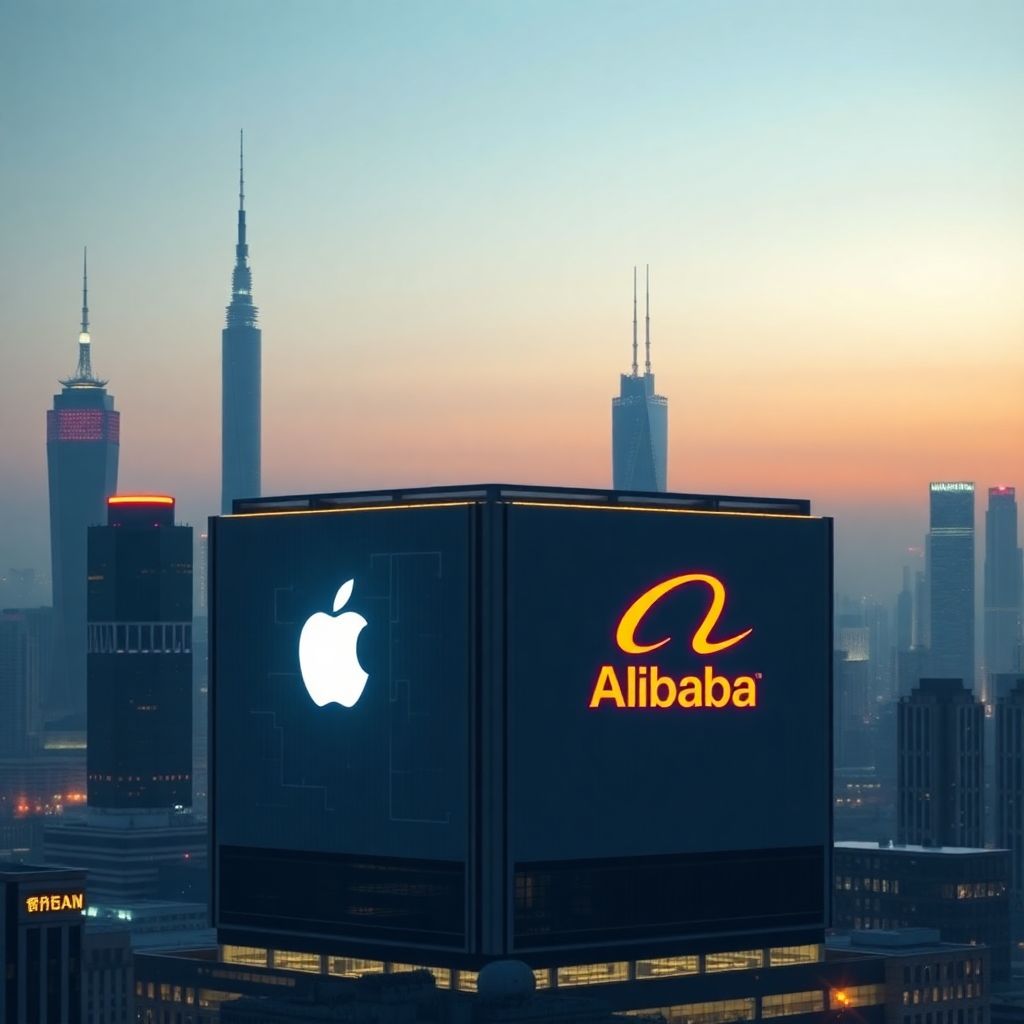
Apple Enlists Alibaba to Power China-Specific AI as It Pushes Apple Intelligence Into the Mainland
Apple has quietly teamed up with Chinese tech giant Alibaba to train a localized artificial intelligence model for the Chinese market, as it prepares to roll out its Apple Intelligence suite on iPhones in China, according to a Reuters report.
People familiar with the deal told Reuters that Apple’s generative AI service was officially registered with the Cyberspace Administration of China (CAC) last month, a crucial regulatory step in a country where foreign AI tools face strict scrutiny. This approval clears one of the biggest obstacles that has so far kept major Western AI products like OpenAI’s ChatGPT and Anthropic’s Claude effectively out of reach for users in mainland China.
Alibaba Chairman Joe Tsai publicly acknowledged the partnership as early as February 2025, confirming that Apple had approached multiple domestic AI providers before making its choice. “They talked to a number of companies in China,” Tsai said at the time. “In the end they chose to do business with us.” His comments underscored the strategic significance of Apple’s selection in a crowded field of Chinese AI developers.
According to the Reuters report, Apple is not relying on a single external system. Instead, the company is combining its own in-house AI model with Alibaba’s Qwen, and is also expected to incorporate technology from Baidu. While the precise division of labor between these systems has not yet been disclosed, the architecture suggests a hybrid approach: Apple maintaining core control over its branded Apple Intelligence experience, while using Chinese partners to ensure local compliance, language fluency, and integration into the country’s AI ecosystem.
Apple Intelligence-Apple’s umbrella brand for generative AI features across iPhone, iPad, and Mac-is expected to be adapted specifically for China, where data regulations, content rules, and technical standards differ significantly from those in the United States or Europe. In practice, that likely means that, even if the user experience resembles Apple Intelligence elsewhere in the world, the underlying models and data pipelines running on Chinese devices will be distinct and tailored to local requirements.
The partnership highlights how essential local alliances have become for foreign tech firms operating in China’s tightly controlled digital environment. Generative AI products must be vetted, registered, and compliant with content guidelines set by regulators, making it extremely difficult for Western services to operate without a domestic intermediary. Alibaba’s Qwen model, already approved for wide deployment inside China, offers Apple an AI engine that is both technically mature and politically acceptable to regulators.
For Apple, the stakes are high. China remains one of its most important markets, both as a manufacturing base and as a huge pool of iPhone users. Rolling out Apple Intelligence without a China strategy would effectively split the iPhone ecosystem into AI “haves” and “have-nots,” weakening the appeal of new devices for Chinese consumers. By partnering with Alibaba and integrating Baidu technology, Apple is signaling that it intends to avoid that split and keep Chinese iPhones competitive with devices sold elsewhere.
At the same time, the arrangement allows Apple to preserve its core brand promise: a consistent, Apple-controlled experience on the surface, even if the background architecture varies by region. The company can present Apple Intelligence to Chinese users under its own name and interface design, while quietly swapping in localized back-end models to generate responses, handle Chinese-language queries, and filter content in accordance with national rules.
This kind of layered approach-Apple on the front end, Chinese partners on the back end-could become a template for how Western tech firms bring advanced AI into markets with heavy regulation. Instead of trying to force global models through local approval processes, companies may increasingly opt to build regional AI stacks that sit beneath a unified brand. That reduces legal risk while preserving the marketing power of a single global product name.
For Alibaba, the collaboration is a major validation of its AI ambitions. Qwen competes with a growing roster of Chinese large language models from firms like Baidu, Tencent, and startups backed by major investors. Being chosen by Apple over other candidates is likely to strengthen Qwen’s positioning as a foundation model for both consumer and enterprise applications in China. It also opens the door for deeper technical exchange on topics such as optimization for mobile hardware, battery efficiency, and privacy features-areas where Apple has long experience.
Baidu’s role, while less clearly defined in the public reporting, is also notable. The company has been one of the earliest and most vocal champions of generative AI in China, pushing its own models and services across search, cloud, and smart devices. Apple’s plan to integrate Baidu technology alongside Qwen suggests that no single partner can fully cover Apple’s needs in such a complex regulatory and technical environment. A multi-partner approach could give Apple more redundancy, flexibility, and access to specialized tools developed by different Chinese companies.
The regulatory context remains central to this strategy. China has introduced rules that require generative AI services to undergo security reviews, avoid prohibited content, and ensure that output aligns with state-defined values. By registering its service with the CAC and relying on local partners whose models are already tuned to these constraints, Apple reduces the risk of sudden disruptions, bans, or costly retrofits. At the same time, it must navigate user expectations around privacy and data handling in a market where government access and corporate obligations can differ sharply from Western norms.
Analysts are closely watching how Apple balances this tension. The company has built its global reputation on privacy-first marketing and on-device processing, emphasizing that user data stays local whenever possible. In China, where cloud infrastructure, data residency rules, and security laws are more stringent and more opaque, Apple Intelligence will be an important test of how far the company can push its traditional privacy stance while remaining compliant. Any future disclosures about how the Chinese AI stack stores, processes, and transmits data will be scrutinized by both local users and international observers.
Another open question is feature parity. Even with regulatory approval and strong local partners, Apple may choose-or be forced-to limit certain Apple Intelligence capabilities in China. Some generative features, especially those involving open-ended content creation or sensitive topics, may be restricted or modified. Over time, differences between the Chinese and global versions of Apple Intelligence could emerge, influencing app developers, user behavior, and even the secondary market for imported devices.
For Chinese consumers, however, the most immediate impact will likely be straightforward: newer iPhones will gain AI-powered features more comparable to those available overseas. That could include smarter text suggestions, context-aware assistance, enhanced search, and more natural-language interactions across apps. Even if the underlying models are different, a functional Apple Intelligence rollout would help ensure that buying an iPhone in China still feels like buying into Apple’s cutting-edge ecosystem, rather than a downgraded regional version.
On a broader level, Apple’s decision to work with Alibaba and Baidu underscores how AI is reshaping global technology alliances. Instead of a simple divide between “domestic” and “foreign” platforms, companies are now building layered, region-specific AI stacks that blend local expertise with global product design. As regulations tighten and AI becomes more deeply embedded in everyday devices, such hybrid models may cease to be the exception and become the norm for any company operating at Apple’s scale.