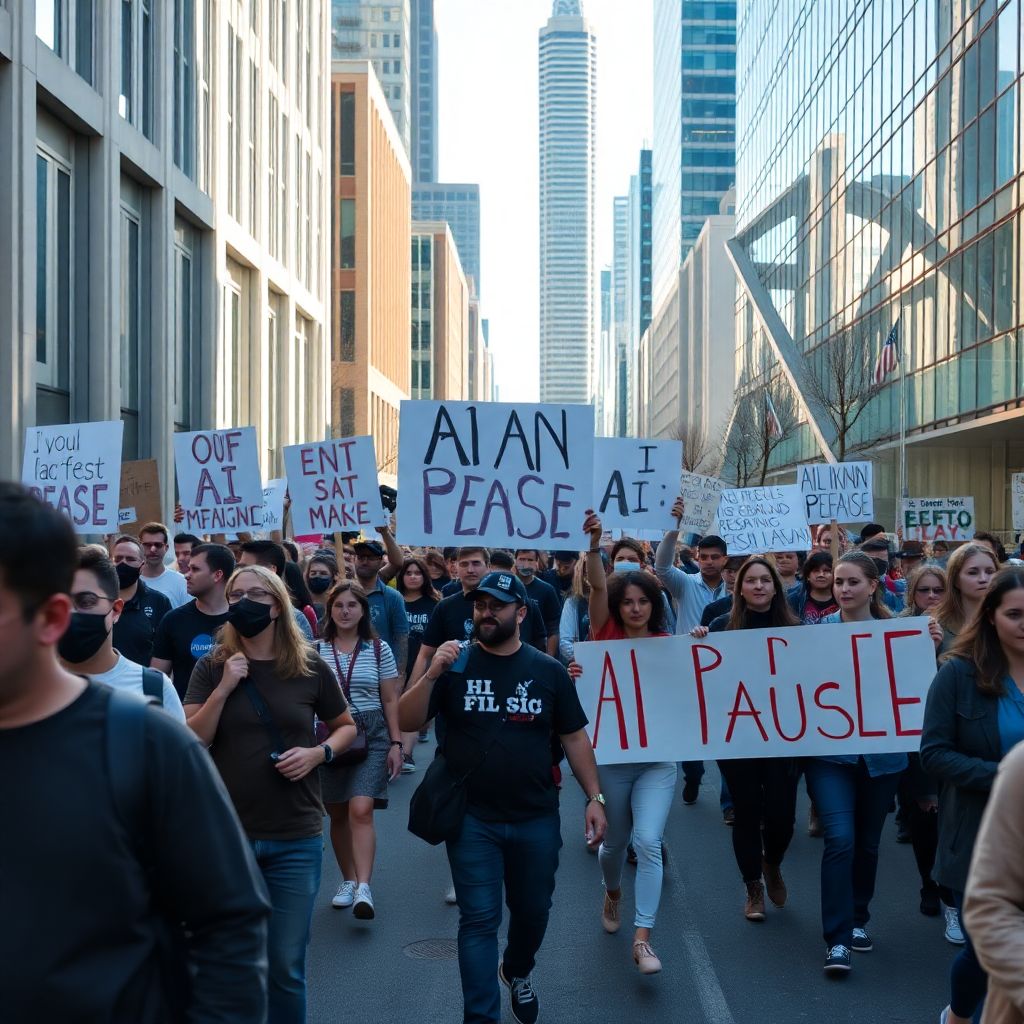
Protesters converged on San Francisco’s tech corridor over the weekend, marching between the offices of OpenAI, Anthropic, and Google DeepMind to demand a halt to the race toward ever more powerful artificial intelligence systems. Around 200 people joined the demonstration, calling for a pause on training so‑called “frontier” AI models and for a fundamental shift in how the technology is being developed and deployed.
The march, coordinated by the group Stop the AI Race and led by former AI researcher Michaël Trazzi, was designed to send a message directly to the companies seen as sitting at the cutting edge of AI progress. Rather than calling for AI to be dismantled altogether, organizers insisted that existing systems should remain online, while work on even more capable models should be frozen until more robust safety frameworks and regulations are in place.
Participants carried signs warning of existential risks, mass job displacement, and ecological damage tied to large‑scale AI systems. Their main demand was that OpenAI, Anthropic, and Google DeepMind temporarily halt the training of new, more advanced models and instead focus their R&D on safety, alignment, and governance. In other words, protesters argued that the industry should prioritize making current tools reliably safe and controllable before pushing for the next big performance leap.
While AI safety was a central theme, the demonstration broadened into a critique of the social and economic fallout of the current technology boom. Marchers voiced anxiety about the possibility that generative AI could automate a significant share of white‑collar jobs, from software engineering and design to marketing, legal work, and content creation. Several banners underscored fears that companies are moving ahead with automation plans far faster than governments can adapt welfare systems, worker retraining programs, or labor protections.
Environmental concerns added another layer to the protest. Large AI models require enormous computing power both to train and to operate at scale, consuming vast amounts of electricity and, in many cases, water for data center cooling. Demonstrators argued that in an era of intensifying climate crisis, pouring energy and resources into training ever-larger models-often for marginal performance gains-cannot be justified without strong evidence that the social benefits outweigh the ecological costs.
The choice of San Francisco as the protest site was deliberate. The city has long been shaped by waves of tech-driven wealth, and this AI boom is being felt in the housing market and the broader cost of living. Protesters linked the rapid expansion of AI firms and well‑funded startups to rising rents and real estate prices, arguing that the economic upside of AI is being concentrated among investors and highly paid engineers, while ordinary residents and service workers face growing financial pressure.
Another recurring theme was the concentration of power in the hands of a few dominant AI labs. Marchers criticized the fact that a small number of private companies are effectively charting the course of a technology that could transform economies, media, politics, and culture worldwide. They warned that without public oversight, this concentration could entrench corporate control over critical digital infrastructure, from AI copilots and chatbots to recommendation systems and productivity tools.
The group’s call for a pause echoes a broader debate that has been unfolding in academic, policy, and industry circles. Over the past two years, a growing cohort of researchers and public figures has argued that the pace of AI development is outstripping the field’s ability to ensure safety, transparency, and accountability. The San Francisco protest gave that argument a visible, street‑level expression, turning what can seem like an abstract, technical discussion into a concrete public demand.
At the core of the protesters’ platform is the concept of “alignment” – ensuring that powerful AI systems act in accordance with human values, legal norms, and democratically chosen objectives. Protesters urged major labs to redirect substantial resources from capability gains to alignment research: improving interpretability, robustness, controllability, and safeguards against misuse. In practice, this could mean slowing down the race to build models that are bigger and stronger, and instead rigorously stress‑testing existing systems for unexpected behaviors and vulnerabilities.
The march also drew attention to the gap between voluntary industry commitments and legally binding rules. While leading AI companies have announced internal safety protocols and published policy statements about responsible development, protesters argued that self‑regulation is inadequate when commercial and competitive pressures push constantly toward faster releases and more advanced systems. They called for national governments and international bodies to set concrete limits on model size, training runs, and deployment practices, particularly for systems that can generate code, persuasive text, or realistic images at scale.
Beyond high‑level policy questions, some participants focused on immediate workplace impacts. Creative professionals, translators, writers, and designers voiced concern that generative AI tools are already undercutting their income and bargaining power. Protesters stressed that, without robust labor protections, AI could accelerate a trend toward precarious gig work, weakened unions, and downward pressure on wages, even as productivity and corporate profits rise.
Others highlighted the risks of deploying powerful AI in security‑sensitive contexts. As models grow more capable, they may assist with tasks such as writing malware, designing biological threats, or orchestrating sophisticated social engineering attacks. Protesters argued that the push to monetize AI as quickly as possible has overshadowed the need for strict guardrails that prevent these tools from being repurposed for harmful or criminal use.
Supporters of rapid AI progress often counter that slowing development could mean falling behind in global competition or missing out on life‑saving innovations in medicine, climate science, and education. Protesters did not dismiss these potential benefits, but contended that meaningful gains require trust, legitimacy, and public buy‑in. They argued that pausing frontier training now does not mean halting useful applications altogether; instead, it means consolidating what already exists and ensuring it can be governed safely before taking the next leap.
The demonstration also showcased the diversity of people concerned about AI’s trajectory. Alongside technologists and former industry insiders were climate activists, labor advocates, students, and longtime residents frustrated with the direction of the city’s economy. Their shared message was that decisions about how powerful AI systems are built, tested, and deployed should not be left solely to a handful of CEOs, investors, and research leaders.
In practical terms, the protesters’ demands coalesced around several actions: an immediate moratorium on training new state‑of‑the‑art models; a large increase in funding and staffing for independent oversight and auditing; mandatory transparency around training data, energy usage, and safety evaluations; and stronger legal frameworks for accountability when AI systems cause harm. They also urged companies to engage more seriously with civil society organizations, labor groups, and local communities affected by the tech industry’s expansion.
Whether demonstrations like this shift corporate behavior remains uncertain. Major AI labs continue to invest heavily in next‑generation systems, and many executives argue that strong internal safety teams and external partnerships are sufficient to manage risks while innovation continues. Yet the march in San Francisco added to mounting public pressure, signaling that concerns about AI’s direction are no longer confined to academic white papers or closed‑door policy meetings.
For now, the protest serves as a visible marker of a growing rift over how fast AI should advance and who gets to decide that pace. On one side are companies and investors pushing aggressive timelines for new capabilities; on the other, an emerging movement insisting that democratic oversight, worker protections, and environmental limits must come first. The streets between OpenAI, Anthropic, and Google DeepMind became the latest arena where that conflict played out in public – and organizers made clear they intend to keep it there until their calls for an AI development pause are taken seriously.