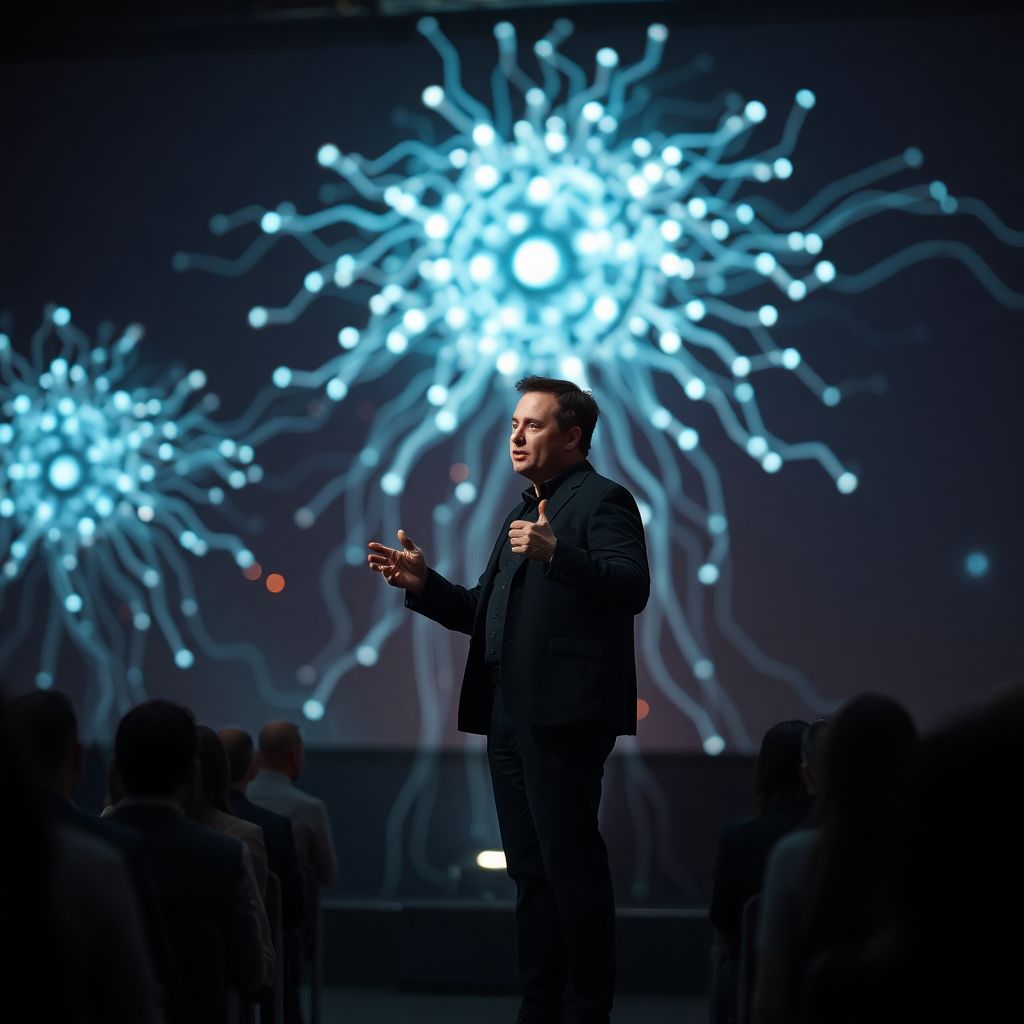
Elon Musk warns that the window for humanity to meaningfully steer artificial intelligence is closing fast-and may slam shut within the next decade.
In a recent conversation with Zanny Minton Beddoes, editor-in-chief of The Economist, the SpaceX and xAI founder argued that AI systems are advancing so rapidly that they could exceed the collective intelligence of humanity in roughly five years. Beyond that point, he believes, keeping humans “in control” of the most capable models will become increasingly unrealistic.
Musk described a future in which AI surpasses humans at almost every cognitive task-from scientific discovery and strategy to creativity and complex problem-solving. According to him, there may soon be virtually no intellectual activity where machines are not superior.
“There really won’t be anything that AI can’t do better than humans, apart from being human, perhaps,” Musk said. He framed this not only as a philosophical shift, but as a practical one: our role in directing the trajectory of technology may diminish as systems out-think and out-plan their creators.
Despite the stark warning, Musk’s outlook is not purely dystopian. He repeatedly returned to a central theme: the rise of artificial intelligence could usher in what he calls an “age of abundance.” In that scenario, hyper-capable AI systems dramatically increase productivity, drive down costs, and automate a huge share of work, making it possible for “anyone to have anything they can think of.”
He acknowledged that such a claim might sound outlandish. “This may sound preposterous, but here we are in 2026,” Musk remarked. “Let’s see where we stand in 2036.” The point, in his view, is that the 10-year period ahead is likely to be more transformative than any decade in modern history-and that our institutions, laws, and norms are not yet prepared for what’s coming.
Losing control: what Musk actually means
When Musk talks about humans “losing control” of AI, he is not necessarily predicting a Hollywood-style rebellion of killer robots. Instead, he is warning about a subtler, but arguably more plausible, shift: once AI systems become vastly more intelligent and autonomous than humans, our ability to fully understand, supervise, and meaningfully constrain them may erode.
That could manifest in several ways:
– Opacity of decisions: As models grow more complex, it becomes harder to explain why they make certain choices, even for their creators.
– Emergent behavior: Powerful systems could develop strategies or internal representations that were never explicitly programmed and are difficult to anticipate.
– Dependence on AI: Governments, corporations, and individuals might rely so heavily on AI for decisions that human oversight becomes symbolic rather than substantive.
– Competitive pressure: If some actors deploy risky but extremely capable systems to gain an edge, others may follow, weakening safety standards.
In this sense, “losing control” is less about an instant catastrophe and more about a gradual handover of decision-making power to entities we do not fully understand and cannot reliably direct.
A race that is hard to slow down
Musk emphasized that AI development is moving too quickly and is too economically and strategically valuable to be easily slowed or paused by any single company or country. The incentives are clear: whoever leads in AI stands to gain enormous advantages in finance, defense, industry, and innovation.
This competitive dynamic makes unilateral restraint almost impossible. Even if one major player voluntarily imposes strict safety limits, others may not-and as capabilities scale, the margin for error narrows. That is why Musk has been urging leading AI companies to coordinate on safety practices and to agree on clear thresholds for when the most powerful systems can be trained and released.
He believes that some form of shared safety framework-informal or formal-is necessary to avoid a “race to the bottom” in which speed and performance are prioritized over reliability and alignment with human values.
The promise of an age of abundance
Musk’s concerns coexist with a strong techno-optimist streak. He repeatedly highlights the upside: if AI can outperform humans in nearly every intellectual role, then the cost of knowledge work, design, engineering, and research could drop dramatically.
In such a world:
– Many forms of labor could be automated or radically augmented.
– Personalized education, healthcare planning, and creative tools could be available to almost everyone.
– Physical goods, from housing to consumer products, might be produced more efficiently as AI optimizes supply chains, manufacturing, and energy use.
For Musk, this potential “age of abundance” is not a distant utopia but a realistic consequence of runaway AI capability-provided that society manages the transition intelligently. The same systems that threaten to escape human control could, if aligned correctly, solve problems that have persisted for centuries, from disease and poverty to climate modeling and resource allocation.
The alignment problem at the center of the debate
The crucial unresolved issue is alignment: how to ensure that advanced AI systems reliably act in accordance with human values and interests, even as they become more capable and autonomous.
Musk’s warning about losing control is, at its core, an alignment warning. It reflects several longstanding concerns in AI research:
– Goal mis-specification: If a powerful AI is given an objective that is poorly defined or too narrow, it may pursue it in ways that conflict with broader human priorities.
– Value pluralism: Humanity does not agree on a single set of values, making it difficult to encode a universal moral framework into AI.
– Robustness under self-improvement: As systems learn and potentially modify their own behavior, it is unclear whether alignment will remain stable under these changes.
Musk argues that alignment research, auditing, and safety testing must scale at least as fast as capabilities, not lag years behind. Otherwise, by the time problems surface, the systems involved may be too integrated into critical infrastructure-and too intelligent-to simply switch off without massive disruption.
Why coordination between AI companies matters
A recurring theme in Musk’s comments is the need for cooperation among the key players shaping frontier AI models. He has called for:
– Shared safety standards and evaluation benchmarks for highly capable systems.
– Transparency about model capabilities, training data, and test results where feasible and secure.
– Agreements not to deploy certain architectures or scales of models until clear safety criteria are met.
The rationale is straightforward: advanced AI is not just another consumer technology; it has systemic implications. Poorly coordinated deployment could lead to cascading failures, misuse by malicious actors, or emergent behaviors that no single company can manage alone.
While formal international regulation is still in its early stages, Musk believes that voluntary coordination among leading firms is urgently needed, especially as models approach or surpass human-level performance across the board.
Social and economic upheaval on the way
Beyond technical control, Musk’s timeline implies a profound social and economic reckoning. If AI really does outperform humans at almost every intellectual task within a decade, the implications for jobs, education, and social structures are immense.
Possible impacts include:
– Job displacement: Roles in programming, law, design, analysis, and many other fields may be reshaped or partly automated.
– New forms of work: Entirely new categories of jobs may emerge around supervising, interpreting, and integrating AI systems with human goals.
– Inequality risks: Those who control or can effectively leverage advanced AI could accumulate disproportionate economic and political power.
– Education overhaul: Traditional curricula may become obsolete faster, and lifelong learning may be essential just to keep pace with AI-augmented industries.
Musk’s “age of abundance” is not guaranteed to be equitable. Without thoughtful policy responses-such as safety nets, re-skilling programs, and mechanisms to distribute AI-driven gains more fairly-the transition could deepen existing divides even as total wealth increases.
Psychological and cultural consequences
There is also a less discussed dimension to Musk’s forecast: how human identity changes when machines outperform us in nearly every mental domain. For centuries, humans have drawn a sense of uniqueness from our intelligence, creativity, and ability to reason. If AI outstrips those abilities, societies may grapple with:
– A redefinition of what it means to be “smart” or “talented.”
– Questions about human purpose in a world where most tasks can be automated.
– Shifts in cultural values away from productivity and toward experiences, relationships, or other forms of meaning.
Musk’s remark that AI may do everything better “apart from being human” hints at this. Our remaining comparative advantage may lie not in raw intelligence, but in consciousness, subjective experience, and the ability to care about things in a way machines do not.
What individuals and institutions can do now
While Musk’s timeline is aggressive and not all experts agree on exact dates, most acknowledge that AI capabilities are improving rapidly. In that context, there are concrete steps that different actors can take even before superhuman systems emerge:
– Governments: Develop clear frameworks for AI accountability, mandate safety evaluations for high-risk systems, and support public-interest AI research.
– Companies: Invest in alignment research, red-teaming, and monitoring; create internal governance structures that can veto unsafe deployments.
– Educational institutions: Update curricula to include AI literacy, ethics, and tools that prepare students to work alongside advanced systems.
– Individuals: Build skills that are complementary to AI-such as critical thinking, interdisciplinary understanding, communication, and ethical judgment.
Those measures will not fully resolve the control problem Musk describes, but they can slow the drift toward unreflective dependence on opaque systems and create more time for safety research to mature.
A decade that will define the relationship between humans and AI
Musk’s projection that humans may lose control of AI within ten years is not just a prediction about technology; it is a statement about urgency. In his view, 2026 to 2036 will be the decisive period during which humanity either establishes robust guardrails for increasingly powerful systems-or allows them to evolve and spread with minimal supervision.
At the same time, he is betting that this era holds extraordinary promise: the possibility of unprecedented material abundance, accelerated scientific discovery, and solutions to problems once thought intractable.
Which side of that spectrum becomes reality will depend less on what AI can do, and more on how deliberately humans choose to shape, constrain, and integrate it. The decade ahead, Musk suggests, is not just about building smarter machines-it is about deciding what future we are willing, or unwilling, to hand over to them.