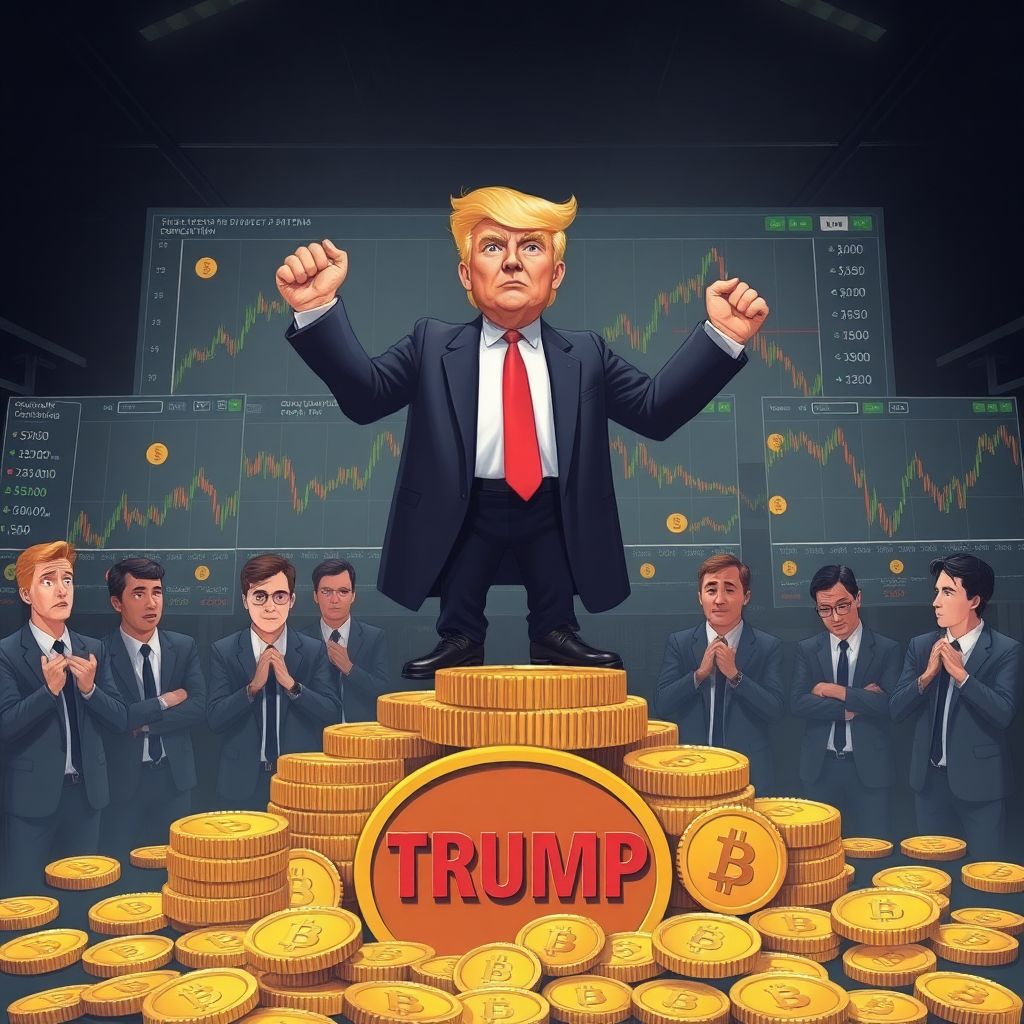
Trump’s branded TRUMP memecoin has delivered a staggering windfall for the former president while inflicting heavy losses on much of its investor base, according to new blockchain analysis and his latest financial disclosures.
Data from analytics firm Nansen, cited in recent reporting, shows that 988,905 wallets that purchased the Official Trump (TRUMP) token had, by the end of June, collectively lost about $3.81 billion. That figure includes both realized losses from investors who sold at a loss and unrealized, or “paper,” losses from holders who are still clinging to their tokens.
Trump, by contrast, reported a personal payout of roughly $636 million from the memecoin in his 2025 financial disclosure. The filing also revealed at least $1.4 billion in crypto-related income tied to the same ecosystem, largely through licensing arrangements connected to TRUMP and token sales conducted by Trump-backed World Liberty Financial (WLFI).
The economic structure of the project helped insulate Trump from the volatility that battered most retail buyers. While everyday investors were exposed directly to the token’s price swings, the business entities tied to Trump reportedly earned money from trading activity itself – transaction fees, licensing, and associated revenue streams – regardless of whether the coin’s price was climbing or collapsing.
In the early days following launch, Trump actively promoted the TRUMP token on Truth Social, portraying it as a way for his supporters to participate in his movement. The token was introduced three days before his January inauguration and was framed as a community-building tool. That marketing push contributed to a rapid surge in trading volume and price, followed by an equally sharp reversal.
At its peak, TRUMP traded at an all‑time high of $75.35. By the Friday referenced in Nansen’s analysis, the price had sunk to about $1.76 – a collapse of roughly 97% from its top. This dramatic reversal mirrors the pattern seen in many memecoins, where early entrants and sophisticated traders capture outsized gains while latecomers absorb the bulk of the downside.
Nansen’s wallet-level breakdown underscores this imbalance. Roughly two out of every three wallets that bought TRUMP are now sitting on losses. Fewer than 500,000 wallets collectively generated about $4 billion in profits, with most of those gains concentrated among early buyers and algorithmic or professional traders who moved in quickly and exited into surging retail demand.
According to the analysis, these automated traders and experienced crypto market participants are adept at exploiting the extreme volatility typical of memecoins. They tend to accumulate tokens at launch or before major promotional bursts, then offload their positions as public interest peaks. The result is a familiar transfer of wealth: profits concentrate in a small, well-positioned group, while a much larger pool of late-arriving buyers sees its capital erode.
Individual stories highlight the human cost behind the aggregate numbers. One investor, Nicholas Pinto, said he put approximately $500,000 into TRUMP after backing Trump in the 2024 election, only to watch about half of that value evaporate. He argued that Trump’s public embrace of the project helped create a sense of security and legitimacy among supporters and went so far as to characterize the venture as “almost a legal scam.”
The political response has been swift and polarized. A White House spokeswoman, Anna Kelly, defended Trump’s record and positioning, saying he had turned the United States into the “crypto capital of the world” and insisting that his actions in the sector were taken in the interests of the American people. Supporters frame his involvement as entrepreneurial and pro‑innovation; critics say it blurs ethical lines and exploits loyal followers who lack financial sophistication.
Trump himself, in a recent television interview, claimed he was unaware that his crypto ventures had generated at least $1.4 billion in income, suggesting he could easily find out the precise figures if he cared to. He dismissed any suggestion of wrongdoing, arguing there was nothing improper about making money from digital assets and signaling that he had no intention of distancing himself or his family from their crypto-related businesses.
World Liberty Financial, a Trump‑aligned crypto platform involved in token sales, has shown a similar pattern of retail pain and concentrated gains. Nansen tracked 26,663 WLFI wallets and found that 85% of them were underwater, with combined losses of roughly $83 million compared with around $23 million in profits. The firm also emphasized that the true scale of losses is likely higher, as many secondary-market trades on centralized exchanges cannot be fully observed on public blockchains.
These revelations have fed directly into an intensifying policy fight in Washington. Senator Kirsten Gillibrand has renewed calls for stricter ethics rules that would bar government officials and their spouses from creating or promoting memecoins or other highly speculative crypto products while in office. Her position is being folded into broader negotiations over the proposed CLARITY Act, which aims to define regulatory boundaries for digital assets.
Legislators are not limiting their focus to memecoins alone. Ongoing Senate discussions are also probing topics such as yields offered by stablecoin platforms, anti-money laundering requirements in crypto markets, and new ethics provisions covering public officials’ involvement in digital asset ventures. Together, these debates reflect mounting concern that the current system allows policymakers to profit from opaque, high‑risk financial innovations while ordinary investors shoulder disproportionate risk.
The TRUMP token saga illustrates several defining traits of the memecoin phenomenon. Unlike cryptocurrencies designed to power specific technological use cases, memecoins typically derive value from branding, community sentiment, and speculation. When a high‑profile figure like Trump attaches his name and image to such a project, the marketing power is enormous – but so is the potential for misaligned incentives. The sponsor can benefit from hype and transaction revenue, while late‑stage buyers effectively bet on continued enthusiasm that may be impossible to sustain.
For retail traders, the experience underscores how deceptive surface metrics can be. A soaring price chart, celebrity endorsement, and high social‑media visibility can create the illusion of stability or inevitability. Yet wallet‑level data often reveals a highly skewed distribution of outcomes, with a small minority of addresses realizing outsized profits and a vast majority recording losses. It is a textbook example of why transparency around tokenomics, fee structures, and insider allocations matters.
The Trump memecoin case also raises questions about informed consent and financial literacy. Many supporters likely approached TRUMP not purely as a speculative instrument, but as a way to “support” a political figure they admired. That blending of political loyalty and investment decision-making can distort risk assessment: buyers may downplay warnings, ignore red flags, or hold through steep drawdowns in the belief that the figurehead would not allow a project carrying his name to implode.
From a legal standpoint, projects like TRUMP and WLFI sit at the intersection of securities regulation, consumer protection, and political ethics. Regulators will have to determine whether such tokens fall under existing securities laws, how to treat revenue-sharing or licensing structures involving public figures, and what disclosures are necessary to prevent misleading marketing. Lawmakers are simultaneously weighing whether sitting officials should face stricter boundaries on their ability to profit from markets they may influence indirectly through policy.
For investors, the main lesson is the importance of differentiating between brand and value. A token can be wrapped in the imagery and rhetoric of a powerful public figure yet still operate like any other speculative asset: subject to boom‑and‑bust cycles, liquidity squeezes, and sophisticated trading strategies designed to extract value from less experienced participants. Attachment to a personality does not automatically translate into sustainable economics or price support.
The story also highlights why wallet‑level blockchain analysis is becoming central to evaluating crypto projects. Aggregate market caps and trading volumes can obscure who is actually winning and losing. Detailed on‑chain breakdowns, like those provided by Nansen, show whether profits are distributed broadly or captured by a narrow slice of early insiders and algorithmic traders. In the TRUMP case, the imbalance between Trump’s $636 million payout and the $3.81 billion in buyer losses is stark.
Finally, the broader implication is that political branding is entering a new financial era. Campaigns and public figures are increasingly experimenting with tokens, NFTs, and other digital products to mobilize supporters and raise capital. Without clearer rules and better investor education, these experiments can easily cross the line from fan engagement into wealth transfer schemes where enthusiasm and trust are monetized at the expense of those least equipped to bear the loss.
Trump’s TRUMP memecoin encapsulates this tension: a project marketed as a way to join a movement, yet ultimately functioning as a high‑risk trading instrument that delivered enormous gains to its namesake and a small group of savvy participants, while leaving hundreds of thousands of wallets deeply in the red. As regulators, lawmakers, and voters digest the numbers, the outcome is likely to shape not only crypto policy but also how future leaders are allowed to monetize their political brands in digital markets.