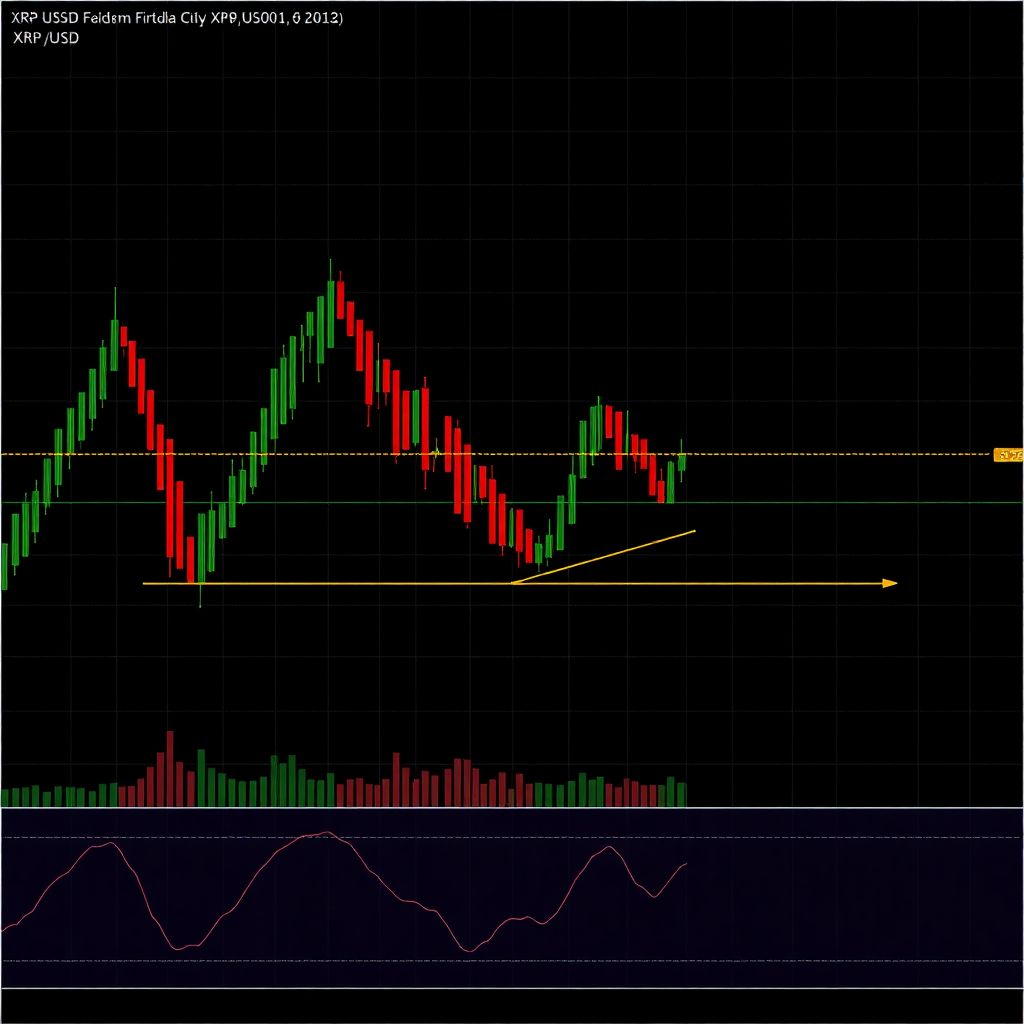
XRP Reversal Setup Emerges Around Harmonic Pattern And Major Support Cluster
XRP is approaching a crossroads that could determine its next significant price leg, as a confluence of technical factors is forming a potential reversal setup. According to a recent TradingView analysis by The_Alchemist_Trader_, the XRP/USD pair is currently sitting on a key support area reinforced by both Fibonacci levels and volume profile dynamics.
At the core of this setup is the 0.618 Fibonacci retracement level of the latest impulse move. This ratio, often referred to as the “golden” level, is closely watched by technical traders as a classic zone where exhausted downtrends can stabilize and reverse. On its own, a 0.618 retracement is enough to attract bargain hunters who are waiting for a deeper pullback before entering long positions.
Layered on top of this Fibonacci level is the point of control (POC) for the existing trading range. The POC marks the price area where the highest amount of trading volume has taken place over a given period. Markets naturally gravitate toward such high-volume nodes because they represent zones where both buyers and sellers previously agreed on value. When a POC aligns with a major Fibonacci level, the resulting area becomes a particularly important technical battleground.
This combination of factors creates what many traders call a “confluence zone” – a price area where multiple independent tools point to the same level as significant. Confluence matters because it can amplify the psychological impact of support or resistance. Instead of one indicator suggesting buyers might step in, several are doing so at the same time. This often translates into higher participation when price tags the level, leading to stronger reactions – either as sharp bounces or decisive breakdowns.
Overlaying this confluence is a developing harmonic pattern that appears to be nearing completion. Harmonic patterns are precise geometric price structures based on Fibonacci ratios, designed to highlight potential reversal points. While they are not guarantees of a trend change, they provide a framework for traders to define invalidation levels, risk boundaries, and projected targets with relatively tight parameters.
In the current XRP context, the harmonic layout implies that price is testing the potential “completion zone” of the pattern. If the structure holds, it would suggest that this region could serve as the origin of a new bullish leg or at least a meaningful corrective rally. If it fails, the pattern is invalidated, and the bearish momentum is likely to extend as trapped longs unwind their positions.
The key issue now is not just whether XRP respects support, but how it reacts from it. A mere intraday spike off the level, leaving behind a long wick, is not enough by itself to support the bullish thesis. What traders want to see is a sustained, impulsive reaction: higher time frame candles closing well above the support, increasing volume on the bounce, and a clear shift in market structure from lower lows to higher lows.
A convincing rebound would likely require XRP to reclaim nearby resistance zones that have recently acted as supply. If price can push back above short-term resistance and then use that former ceiling as support on a retest, it would strengthen the case that a genuine reversal is forming rather than a simple relief rally. The longer XRP can hold above this reclaimed area, the more credible the bullish narrative becomes.
On the flip side, repeated taps of the same support level without a strong follow-through often signal weakening demand. If price continues to grind along the confluence zone, with each bounce becoming weaker, the risk of a breakdown grows. A decisive close below the 0.618 Fibonacci support and the point of control would undermine the harmonic pattern and suggest that sellers remain firmly in control.
This is why the current structure is best treated as a setup, not a foregone conclusion. The technical ingredients for a reversal are present: confluence of major levels, a developing harmonic pattern, and a clear invalidation area below. However, until price confirms with a strong reaction and a change in trend behavior, it remains only a possibility. Traders watching XRP at this stage are essentially waiting for the market to reveal whether this zone will become a springboard or a trap.
From a risk management perspective, setups like this highlight the importance of planning entries and exits in advance. For bullish traders, the confluence zone may be attractive as a defined-risk area: stops can be placed just below invalidation, while potential upside targets are derived from the harmonic pattern and previous resistance structures. For more conservative participants, waiting for confirmation – such as a break above local resistance or a higher low on the daily chart – can reduce the risk of catching a falling knife, albeit at the cost of a less favorable entry price.
It is also important to recognize the broader context around XRP. The asset has historically been prone to extended consolidation phases followed by sharp, directional moves. This behavior can make levels of confluence even more important, because once a range resolves, price often travels quickly to the next significant liquidity zone. If this current support holds, the next natural magnet could be the mid-range or upper boundary of the existing consolidation. If it fails, the market may seek out a deeper historical support area where previous accumulation took place.
For short-term traders, intraday behavior around this support will be crucial. Signs of absorption – where large buying volume appears as price approaches the level, slowing or halting the decline – can hint that bigger players are defending the area. Conversely, if each bounce is met with aggressive selling and volume spikes on down moves rather than up moves, that may foreshadow a breakdown. Monitoring volume, order flow (where available), and candlestick structure around the zone can help refine timing.
Swing traders and position traders will likely focus more on the daily and weekly charts. A strong weekly close above the confluence area, especially if it follows a brief undercut or “fake-out” below support, can often mark a meaningful low. In contrast, a clean weekly close below support usually confirms that the prior structure has failed and that the market is repricing lower, often triggering stops and forced selling.
The behavior of the broader crypto market can also influence how this setup resolves. If Bitcoin and large-cap altcoins are under heavy pressure, even strong technical areas on individual charts may break more easily as correlation drives flows. Conversely, a supportive macro backdrop – such as Bitcoin stabilizing at its own key support – can increase the odds that buyers step in across the board, including on XRP.
Another factor for traders to consider is sentiment. Extended downtrends tend to generate pessimism and fatigue, which can make reversals from strong support zones more violent when they finally occur. Many market participants give up near the end of a decline, just as value-oriented traders and technically focused buyers begin to step in. If sentiment around XRP is particularly negative while technical confluence is building, it can create the conditions for a sharp short-covering rally once price starts to move in the opposite direction.
For those using harmonic patterns specifically, strict adherence to rules is essential. These patterns rely on specific Fibonacci ratios between swings; if price overshoots or fails to meet the required measurements, the setup loses reliability. Traders often combine harmonics with additional tools like relative strength indicators, momentum oscillators, or moving averages to filter out weak patterns and focus on the highest probability environments.
Ultimately, the current XRP structure is a textbook example of how multiple technical tools can converge to outline a decisive zone. The confluence of the 0.618 Fibonacci retracement and the point of control creates a logical area for bulls to defend. The harmonic pattern adds a structured reversal framework with clear invalidation. But the crucial missing piece is confirmation from price action, which will determine whether this becomes a significant turning point or merely a pause before the next leg down.
Until that confirmation arrives, traders may treat this level as a focal point for planning different scenarios rather than making bold predictions. If strong buyers emerge, the setup could mark the beginning of a more constructive phase for XRP. If they do not, the same zone will instead serve as a marker of where the market’s attempt to base ultimately failed, paving the way for lower prices and a new search for support further down the chart.