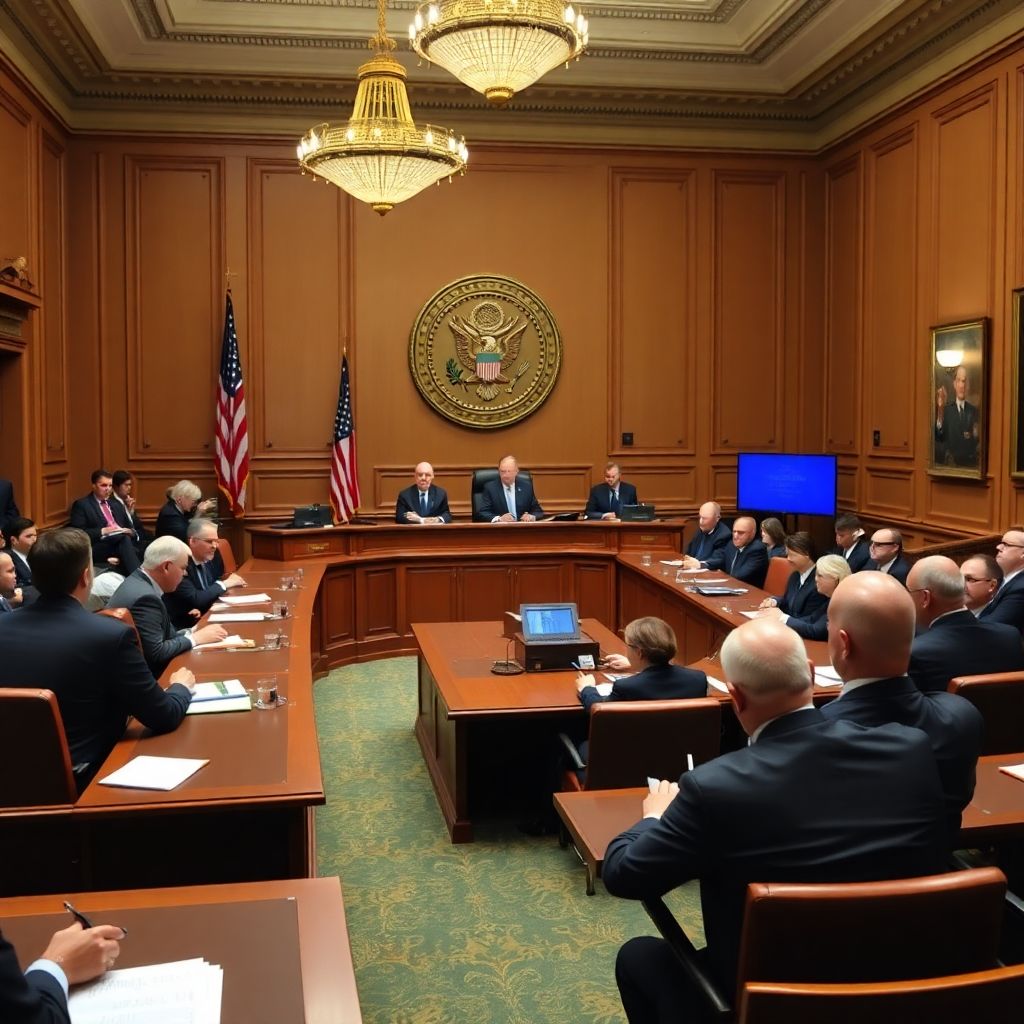
US lawmakers push for nationwide task force to combat crypto crime
US lawmakers are backing a new federal task force aimed at tackling cryptocurrency theft, fraud and hacking, in response to surging digital-asset crime and billions of dollars in reported losses.
The proposal, introduced in Congress as the Federal Cryptocurrency Theft Enforcement and Coordination Act, would create a centralized structure for reporting and investigating crypto-related offenses. If enacted, it would knit together the efforts of multiple federal agencies and offer victims a single, clearly defined channel for seeking help.
The task force would be headed by the U.S. attorney general and draw officials from the Department of Justice, the FBI, the Department of Homeland Security and the Treasury Department. Lawmakers argue that this kind of interagency hub is necessary because existing enforcement efforts are scattered, leaving both investigators and victims to navigate a confusing maze of overlapping jurisdictions.
The legislative push comes after an especially damaging year for crypto users in the United States. The FBI’s 2025 Internet Crime Report documented 181,565 cryptocurrency-related complaints, with reported losses topping $11.3 billion. That figure represents a sharp escalation from the prior year, underscoring how quickly digital-asset crime has grown in scale and sophistication.
Investment fraud accounted for the largest share of those losses. According to the FBI, crypto investment scams alone generated around $7.2 billion in damages in 2025. These schemes often promise unrealistic returns, exploit social media and messaging apps, and increasingly mimic legitimate investment platforms, making them difficult for ordinary users to detect.
The volume of complaints rose as well. The FBI recorded a 21% increase in crypto-related reports year-on-year, suggesting that scammers are both finding more victims and extracting more money from each scheme. Officials warn that these figures likely understate the problem, as many victims never report their losses due to embarrassment, confusion or the belief that nothing can be done.
Older Americans have suffered some of the worst damage. Individuals aged 60 and above filed 44,555 crypto-related complaints in 2025, more than any other age bracket. The FBI estimates that this group lost around $4.43 billion through scams, ranging from fake tech-support calls and romance scams to fraudulent investment opportunities and imposter schemes invoking law enforcement or government agencies.
At the same time, blockchain analytics company TRM Labs has flagged a sharp rise in flows to wallets linked with illegal activity. The firm estimates that addresses associated with criminal behavior received around $158 billion worth of cryptocurrency in 2025, up from $64.5 billion in 2024. That jump highlights how digital assets are being used across a wide range of illicit operations, from ransomware and darknet markets to cross-border money laundering.
The new bill is spearheaded by Representative Lance Gooden and Representative Josh Gottheimer, who are presenting it as a bipartisan response to a growing public safety and consumer protection issue. They contend that victims today have no obvious entry point when they fall prey to crypto scams: local police may lack expertise, federal agencies are fragmented, and reporting portals are confusing or inconsistent.
Gooden has argued that the country needs a unified, national strategy to confront crypto-enabled crime. In his view, the current patchwork of authorities and programs allows criminals to exploit gaps in coordination, while victims often do not know which agency to contact or what steps to take after losing funds.
Under the proposed framework, the new task force would be responsible for organizing joint investigations across participating agencies, minimizing duplication and closing jurisdictional loopholes. It would work to streamline evidence collection, share intelligence in real time and prioritize large-scale or cross-border operations where cooperation is essential.
Another central function would be developing standardized guidance for state and local law enforcement. Many local departments lack specialized knowledge of blockchain tracing, wallet analysis or crypto exchange procedures. The task force would be expected to produce training materials, best-practice manuals and protocols for handling crypto-related cases-from seizing digital assets and preserving evidence to engaging with foreign counterparts.
Victim assistance forms a distinct pillar of the legislation. Lawmakers want to establish a clear, centralized reporting pipeline so that individuals and businesses hit by crypto theft or fraud know exactly where to turn. In practice, this could mean a single federal portal or hotline that routes cases to the appropriate agency, while also connecting victims to support services and updates on investigations.
The act arrives against the backdrop of recent shifts in the federal government’s approach to digital-asset enforcement. In 2025, the Department of Justice disbanded the National Cryptocurrency Enforcement Team, a unit that had focused heavily on enforcement actions against crypto industry participants such as exchanges and service providers. The new proposal is consciously framed as a pivot toward targeting criminals and assisting victims rather than primarily policing compliant market players.
Several federal bodies already operate specialized programs in this arena. The FBI’s Operation Level Up, for example, focuses on identifying victims of ongoing scams before they incur catastrophic losses. According to FBI figures, that initiative prevented more than $225.8 million in potential losses during 2025 by interrupting scams in progress and coordinating with financial institutions and exchanges.
The Treasury Department runs its own initiatives through units such as the Scam Center Strike Force, which concentrates on dismantling foreign fraud networks that use crypto rails to move money. Authorities report that this program has seized over $700 million tied to scam operations, often in coordination with overseas partners and private-sector analytics firms.
Industry groups have largely welcomed the push for a dedicated federal task force. Representatives from the Digital Chamber have argued that effective enforcement benefits legitimate businesses by reducing reputational damage and clarifying expectations. They stress that law enforcement agencies need both better tools and specialized training to keep pace with criminals who rapidly adopt new technologies.
Dennis Porter, CEO of the Satoshi Action Fund, has described the bill as an important step toward offering a coherent federal response for both victims and investigators. In his view, clearer structures and lines of communication could accelerate investigations, improve asset recovery rates and make it easier for honest firms to cooperate with authorities without fear of inconsistent treatment.
Before it can become law, the measure must pass through multiple congressional committees, where it may be revised, narrowed or expanded. Lawmakers also have the option of attaching the proposal to a broader legislative package, such as a comprehensive financial-services, cybersecurity or technology bill, during the current session. The political timing and the level of bipartisan support will determine how quickly it moves.
If the task force is ultimately established, one of its first challenges will be balancing aggressive enforcement with the privacy expectations and civil liberties of crypto users. Blockchain analysis can reveal extensive information about transaction patterns, counterparties and financial behavior. Policymakers will have to consider safeguards to prevent overreach, including clear standards for data collection, retention and sharing.
Another open question is how the task force will interact with state regulators and attorney general offices, many of which have launched their own crypto enforcement actions. Coordinating across federal and state lines-while respecting distinct legal authorities-will be critical to avoid duplicative investigations or conflicting guidance to industry participants.
For everyday users and investors, a functioning federal crypto crime task force could have several practical implications. A centralized reporting system might reduce the time it takes to file a complaint and receive a response. Clearer procedures could improve the odds of freezing funds at exchanges or intercepting transfers before they disappear into mixers, high-risk platforms or foreign jurisdictions.
Exchanges, wallet providers and other service platforms may also face new expectations. A more coordinated enforcement framework could lead to standardized requirements for suspicious activity reporting, account freezes, cooperation timelines and customer notification practices. Firms that already maintain robust compliance programs may benefit from having a single, consistent point of federal contact, while those with weaker controls could come under greater scrutiny.
The initiative could also accelerate the professionalization of crypto investigations within law enforcement. With a dedicated task force, there is likely to be more funding for specialist training in blockchain forensics, on-chain intelligence, smart contract analysis and the tracing of assets across multiple chains and privacy tools. This may reduce the current imbalance where sophisticated criminals often outpace under-resourced investigative teams.
On the other hand, some critics may worry that the creation of yet another federal body could lead to overlapping mandates or mission creep, particularly if its remit is not clearly defined. Without careful design, the task force could duplicate efforts that are already underway in agencies like the FBI, the Secret Service or existing Treasury units, rather than simply knitting them together more efficiently.
Comparisons are already being drawn with other jurisdictions that have created centralized crypto enforcement teams. Several countries have formed specialized police units focused on digital-asset fraud, ransomware and online financial crime. U.S. policymakers and advocates are watching those models to understand what works-such as fast asset-freeze procedures and rapid data-sharing protocols-and which pitfalls to avoid.
In the broader debate over crypto regulation, the proposed task force is being framed as an enforcement and consumer-protection measure rather than a direct attempt to redefine the legal status of digital assets. Nonetheless, its work could influence future regulatory decisions by generating data on the scale and nature of crypto-related crime, the effectiveness of existing rules and the areas where new standards may be needed.
Meanwhile, high-profile enforcement actions continue to highlight the stakes. Recent U.S. charges against operators allegedly involved in a $389 million crypto laundering network show how digital assets can be used to move large volumes of illicit funds at speed and across borders. At the same time, major industry players are pressing Congress to refine tax and reporting rules for everyday users, arguing that overbroad requirements risk pushing activity offshore or into less transparent channels.
Taken together, rising losses, the growing sophistication of criminal operations and pressure from both victims and industry have created momentum for a more coherent federal response. Whether the Federal Cryptocurrency Theft Enforcement and Coordination Act becomes law in its current form or after substantial revision, it signals that Washington is moving toward a more structured approach to policing digital-asset crime and supporting those who fall victim to it.