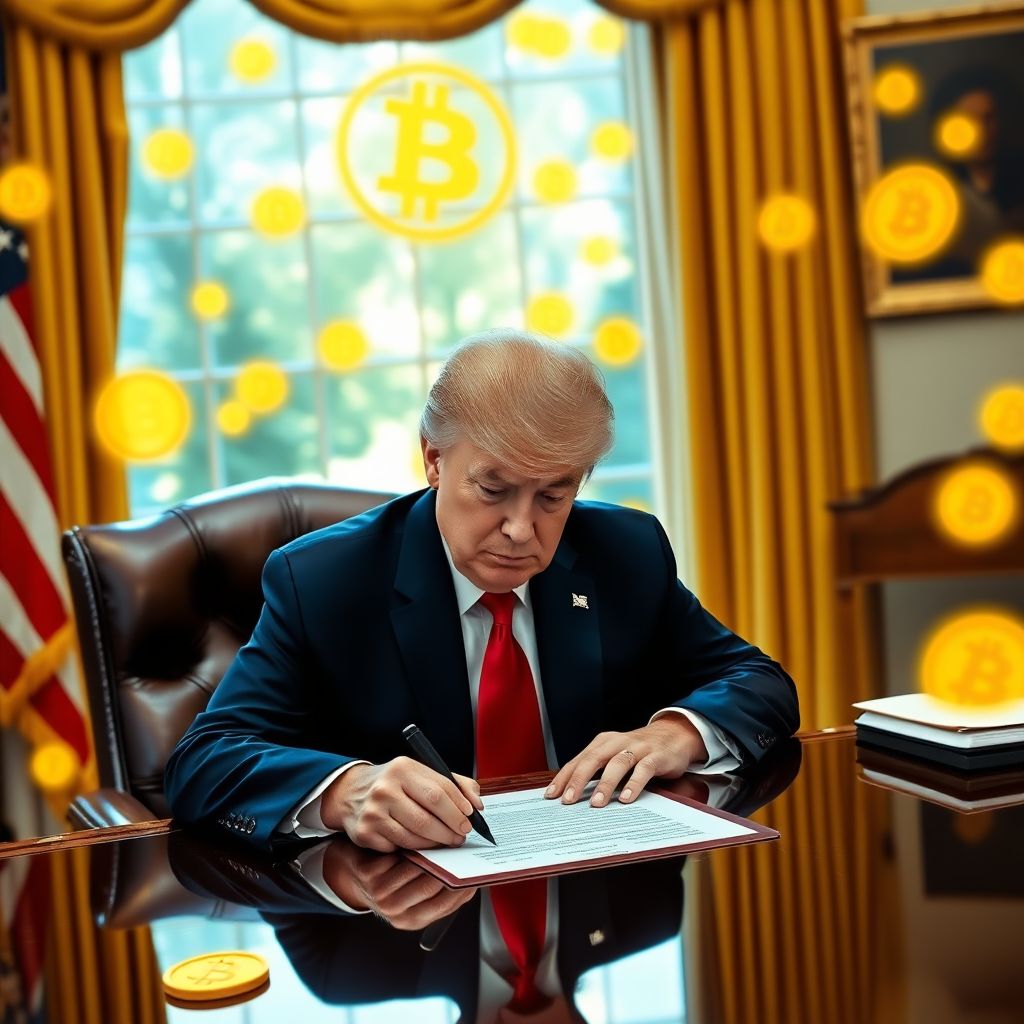
Inside the Strategic Bitcoin Reserve: between ambition and reality
When Donald Trump signed the executive order creating the Strategic Bitcoin Reserve (SBR) on March 6, 2025, supporters framed it as the birth of a “digital Fort Knox.” Fourteen months later, in May 2026, the picture is more complicated: the legal scaffolding is in place, the assets exist, but the program that was sold as a transformational Bitcoin strategy still operates far more as a legal construct than as an active acquisition machine.
At Consensus Miami in May 2026, White House digital asset adviser Patrick Witt tried to reset expectations. He announced that a “major” update on the reserve would arrive “in the next few weeks,” calling the underlying legal and custody work a “breakthrough.” For the first time, the administration publicly disclosed that the government controls roughly 328,372 BTC, valued at about 25.4 billion dollars at current prices.
That disclosure was striking, but it also underscored the core tension: the reserve sounds massive, yet almost all of it is Bitcoin the government already had. There is still no functioning program for buying more.
—
What the executive order actually created
Much early coverage blurred key distinctions, treating the SBR as if it automatically turned the United States into an active Bitcoin accumulator. The text of the order tells a more restrained story.
It established two separate buckets of digital assets:
1. The Strategic Bitcoin Reserve (SBR) – a silo for Bitcoin only. Under the order, these BTC holdings are not to be sold. The design is meant to resemble a strategic, long-term asset pool, more akin to gold reserves than a tradable portfolio.
2. The U.S. Digital Asset Stockpile – a distinct pool for non-Bitcoin cryptocurrencies such as Ethereum, XRP, Solana, Cardano, and other seized or forfeited tokens. Unlike the SBR, these assets can be liquidated. Treasury is explicitly allowed to sell them at its discretion.
This separation matters. While the government can still routinely auction off non-Bitcoin tokens, the Bitcoin held in the SBR is supposed to be locked down. In theory, that signals a strategic shift from “sell seized assets for cash” to “treat Bitcoin as a long‑term strategic resource.”
Equally important is how the SBR is funded. The order states that the reserve is “capitalized with all BTC held by the Department of the Treasury that was finally forfeited” through criminal or civil forfeiture, or as payment for civil money penalties. In practice, that means:
– The SBR is built out of Bitcoin already in government hands.
– No new budget appropriation was created.
– No explicit authorization was granted to go into the open market and buy additional BTC.
Legally, this is a passive reserve, not an active buyer.
The order does invite future policy innovation. It instructs the Secretaries of Treasury and Commerce to develop “strategies for acquiring additional Government BTC, provided that such strategies are budget‑neutral and do not impose incremental costs on United States taxpayers.” The distinction is subtle but critical: agencies were told to *study and design possible mechanisms*, not to *execute* them.
In other words, the executive branch created a container and asked its economic agencies to figure out if there was any way to fill it further without new spending. That is a far cry from a mandate to accumulate one million coins.
—
The audit: from desk drawers to a multimillion‑dollar exploit
The first tangible product of the executive order was not a bold acquisition plan, but an audit. All federal agencies had 30 days-until April 5, 2025-to report every Bitcoin and other digital asset in their possession to Treasury and the President’s Working Group on Digital Asset Markets.
The audit wrapped up on schedule, but the details were not shared with the public until a White House report was released on July 30, 2025. The findings highlighted just how fragmented and ad hoc federal crypto custody had been:
– Some agencies kept hardware wallets in literal desk drawers or file cabinets.
– Access controls were inconsistent, sometimes relying on a single individual.
– Documentation of keys, backups, and chain‑of‑custody records was incomplete or outdated.
The most alarming revelation was a security failure at the U.S. Marshals Service. The report confirmed that in late 2025, more than 60 million dollars’ worth of BTC under Marshals custody had been compromised in an exploit. The episode did more than embarrass one agency; it illustrated the systemic risk of scattered, non‑standardized crypto storage across the federal apparatus.
This context explains why Witt described the new custody architecture as a “breakthrough.” Before the SBR, federal Bitcoin management resembled a patchwork of improvised solutions. The reserve’s behind‑the‑scenes impact has been to push agencies toward professionalized, centralized, and auditable custody.
Operationally, then, the SBR’s first real achievement is housekeeping: discovering what the government actually owns, consolidating it, and locking it down under a unified security framework.
—
The Bo Hines era and its abrupt end
The political messaging around the SBR initially outpaced the underlying legal reality. Former White House crypto adviser Bo Hines became the most visible cheerleader, touting the idea of the United States as a “Bitcoin superpower” and hinting that the reserve would be aggressively expanded.
That rhetoric clashed with the more cautious posture of Treasury. In August 2025, Treasury Secretary Scott Bessent publicly stated that the United States “won’t be buying” additional Bitcoin. The comment directly contradicted the impression that the SBR had turned the federal government into a large‑scale market buyer.
Within the same month, Hines stepped down amid growing scrutiny of the SBR’s structure and messaging. His departure revealed an internal divide:
– One camp framed Bitcoin as a strategic national reserve asset that should be accumulated.
– The other prioritized fiscal conservatism, legal constraints, and market neutrality, resisting the idea of government BTC purchases without explicit congressional authorization.
The Hines episode underscored a broader gap between the political narrative sold to Bitcoin advocates and the cautious, lawyerly design embedded in the executive order.
—
Competing legislative visions: BITCOIN Act vs ARMA
Because the executive order did not fund active purchases, the real battle over the SBR’s future shifted to Congress. Two major bills now define the debate.
1. Senator Cynthia Lummis’s BITCOIN Act
Lummis’s proposal is the most aggressive articulation of the “Bitcoin superpower” vision. The bill would:
– Require the government to acquire 1 million BTC over five years.
– Finance these purchases through a revaluation of the nation’s gold holdings rather than new taxes or deficit spending.
– Cement Bitcoin as a core reserve asset alongside gold.
From a Bitcoin‑centric perspective, this is the dream scenario: a clear statutory mandate to amass an enormous stash of BTC on a defined timeline. From a policy and market‑risk standpoint, it is a radical shift that would:
– Turn the U.S. into the single largest known Bitcoin holder by far.
– Potentially disrupt market dynamics during the accumulation phase.
– Make macroeconomic and foreign‑policy strategy more directly intertwined with Bitcoin’s price cycles.
2. The ARMA bill (Begich-Golden)
Introduced in May 2026 by a Republican-Democrat pair, the ARMA bill adopts a more measured stance. Notably, it:
– Drops the explicit target of acquiring 1 million BTC.
– Focuses instead on formalizing the structure of the SBR and related reserves.
– Adds a 20‑year lockup for certain government Bitcoin holdings.
By removing hard acquisition numbers, ARMA looks less like a Bitcoin accumulation crusade and more like a governance and risk‑management framework. The 20‑year lockup, however, is significant: it would codify a long investment horizon, supporting the idea that at least a portion of government BTC should not be casually liquidated for short‑term budget needs.
With Senate Banking Committee markup of these and related proposals expected by May 31, the legislative pathway is approaching a decision point. The outcome will determine whether the SBR becomes:
– A static container for whatever BTC the government confiscates, or
– A dynamic reserve whose size and role in fiscal strategy are actively managed by statute.
—
What the “breakthrough” announcement is likely to include
Witt’s promise of a looming “breakthrough” announcement has sparked speculation about what, exactly, will change. The constraints of the executive order and the current political balance suggest any near‑term news is more likely to be structural than explosive. Plausible components include:
– Formalization of unified custody
Clear confirmation that all federal Bitcoin holdings-across agencies-are now under a standardized cold‑storage architecture, with multi‑sig controls, formal key‑management procedures, and independent security audits.
– Clarified governance and reporting
A defined chain of responsibility for the SBR, potentially including a recurring public report on holdings, security practices, and any changes resulting from seizures, forfeitures, or legal settlements.
– Prototype acquisition mechanisms
Early‑stage frameworks for budget‑neutral BTC accumulation, such as:
– Using proceeds from the sale of non‑Bitcoin seized assets to purchase Bitcoin.
– Swapping certain financial assets for BTC where legal and fiscally neutral.
– Allocating a portion of fines denominated in Bitcoin rather than dollars, within existing legal authority.
– Conditional triggers tied to legislation
Language outlining how the executive branch would operationalize the BITCOIN Act or ARMA if either passes, including timelines for implementation and guardrails around market impact.
What the announcement is unlikely to contain-absent new legislation-is a unilateral commitment to large‑scale market purchases. The executive branch is signaling that it has built the rails; it still needs Congress to approve the train and the fuel.
—
Structural questions that remain unresolved
Even with improved custody and clearer governance, several big‑picture questions around the SBR are still unanswered:
1. How much Bitcoin is enough?
Is 328,372 BTC a symbolic holding, or the seed of a much larger reserve? Without statutory targets, the future size of the SBR will depend on unpredictable enforcement actions and shifting political will.
2. What is the SBR actually for?
The order implies a strategic role, but does not define concrete use cases. Possibilities include:
– Serving as a hedge against dollar debasement or foreign reserve diversification.
– Functioning as a backstop in digital‑asset market crises.
– Supporting national security or sanctions policy in a world where Bitcoin plays a larger role in cross‑border finance.
None of these visions has been codified.
3. How will market impact be managed?
If the U.S. eventually becomes an active Bitcoin buyer or seller:
– Will purchases be transparent and pre‑announced, or conducted discreetly to avoid front‑running?
– How will policymakers balance the desire for price stability with any strategic objectives?
4. What happens in a fiscal crunch?
The insistence that SBR BTC cannot be sold under the executive order may be tested in a future economic downturn. Congress can always change the law. If budget pressure mounts, will politicians respect a 20‑year or indefinite lockup, or treat BTC reserves as an emergency piggy bank?
5. Interplay with monetary policy
As Bitcoin matures, its role in global macroeconomics may become more significant. How the SBR interacts with Federal Reserve policy-if at all-remains undefined. For now, the SBR sits outside the traditional central banking toolkit.
—
What the SBR means for Bitcoin itself
From Bitcoin’s perspective, the existence of the SBR signals several things:
– Recognition of Bitcoin as a strategic asset
Whatever one thinks of the politics, placing Bitcoin alongside gold in a “reserve” framework elevates its status beyond a speculative instrument or purely criminal‑proceeds vehicle.
– Implicit supply tightening
A long‑term lockup of hundreds of thousands of BTC effectively removes that supply from active circulation for years, possibly decades. If the ARMA‑style 20‑year lockup is enacted, that effect increases.
– Regulatory and policy anchor
Once the federal government holds substantial Bitcoin with an explicit long‑term horizon, it acquires a direct financial stake in the network’s security, liquidity, and regulatory clarity. That could gradually shape more coherent policy compared to the fractured approach of the past decade.
At the same time, Bitcoin’s core properties remain unchanged: it is a global, permissionless asset. The SBR does not grant the United States control over the protocol, issuance schedule, or consensus process. It simply marks one more large holder among many, albeit a uniquely consequential one.
—
Scenarios for the next phase
Over the coming years, the SBR could evolve along several paths:
1. Minimalist status quo
No major legislation passes. The SBR remains a static vault for seized BTC, occasionally updated as law enforcement actions add to or modify holdings. The main story becomes ongoing improvements in security, transparency, and inter‑agency coordination.
2. Moderate expansion under ARMA‑style rules
Congress enacts a bill that formalizes long‑term holding periods and clearer governance but stops short of legally binding large purchases. Treasury explores incremental, budget‑neutral acquisition methods, such as swapping non‑Bitcoin seizure proceeds into BTC, slowly growing the reserve without dramatic market moves.
3. Aggressive accumulation via BITCOIN Act
A political realignment propels the BITCOIN Act or a similar mandate through Congress, forcing rapid accumulation of up to 1 million BTC. This would dramatically reshape market expectations and likely trigger both domestic and international responses, from other nations studying similar policies to central banks re‑examining their reserve mixes.
4. Partial reversal in a future administration
A future White House might attempt to scale back or repurpose the SBR, especially if Bitcoin’s price or reputation suffers a major shock. While existing holdings could be legally locked up, Congress always retains the power to loosen restrictions and authorize liquidations, turning Bitcoin from strategic asset to budget plug.
Which path emerges will depend not only on crypto‑specific politics but on broader macroeconomic conditions, fiscal pressures, and geopolitical dynamics.
—
The bottom line
Fourteen months after Trump’s executive order, the Strategic Bitcoin Reserve is best understood as a legal container with real assets inside, but without the active acquisition engine that early rhetoric implied. The administration has:
– Consolidated and documented federal Bitcoin holdings.
– Exposed and begun to fix serious custodial weaknesses.
– Designed a policy and security framework that could support larger reserves in the future.
What it has not yet done is transform the United States into a systematic Bitcoin buyer. That step requires Congress, and Congress is still debating whether the SBR should be a modest, carefully governed reserve or the foundation of a full‑scale Bitcoin‑backed strategy.
The coming legislative decisions-and the content of the promised “breakthrough” announcement-will clarify whether the SBR matures into a true digital counterpart to gold reserves or remains, for now, a symbolically powerful but operationally limited experiment in sovereign Bitcoin ownership.