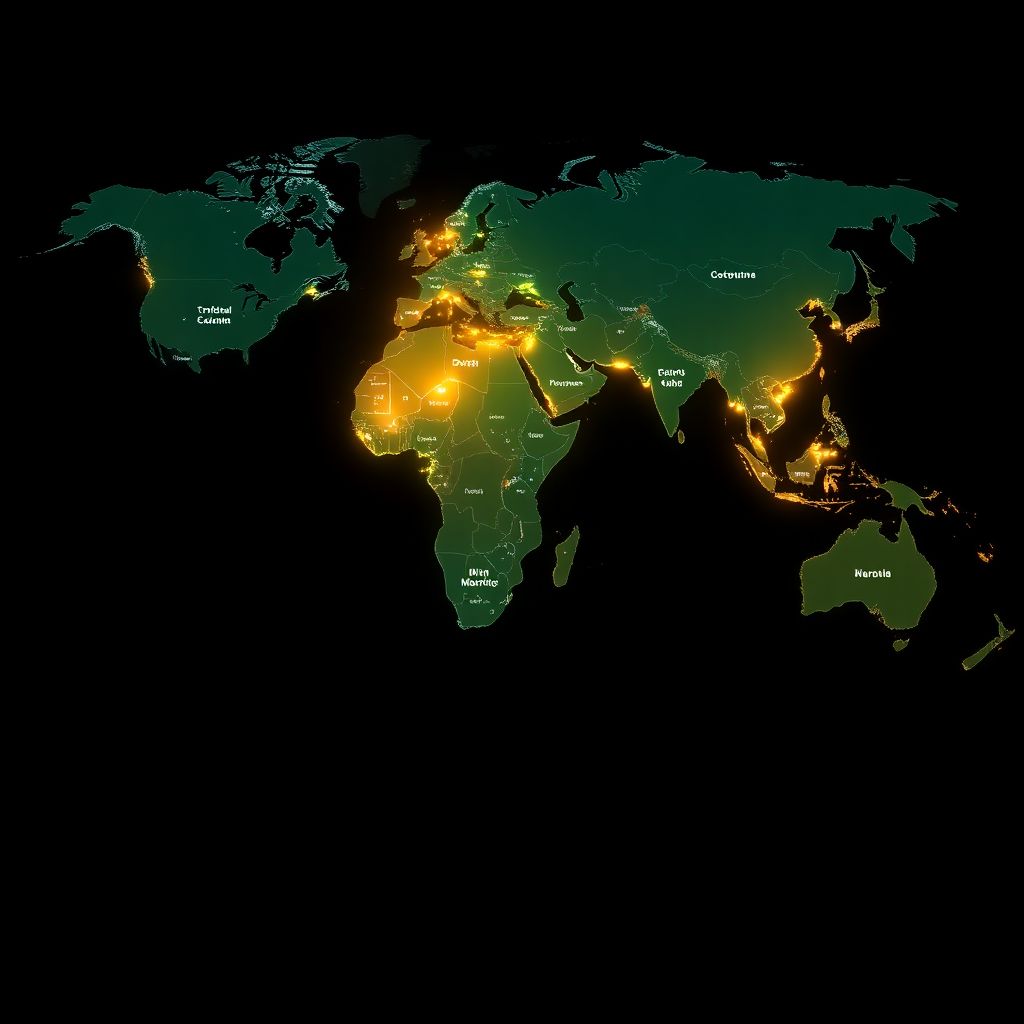
The Stablecoin Founder Map Doesn’t Match the Stablecoin Volume Map
Most people in crypto still assume that the center of gravity for stablecoins is wherever the capital lives: New York, San Francisco, London. Pitch decks are written for investors in those cities, products are shaped around their assumptions, and regulatory strategy is drafted with those jurisdictions in mind.
Yet if you follow the money on-chain, a very different picture emerges. The biggest and most intense stablecoin markets on the planet are not in the traditional financial capitals at all. They are in countries where the majority of venture capital firms have never sat down with a founder, and in some cases, where they have never even set foot.
By 2025, global stablecoin transaction volume surpassed 28 trillion dollars, overtaking Visa and Mastercard combined. On paper, this should have triggered a gold rush of new products and startups solving real-world problems with dollar-pegged (and increasingly, local-currency-pegged) digital assets. Instead, most founders and most venture funding are still clustered in the United States and Europe, where stablecoins are largely treated as an institutional or trading infrastructure product rather than a mass‑market financial tool.
That institutional layer is already crowded. Big issuers, well-capitalized exchanges, and traditional financial players are all fighting for the same territory: regulated, compliant, high-volume infrastructure for funds, banks, and corporates. The irony is that while this battle consumes attention in the West, the most dynamic and underserved stablecoin demand is happening elsewhere.
Where stablecoins are actually used as money
In emerging markets, stablecoins are not primarily an arbitrage tool, a DeFi collateral type, or a balance-sheet instrument. They are the product.
People use stablecoins as a workaround for broken banking systems, capital controls, inflation, currency devaluation, and unstable payment rails. For millions of users, a stablecoin is the first reliable way to:
– Hold savings in a relatively stable currency
– Move money across borders in hours instead of weeks
– Pay remote workers or freelancers without punitive fees
– Protect purchasing power against double- or triple-digit inflation
Think of workers in Argentina, Nigeria, Turkey, or Lebanon trying to escape local currency collapses; small businesses in Africa paying Chinese or European suppliers; families in Southeast Asia sending remittances home. In these contexts, a dollar-pegged token on a cheap, accessible chain is not a speculative asset. It is a lifeline.
This is why the “stablecoin volume map” – where transactions actually happen – looks completely different from the “founder map” and “VC funding map.” The heaviest real-world usage is in markets that many Western investors still classify vaguely as “emerging” and rarely visit or deeply study.
Why venture capital keeps missing the real stablecoin opportunity
There are several structural reasons why capital keeps chasing the wrong stablecoin thesis:
1. Home bias and familiarity
Investors fund what they understand and what is close to them. U.S. and European funds are more comfortable backing compliance-heavy, institution-facing issuers and infrastructure teams they can meet in person, with jurisdictions they already know how to navigate.
2. Regulatory obsession
A disproportionate amount of attention goes to policy battles in Washington, Brussels, and London. While regulation is critical, this focus crowds out attention from more chaotic but more fertile markets where clear-cut rules may not exist, yet user demand is overwhelming.
3. Narrative inertia
For years, the dominant narrative was that crypto’s killer app was trading and speculation. That shaped how stablecoins were perceived: as plumbing for exchanges and DeFi, not as a consumer cash equivalent for people facing currency crises or payment frictions.
4. Data myopia
Many funds rely on English-language reports, Western market surveys, or exchange volumes, which skew heavily toward developed markets. On-chain flows, P2P volumes, and local OTC activity in emerging regions paint a different story – but that data is harder to access, interpret, and contextualize.
5. Operational friction
Building in emerging markets is messy. Legal frameworks are patchy, infrastructure is uneven, and founders may need to navigate multiple overlapping informal systems. For funds used to standardized term sheets and Delaware entities, this looks like risk rather than opportunity.
The result is a mismatch: the frontier of usage is in Lagos, Buenos Aires, Manila, and Istanbul, while the majority of funded founders are in New York, Berlin, and San Francisco, building for a different problem set.
The three layers of the stablecoin stack
To understand where the next wave of winners will come from, it helps to break the stablecoin landscape into three rough layers:
1. Base issuance and custody
These are the global issuers, custodians, and compliance-heavy platforms. They manage reserves, interface with regulators, and maintain pegs. This is where the U.S. and Europe dominate and where competition is already intense.
2. Infrastructure and rails
Wallets, bridges, payment processors, liquidity providers, on/off-ramps, and APIs that move stablecoins efficiently and safely. Much of this is built in the West too, but increasingly localized players are emerging.
3. Last-mile products and experiences
Apps that sit directly in people’s hands and solve specific problems: getting paid, paying suppliers, saving in hard currency, hedging inflation, or accessing credit. This is where emerging markets are vastly under-served and where the founder map diverges most sharply from the volume map.
Today, VCs are over-indexed on the first two layers, especially the first. However, the largest untapped upside is in the third layer – especially in corridors where traditional finance is structurally incapable of serving users efficiently.
The stablecoin corridors that matter most
If you plot stablecoin flows between countries and regions, certain corridors stand out as both high-volume and badly served by incumbents:
– Remittance-heavy routes
From North America and Europe to Latin America, Africa, and South Asia. Traditional remittance fees and delays make stablecoin rails dramatically more attractive.
– Import/export corridors
Trade routes where small and mid-sized businesses need to pay suppliers abroad but have limited access to dollar accounts or reliable correspondent banking, especially in parts of Africa, the Middle East, and Southeast Asia.
– Capital control and inflation corridors
Countries where banking systems are fragile, capital controls are strict, or inflation erodes savings, driving people to substitute local currency with digital dollars.
– Freelance and digital labor hubs
Economies with large populations of online workers and creators getting paid in global markets but locked into weak or volatile local currencies.
In each of these corridors, stablecoins are already flowing at scale – often via informal OTC desks, semi-clandestine Telegram markets, or grey-zone payment apps. Yet there are surprisingly few well-funded, locally grounded startups building compliant, user-friendly, and scalable products on top of those flows.
What the next generation of winners will likely look like
Tomorrow’s dominant stablecoin companies are unlikely to be clones of today’s issuers. Instead, they will:
– Be deeply local in at least one region, with real understanding of local regulations, banking quirks, and cultural norms.
– Focus on a specific use case – such as payroll, B2B payments, remittances, savings, or cross-border trade – rather than being “everything wallets.”
– Rely on interoperability, abstracting away which chain or stablecoin users are on, while optimizing aggressively for low fees and reliability.
– Build robust compliance rails tuned to the realities of their markets – not simply copy-pasting Western KYC/AML models, but adapting to local identity systems and risk profiles.
– Monetize through services, spreads, and ancillary products (FX, credit, insurance, working capital), not just on raw transaction fees.
These products will feel less like “crypto apps” and more like modern financial utilities. For many users, the underlying stablecoin technology will be invisible. They will just know that money arrives faster, holds its value longer, and costs less to move.
The stablecoin investment thesis most funds are missing
For investors, the core missed thesis can be summarized simply:
Stablecoins are not just a new asset class. In many markets, they are becoming the default settlement and savings layer, leapfrogging broken or underdeveloped banking systems.
That implies several underexplored strategies:
1. Back founders native to high-volume markets
Instead of only funding teams relocating to Western hubs, investors should seek out founders who grew up in high-inflation, high-friction economies and understand those pain points viscerally.
2. Think in corridors, not countries
Some of the best opportunities sit between jurisdictions: for example, a platform specializing in moving value between one key export market and a specific import destination, not “global money movement” in the abstract.
3. Look beyond pure-play issuers
The issuance game is already dominated by a few giants. The more interesting upside is in distribution, UX, integration with local financial infrastructure, and problem-specific verticals like trade finance or SME payments.
4. Integrate regulatory risk into upside, not just downside
Jurisdictions with messy or immature regulations also tend to have the most distorted financial markets and therefore the strongest organic demand for alternatives. Careful navigation here can unlock outsized returns.
5. Measure success with real-economy metrics
Instead of just watching TVL and volumes on DeFi dashboards, investors should track metrics like merchant adoption, payroll processed, cross-border payout volumes, or percentage of user balances held for more than 30 days.
Why this gap persists despite obvious data
The discrepancy between where stablecoins are founded and where they are actually used has been visible in on-chain data for years. Yet it persists, and will likely persist for some time, for human and institutional reasons:
– Language and cultural barriers slow the flow of insight between local operators in emerging markets and capital allocators in the West.
– Risk committees and LP expectations favor “safer,” better-known jurisdictions, even if that means missing out on structurally higher-growth plays.
– Historical success patterns bias investors toward repeating what worked in Web2 and early crypto: fund infrastructure, exchanges, and platforms close to home.
– Underestimation of how fast behavior can change in unstable economies, where adoption curves for useful tools can be exponentially steeper than in mature markets.
This inertia is precisely what creates opportunity for those willing to do the harder work: travel, build local networks, understand complex regulatory landscapes, and back founders who do not fit the standard Silicon Valley mold.
How founders should recalibrate their strategy
For founders operating in or targeting emerging markets, the misalignment between capital and volume cuts both ways. On one hand, funding can be harder to secure. On the other, competition is lighter, and user demand is often stronger and more urgent.
A few strategic implications:
– Design for constraints, not for pitch decks
Build for unreliable internet, low-end phones, mixed levels of financial literacy, and users who think in terms of cash flows, not APRs and TVL.
– Lean into local partnerships
Cooperate with local banks, telcos, fintechs, and regulators where possible. Distribution and legitimacy are often more important than perfect technology.
– Make FX and local currency realities central
Users do not want “dollars” abstractly; they want stability relative to their cost of living and obligations. Think hard about how your product interacts with local currencies, not just the dollar peg.
– Plan for gradual regulatory convergence
Many countries will eventually formalize their stance on stablecoins and digital dollars. Building with a compliance and reporting mindset from day one can become a competitive advantage as rules emerge.
– Tell the right story to investors
Frame your company not as a “crypto project” but as fintech infrastructure or a payments company solving measurable, painful market failures with better rails.
What happens if this gap finally closes
If, over the coming years, the founder and funding maps begin to line up more closely with the volume map, several shifts are likely:
– A wave of regionally dominant stablecoin payment apps and platforms will appear, many of which Western users will barely hear about, despite processing tens or hundreds of billions annually.
– Global issuers will increasingly partner with local last‑mile operators rather than trying to own every layer themselves.
– Traditional payment giants will either acquire or integrate with stablecoin-native startups in high-growth corridors, rather than build all the tech in-house.
– The language of “crypto” will slowly fade from consumer-facing interfaces, replaced by brands and experiences that feel like modern banking – even though settlement remains on-chain.
In that world, the most valuable stablecoin companies are not necessarily those with the largest reserves, but those that control trusted, high-friction corridors and deeply understand the users they serve.
The real stablecoin map
The story of stablecoins is no longer simply about on-chain liquidity, DeFi yields, or exchange arbitrage. It is about a quiet redraw of the global financial map, driven not from boardrooms in New York or London, but from households, street markets, freelancers, and SMEs in economies where the legacy system is visibly failing.
Right now, the map of who builds and who funds stablecoin businesses still reflects old assumptions: that innovation and value creation are tightly tethered to Western financial centers. The transaction data says otherwise.
The founders and investors who align themselves with the true stablecoin map – the one traced by real people solving real problems with digital dollars and other pegs – are the ones most likely to capture the next wave of growth. Those who keep building only for the institutional, Western layer will find that, while important, it is no longer where the most transformative part of this story is unfolding.