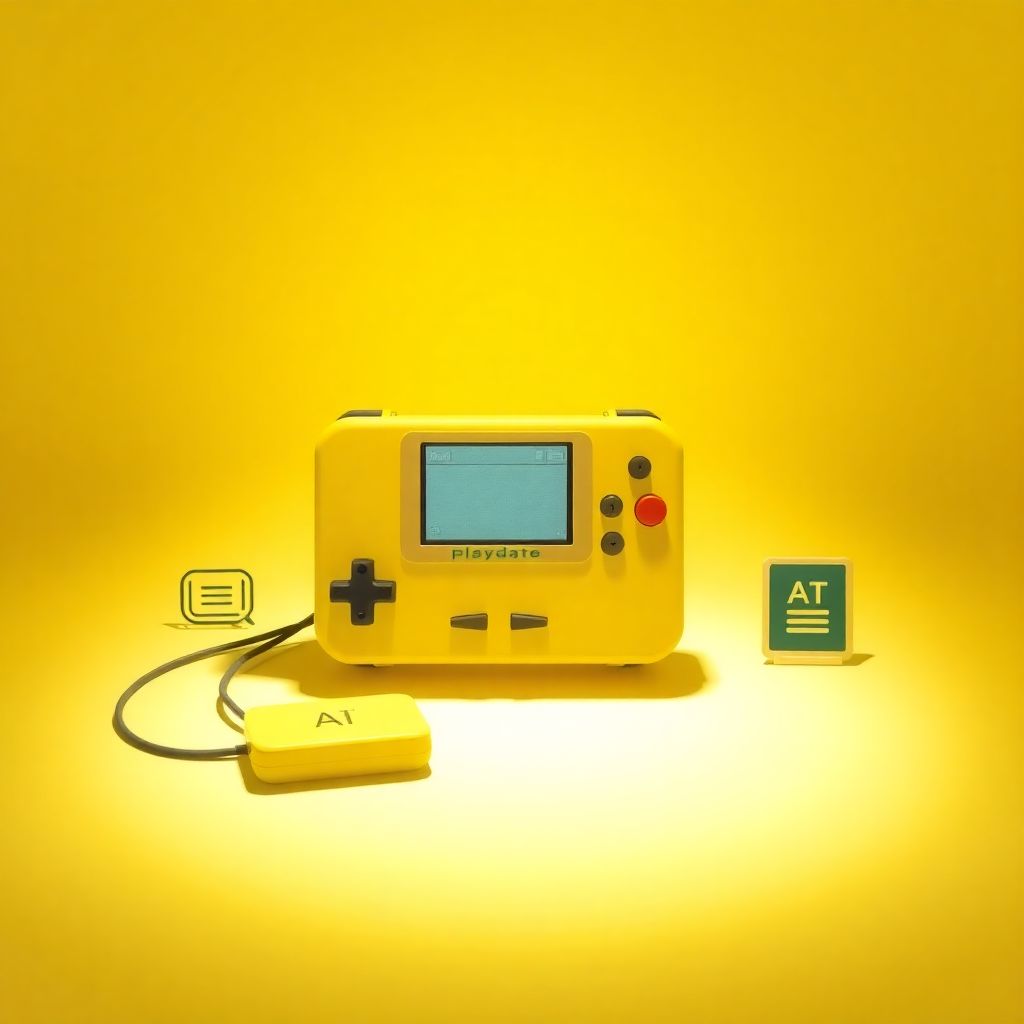
Playdate handheld maker Panic is drawing a firm line between “creative” and “technical” uses of artificial intelligence, and only one of those will be welcome on its official game store.
The company has updated its terms for the Playdate Catalog-the curated digital storefront for the crank-equipped yellow handheld-to explicitly ban AI-generated art, music, and writing in third‑party games. At the same time, Panic will still allow developers to use AI‑powered tools to help them write code, provided they are transparent about it.
Panic co‑founder Cabel Sasser explained that disclosure has always been part of the submission rules: developers were already required to state whether they used AI at any point in the creation of their games. What has changed is the scope of what’s allowed. Going forward, any game that includes AI‑generated visual assets, soundtracks, sound effects, or narrative text will not be accepted into the Playdate Catalog.
According to Sasser, the requirement to disclose AI usage “has never changed,” but as of this month, the Catalog’s rules now go further by outright prohibiting AI‑generated creative content. That means no AI‑drawn sprites or backgrounds, no AI‑composed chiptunes or ambient scores, and no AI‑written dialogue, item descriptions, or story text in games sold through the official storefront.
In contrast, AI that functions as a behind‑the‑scenes assistant for programmers remains acceptable. Tools that autocomplete code, suggest functions, or help debug errors are still permitted. Developers are, however, expected to clearly indicate that they relied on these coding assistants when submitting their titles, so buyers can decide for themselves how they feel about the process behind the game.
This split approach underscores Panic’s broader stance: AI is tolerable as a productivity tool, but not as a replacement for human‑made creative expression. It reflects growing concerns in the game and art worlds that generative AI can displace artists, composers, and writers, and that it often learns from copyrighted material without proper consent or compensation. By forbidding AI‑generated art and audio, Panic is signaling support for human creators and attempting to shield its small ecosystem from the flood of low‑effort, AI‑assembled content that has begun to appear on other platforms.
The decision is particularly notable because Playdate occupies a niche where handcrafted, experimental work is a core part of its appeal. The console has built its reputation on quirky, personal games with distinctive art styles and soundtracks, often made by solo developers or very small teams. For that kind of audience and creator community, the authenticity and individuality of human‑made assets are part of the product’s identity. Allowing generative AI artworks or music might dilute that identity and make it harder for original voices to stand out.
There is also a practical, legal, and ethical dimension. Generative AI models are trained on massive datasets, and many artists and rights holders argue that their work is being ingested without permission. A storefront that accepts AI‑generated art and music risks unintentionally hosting assets derived from copyrighted material, making moderation and rights verification significantly more complex. Panic’s ban sidesteps that entire tangle by ruling such content out at the policy level rather than trying to police it case by case.
For developers, the policy draws a clearer set of boundaries. If they want to list their game on the Playdate Catalog, every visual frame, musical note, and line of dialogue must ultimately originate from a human. Tools like image editors, music trackers, and text editors are still fine; what’s not allowed are generators that autonomously produce finished creative assets from text prompts or similar inputs. On the other hand, leveraging AI‑assisted coding to speed up scripting game logic, manage memory, or eliminate bugs remains on the table-as long as that use is acknowledged.
The disclosure requirement around AI coding tools also speaks to a rising expectation of openness in how software is made. Some players want to know whether the game they are buying was, for example, largely handcrafted or pieced together with heavy assistance from automated systems. Panic’s rules give those players at least a basic layer of transparency, even if they don’t drill into exactly which tools were used and how extensively.
This kind of policy may become a template for other boutique platforms and publishers that rely on curated catalogues rather than open, unmoderated marketplaces. By prioritizing human creativity and clarity over how AI is used, Panic is emphasizing quality and trust over sheer volume of releases. That can help avoid the “content sludge” problem, where storefronts become saturated with near‑identical, low‑effort titles churned out with generic AI art and music.
There is also an important cultural signal in choosing to ban AI‑generated creative content now, instead of waiting to see how the technology evolves. Panic is effectively betting that Playdate’s future lies in nurturing distinct artistic voices, not in becoming a testbed for automated content pipelines. This can encourage new and existing Playdate developers to invest in developing their own visual and audio styles, collaborating with artists and composers, or learning those skills themselves, rather than outsourcing them to generative tools.
At the same time, allowing AI‑driven coding helpers shows that Panic isn’t rejecting automation altogether. Game development is complex, and many indie creators work alone or in their spare time. Smarter coding tools can meaningfully lower the barrier to entry by helping with boilerplate code, pointing out bugs, or offering implementation patterns. Keeping those tools on the acceptable side of the line acknowledges the reality of modern software development while still preserving the human core of the artistic process.
Looking ahead, the policy may evolve as AI technology and public sentiment change, but the current stance sends a clear message about priorities: on Playdate’s official storefront, the images, sounds, and stories you experience should be the product of a person’s imagination and craft-not the output of a generative model. For an unconventional little handheld that has built its identity around surprise, charm, and personality, Panic evidently wants to ensure that personality remains unmistakably human.