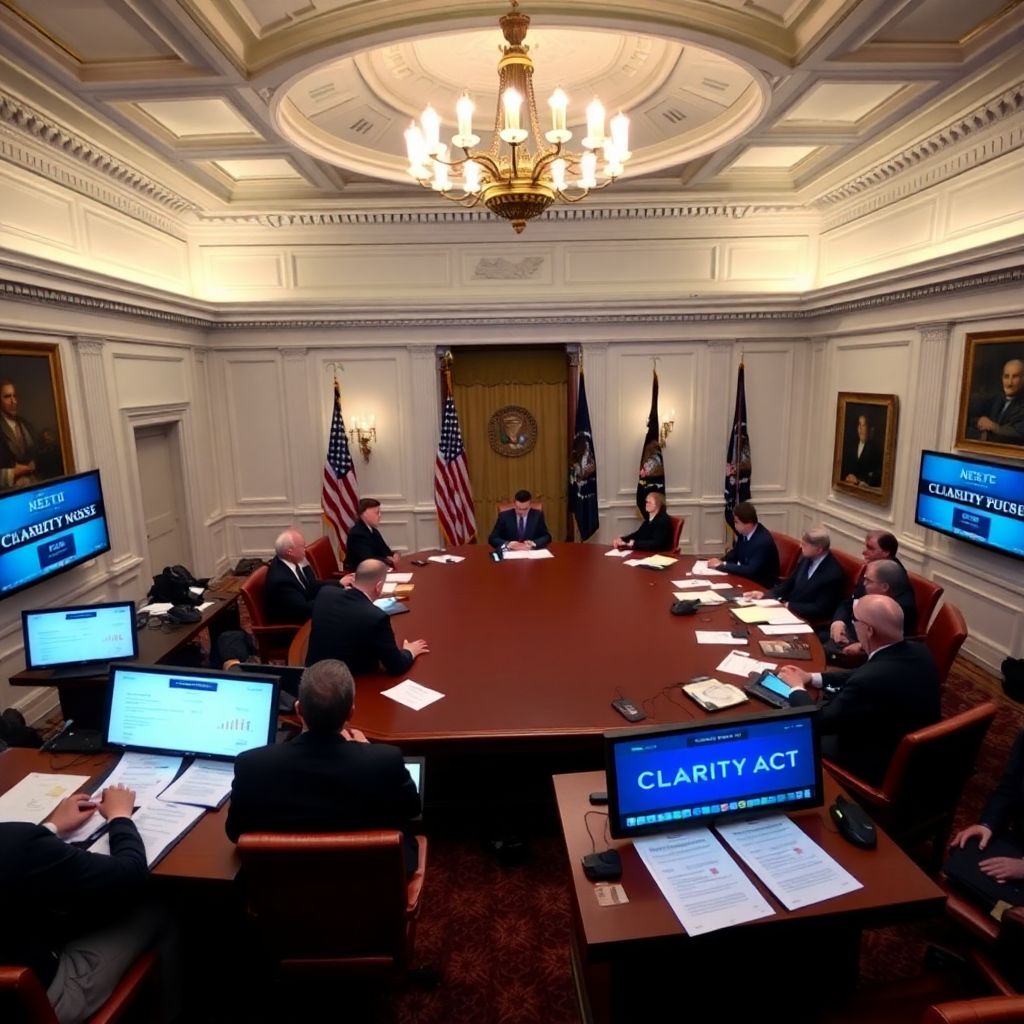
Morning Minute: The Clarity Act Is Suddenly Back in Play
Odds that the Clarity Act will become law in 2026 just jumped sharply, with one key prediction market now pricing its chances at 42%. That move followed an unexpected development from the White House that many in Washington see as the first real breakthrough for the bill in months.
For the first time, the administration has reportedly reached an internal agreement on an ethics framework tied to the CLARITY Act and has circulated this language to select Republican senators. While the exact text has not yet been made public, people familiar with the process say this is the same issue that has kept the legislation stuck in neutral-and that its resolution may finally allow the bill to advance.
According to reporting from a prominent Washington-based crypto journalist, the White House’s ethics package is already in the hands of certain GOP offices in the Senate. Staffers and industry figures she spoke with say they’re cautiously optimistic this clears the path for updated bill text to be released in the near future. That would mark the first meaningful step forward on CLARITY since the last round of hearings.
The reason this matters is straightforward: the ethics language has been the central point of contention behind the scenes. For weeks, negotiations have revolved less around core market-structure rules for digital assets, and more around how to police conflicts of interest, post-government employment, and personal holdings of crypto assets by regulators and staff who will oversee the space. Until that was resolved, neither party was eager to stake political capital on the bill.
Now, by signaling that it has a workable ethics package, the White House is effectively telling Congress it’s ready to see a version of the Clarity Act it can live with. That does not guarantee anything-there are still plenty of substantive policy disputes to work through-but it removes the most visible procedural obstacle that has been used to justify delay.
What the Ethics Deal Likely Covers
Although the precise wording remains confidential, people following the process closely expect the ethics agreement to touch on several sensitive areas:
– Limits on crypto holdings for senior officials involved in digital-asset policy
– Mandatory disclosures of any digital-asset investments held by relevant staff
– Cooling-off periods before former regulators or congressional staff can work for crypto firms or industry groups
– Guardrails around lobbying and advisory roles for ex-officials with deep knowledge of forthcoming rules
These types of restrictions are not unique to crypto-similar structures exist in banking, securities, and defense policy-but the speed and volatility of digital-asset markets, combined with the speculative nature of many tokens, have raised particular alarm in ethics circles. Lawmakers have been under pressure to convince the public that the people writing and enforcing crypto rules are not quietly trading the assets they regulate.
The White House appears to have decided that without a firm, clearly articulated ethics regime attached to the Clarity Act, it would be politically untenable to support any broad deregulatory or market-structure reforms for digital assets.
Why the Market Reacted
The jump in 2026 passage odds to 42% is a sign that traders believe the bill has moved from “theoretical” to “plausible.” Prediction markets and desk analysts tend to watch for exactly this kind of procedural breakthrough-agreements on ethics, committee jurisdiction, or budget scoring-because those are often the true bottlenecks in complex legislation.
Substantive fights over definitions and regulatory turf have been ongoing for years. By contrast, the ethics dispute was a relatively new and very concrete excuse for delay. If that excuse is now off the table, the probability that the bill receives updated text, a committee markup, and eventually a floor vote logically increases.
Still, 42% is not a coin flip-it reflects skepticism, too. Markets are factoring in election-year politics, a crowded legislative calendar, and the possibility that any compromise text that can actually pass both chambers might look very different from what industry advocates initially hoped.
What the Clarity Act Is Trying to Do
Stripped of political noise, the Clarity Act is primarily a market-structure bill. Its overarching goal is to define, in law, which digital assets are securities, which are commodities, and what rules apply to the platforms that list and trade them. Among the broad objectives that have been discussed:
– Establishing a clearer line between tokens that fall under securities regulation and those overseen by commodities authorities
– Creating a federal framework for crypto trading platforms and custodians, with unified licensing standards
– Providing a pathway for existing projects and networks to transition from “security-like” fundraising to “commodity-like” secondary trading as they decentralize
– Harmonizing state and federal rules, especially around consumer protection and disclosures
Supporters argue that this kind of legal clarity is essential if the United States wants to remain competitive in digital finance, attract institutional capital, and keep innovative projects onshore rather than pushing them overseas.
Why Ethics Became the Main Battlefield
Many observers assumed that the toughest part of crypto legislation would be ideological: the divide between those who see digital assets as a threat to consumers and financial stability, and those who see them as a critical next step in financial innovation. But over the last several months, it has been ethics-rather than philosophy-that has quietly held the process hostage.
Several developments contributed to that shift:
– Public scrutiny of trading by officials involved in financial regulation has intensified in recent years.
– Crypto assets are highly visible and often controversial, making any perception of self-dealing explosive.
– Lawmakers in both parties feared headlines about “crypto regulators trading crypto” even more than they feared being labeled anti-innovation.
With that backdrop, the White House was unwilling to endorse any bill that did not visibly tighten standards for conflicts of interest, especially for agencies that would be newly empowered by the Clarity Act.
What Happens Next in Washington
Assuming the ethics package is broadly acceptable to the Republican offices that received it, the next likely steps could include:
1. Revised bill text – Legislative staff work the new ethics language into an updated CLARITY draft, along with any other negotiated changes.
2. Internal party vetting – Leadership on both sides will test whether the package can hold a coalition in their respective caucuses.
3. Committee activity – The relevant committees could schedule hearings or markups to move the bill forward and publicly debate the new provisions.
4. Public release – Once there is confidence the text will not be immediately torpedoed, the updated bill would be published and formally reintroduced or advanced.
Every one of these stages presents fresh risks. Opposition could coalesce around other parts of the bill-like stablecoin rules, DeFi treatment, or exchange licensing-even if the ethics issue is settled. But the absence of a clear ethics deal had effectively frozen all of this procedural machinery. That ice may now be starting to crack.
Implications for the Crypto Industry
If the Clarity Act regains momentum, the digital-asset sector will face both new opportunities and new constraints:
– More regulatory certainty: Projects and exchanges could finally plan multi-year strategies without guessing how agencies will categorize their assets.
– Higher compliance costs: A unified federal regime almost always comes with robust reporting, capital, and operational requirements. Smaller players may struggle.
– Stricter scrutiny of insiders: Executives, advisers, and lobbyists with government backgrounds will find their movements more tightly controlled and disclosed.
– Easier institutional participation: Large asset managers and banks prefer operating under clear statutory rules; passage could unlock new products and services.
In the short term, even the perception that a serious bill is back on track can influence how venture funding is allocated, how token launches are structured, and how exchanges think about listing risk.
Political Calculus Heading Into 2026
The 2026 timeframe attached to the 42% passage odds is not accidental. The next two years are expected to be dominated by election cycles and partisan jockeying. That dynamic cuts both ways for the Clarity Act:
– On one hand, highly technical market-structure bills often struggle to get oxygen in a charged political environment.
– On the other, a bipartisan, ethics-forward, “clean up the rules” narrative can be attractive to both parties looking for a win that signals competence and consumer protection.
If the ethics package is seen as stringent and credible, some lawmakers may feel they can safely back the bill without being accused of favoring industry insiders. Others may argue that even with tight ethics rules, any regulatory “clarity” is effectively a concession to a sector they still view skeptically.
What Investors and Builders Should Watch For
For those trying to gauge how real this momentum is, a few indicators will matter more than daily headlines:
– Publication of updated text – Until there is fresh bill language to analyze, everything remains hypothetical.
– Committee schedules – Hearings and markups are strong signals that leadership is willing to spend time and capital on the bill.
– Cross-party co-sponsors – Genuine bipartisan support is essential in a divided government environment.
– Public statements on ethics – How lawmakers talk about the ethics package will reveal whether it convinced skeptics or simply papered over deeper concerns.
If these signals all trend positive, the 42% probability now being priced may need to be revisited upward.
The Bigger Picture: Clarity vs. Control
At a deeper level, the battle over the Clarity Act is about more than just digital assets. It is a test case for how the United States will regulate fast-moving, code-driven financial systems in which traditional boundaries between issuer, exchange, and user are blurred.
The White House’s move on ethics suggests that, at minimum, the administration is not prepared to cede the field entirely. By insisting on strict standards for officials and staff, it is trying to reassure the public that as federal power over crypto markets grows, so will the guardrails on those who wield that power.
Whether that balance-more clarity for markets, more constraints for policymakers-will be enough to get CLARITY across the finish line remains uncertain. But for the first time in months, the legislation has something it badly needed: a plausible way forward.