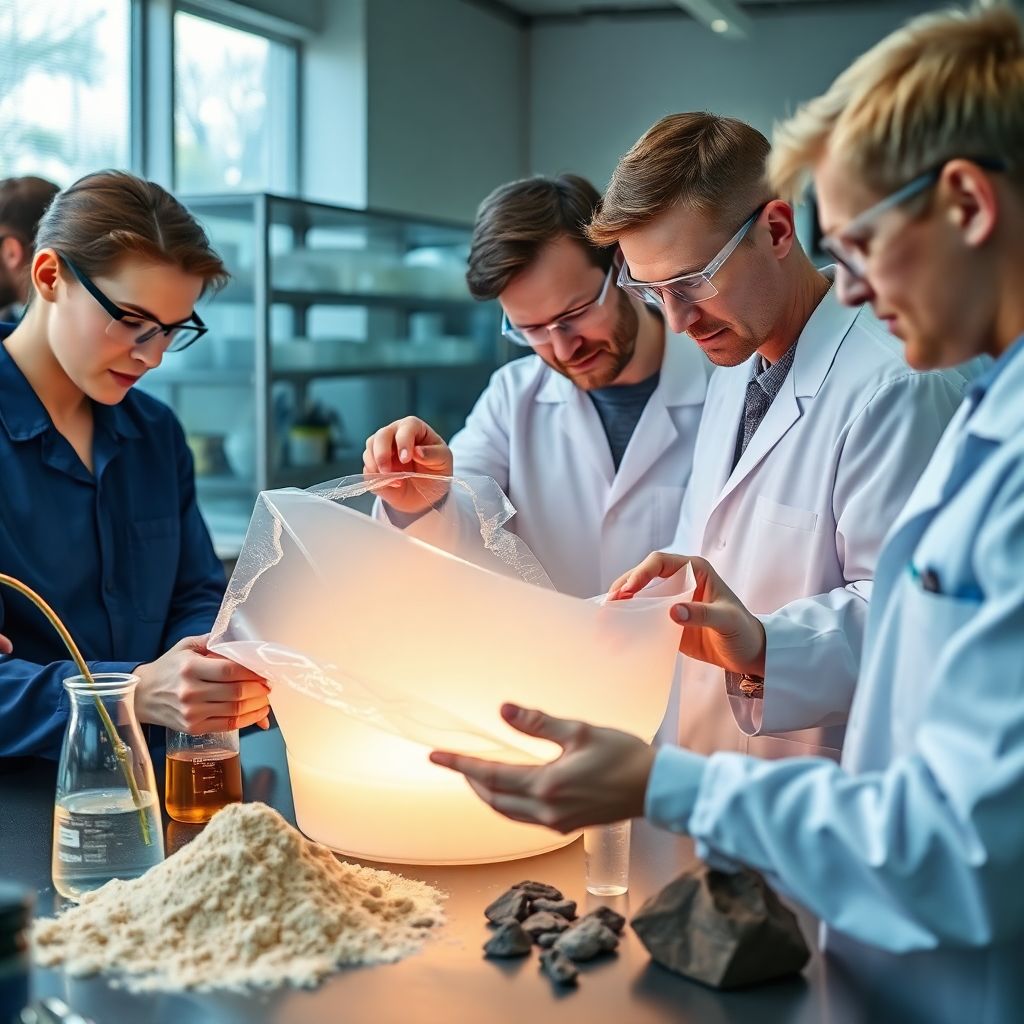
The protein that keeps yogurt creamy and cheese satisfyingly stretchy has just been hired for a very different role: standing in for plastic.
A team of researchers from Colombia and Australia has developed a new biodegradable packaging film built largely from calcium caseinate-the dominant protein in cow’s milk-combined with starch, volcanic clay, and a synthetic binder. According to their study, the material can completely break down in soil in about 13 weeks. For comparison, conventional petroleum-based plastics can persist in the environment for hundreds of years.
How milk turns into “plastic”
Casein, the family of proteins found in milk, is unusually good at forming compact molecular networks. When dissolved in water and then dried, these proteins naturally align and pack tightly, creating a continuous film. This behavior is the same property that helps cheese melt in long strands and gives yogurt its body.
Calcium caseinate, a salt form of casein, offers particularly strong film-forming abilities. When the researchers prepared a solution of calcium caseinate and cast it into thin layers, it dried into a transparent, plastic-like sheet. This provided a promising foundation for a biodegradable material-but with a serious drawback.
The brittleness problem
Left on its own, a film made entirely from casein doesn’t behave like a useful packaging material. As it dries, it shrinks, warps, and becomes brittle-more like a piece of dried glue than a flexible wrap. It can crack under stress and doesn’t tolerate handling or bending very well.
That’s where the rest of the formulation comes in. The scientists had to find a combination of additives that could soften the film, improve its mechanical properties, and make it more resistant to moisture, while still allowing the material to break down in natural conditions.
The three key additives: starch, clay, and binder
The final recipe includes three important ingredients:
1. Starch
Starch, a carbohydrate found in plants like corn and potatoes, acts as a biodegradable “filler” and modifier. It helps reduce the amount of protein needed, lowers costs, and can tune the flexibility of the film. Because starch is hydrophilic (it loves water), it pairs reasonably well with the protein network, integrating into the structure instead of phase-separating.
2. Volcanic clay
The researchers also incorporated a type of volcanic clay, made up of ultra-thin mineral layers. Even in very small amounts, layered clays can act as nano-reinforcements within a polymer matrix. Distributed throughout the film, they help:
– Increase strength and stiffness
– Improve barrier properties by making it harder for gases and water vapor to pass through
– Stabilize the structure so it deforms less during drying
3. Synthetic binder (plasticizer-like component)
To counteract brittleness, the team used a synthetic binder that behaves similarly to a plasticizer. These kinds of molecules slip between protein chains and starch molecules, reducing intermolecular attractions and allowing the chains to move more freely. The result is a film that bends rather than cracks, and can be manipulated like thin plastic packaging.
From lab mixture to functional film
The production process resembles how some biodegradable films are already manufactured:
– Calcium caseinate is dissolved in water and mixed with starch.
– The volcanic clay is dispersed thoroughly to avoid clumps and ensure even reinforcement.
– The synthetic binder is added to adjust flexibility and cohesion.
– The mixture is cast into thin layers and dried under controlled conditions to form a continuous film.
By tweaking ingredient ratios, the researchers were able to balance mechanical strength, flexibility, and biodegradability. Too much binder, for example, could reduce strength or slow degradation. Too little, and the film would remain too brittle for practical use.
How fast does it break down?
In soil burial tests, the composite film degraded completely in around 13 weeks. Microorganisms in the soil feed on the organic components-protein and starch-gradually breaking the material into smaller fragments and ultimately converting it into biomass, carbon dioxide, and water.
The presence of clay does not prevent this process; the mineral component simply remains as harmless, naturally occurring material in the soil. This stands in stark contrast to traditional plastics, which fragment into microplastics and often persist for centuries.
Why this matters for packaging
Single-use plastic packaging-especially films, wraps, and bags-is one of the most challenging types of plastic waste. It’s thin, lightweight, easily contaminated with food, and often not economically viable to recycle. As a result, huge volumes end up in landfills, oceans, and natural ecosystems.
A film made from milk protein and starch offers several potential advantages:
– Rapid degradation in natural conditions compared to conventional plastic
– Renewable feedstocks, since milk and plant starch come from agricultural sources
– Lower long-term pollution burden, with no microplastics left behind
– Potential compostability, if formulated and certified for industrial or home compost systems
For certain uses-like food wrapping, sachets, or internal packaging layers-this kind of material could replace conventional plastics that are currently discarded after a single use.
Potential applications and limits
The immediate opportunity is in low-demand packaging, where extreme durability or water resistance is not essential. Examples include:
– Wraps for dry or low-moisture foods
– Sachets for powdered products (like instant drinks or spices)
– Inner liners that don’t need to survive long after the product is opened
– Short-life protective films for shipping and storage
However, because the material is based on water-loving components (protein and starch), it may not yet be suitable for products exposed to high humidity, direct water contact, or very long storage. Additional coatings or multilayer structures may be needed to broaden its use-for instance, combining the milk-based film with a thin outer barrier layer that is also biodegradable.
How it compares with other bioplastics
This milk protein film joins a growing family of alternatives to conventional plastic:
– PLA (polylactic acid), derived from fermented plant sugars, is widely used but usually requires industrial composting to break down effectively.
– PHA (polyhydroxyalkanoates), made by bacteria, are highly biodegradable but still relatively expensive at scale.
– Starch-based plastics are common but often need synthetic polymers blended in to achieve usable mechanical properties.
The calcium caseinate approach is distinct because it leverages a waste or byproduct stream from the dairy industry-milk proteins-and uses natural reinforcements like starch and clay, rather than relying solely on large-scale chemical polymerization.
Sustainability questions: milk and the environment
Any material that draws on animal products raises additional sustainability questions. Dairy production is associated with greenhouse gas emissions, land use, and water consumption. The environmental benefits of this new film will depend on how and where the casein is sourced.
One plausible path is to use proteins extracted from dairy processing byproducts or surplus milk that would otherwise go unused. Turning low-value or waste streams into high-value, biodegradable materials could improve the overall resource efficiency of the dairy sector.
In the longer term, if precision fermentation or alternative protein technologies can produce casein without cows, similar films might be made with a significantly lower environmental footprint.
Safety and food-contact considerations
Because the film is made from edible components like milk protein and starch (with small amounts of clay and binder), it has potential for direct food-contact applications. Before it can hit supermarket shelves, however, regulators will need to evaluate:
– Possible migration of components into food
– Allergen concerns, since casein is a milk protein
– Stability under typical storage and transport conditions
– Compatibility with existing food packaging and processing equipment
For people with milk allergies, for example, such packaging would have to be clearly labeled or limited to contexts where it does not come into direct contact with food surfaces.
What needs to happen next
To move from lab-scale films to real-world packaging, several challenges must be addressed:
– Scaling up production: Laboratory casting methods need to be adapted to industrial film-extrusion or coating technologies.
– Cost competitiveness: The material must compete with extremely cheap petroleum-based plastics and established bioplastics.
– Performance optimization: Barrier properties against oxygen and moisture, resistance to tearing, and shelf-life behaviors all need to be tuned for specific products.
– End-of-life integration: Waste-management systems-recycling, composting, or biodegradation in soil-must be able to handle the new material without contamination issues.
Despite these hurdles, the research offers a strong proof of concept: a packaging film that behaves like plastic in use but vanishes in weeks rather than centuries.
A small but meaningful step beyond plastic
Turning milk protein into a plastic alternative won’t, by itself, solve the global plastics crisis. But it illustrates a broader shift in materials science: looking to biology, food systems, and natural polymers as the foundation of next-generation packaging.
By combining a common dairy protein with plant starch and a pinch of volcanic clay, scientists have created a material that can be produced from renewable resources, serve its purpose as a protective film, and then quietly return to the earth in a matter of weeks. As similar innovations mature and scale, the thin, crinkly wrap around everyday products could become far less harmful-and far more in tune with natural cycles.