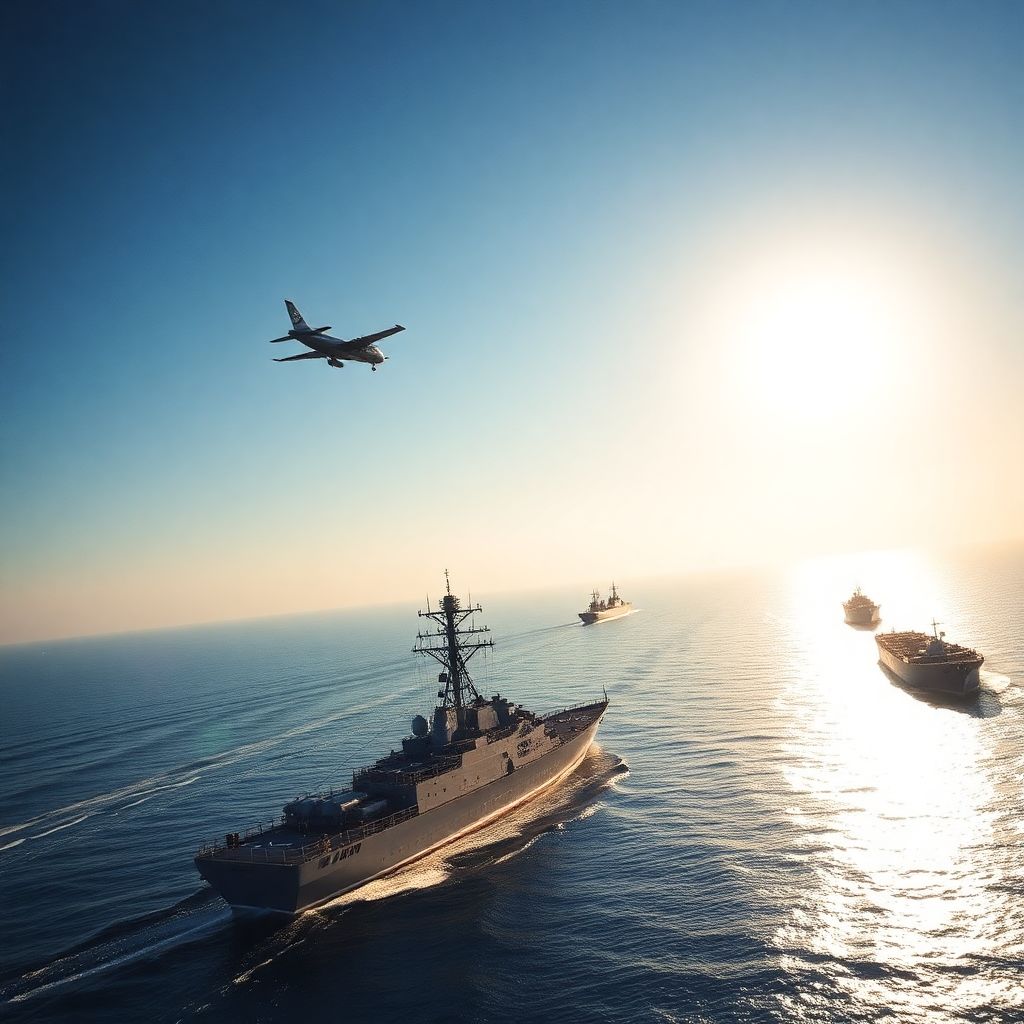
Iran shuts Strait of Hormuz to all traffic as US strikes escalate confrontation
Iran’s top military command has ordered the closure of the Strait of Hormuz to every type of vessel, sharply raising the stakes in its confrontation with the United States after a new round of US airstrikes on Iranian targets.
Khatam al-Anbiya Central Headquarters, which oversees Iran’s joint military operations, announced that the strategic waterway is now “completely closed to all types of vessels” due to what it called mounting security threats in the area. Iranian state-linked media said the command warned that any ship attempting to pass through the strait would be treated as a hostile target.
According to Tasnim news agency, the military directive explicitly stated that “any vessel traffic through the Strait of Hormuz will be targeted,” signaling that Iran is prepared to use force to enforce the closure. The order effectively challenges US assertions that Washington, not Tehran, guarantees freedom of navigation through the narrow chokepoint.
Iran’s Islamic Revolutionary Guard Corps (IRGC) navy said two ships attempted to transit the strait despite the new restrictions. State broadcaster IRIB and the Mehr news agency reported that Iranian forces struck both vessels after they “illegally” tried to pass through the heavily monitored waterway. The IRGC further cautioned ships anchored in the Persian Gulf and the Sea of Oman not to get underway.
“Approaching the Strait of Hormuz will be considered cooperation with the enemy,” the Guards said in a statement. The warning followed reports of US strikes in southern Iran and a series of explosions in coastal areas close to the strait, including near Bandar Abbas, Qeshm, Minab, and Sirik. Iranian sources claimed that “enemy projectiles” hit locations in Qeshm, Kargan, and Sirik, although the extent of the damage was not immediately clear.
US Central Command (CENTCOM) confirmed it had carried out fresh strikes against Iranian targets on 10 June. The command described the operation as “additional self-defence strikes,” saying the attacks began at 5:15 p.m. New York time and were a response to what it called Iran’s “unwarranted and continued aggression.” No detailed list of targets was released, but Iranian media said earlier US strikes had hit air defence systems, radar installations, and other military sites.
The latest operation came one day after US forces launched attacks in retaliation for Iran shooting down a US Apache helicopter. Those earlier strikes marked a significant escalation and prompted a series of increasingly sharp statements from both sides. US President Donald Trump accused Tehran of dragging out negotiations on an interim peace arrangement and vowed more military pressure.
“We hit them hard yesterday, and we’re going to hit them hard again today,” Trump told reporters before the most recent strikes, declining to specify the targets ahead of the official Pentagon announcement. He later claimed that the United States had “supported the passage” of more than 200 commercial vessels through regional waters, carrying over 100 million barrels of oil to international markets. Trump also insisted that the US, not Iran, effectively “controls” the Strait of Hormuz – a claim that Tehran’s closure order directly seeks to refute.
Iran’s Foreign Ministry, for its part, accused the US of bombing civilian infrastructure under the pretext of self-defence, charging that Washington was attempting to use force to gain leverage at the negotiating table. US Defense Secretary Pete Hegseth said the strikes were intended to push Tehran toward accepting a deal, framing the pressure campaign as a way to “change Iran’s calculus” on the conflict.
Despite the spiraling military confrontation, diplomatic contacts have not completely broken down. A White House official said talks are continuing in parallel to the military moves, with the US prepared to maintain and, if necessary, increase pressure until a framework agreement is reached. The official suggested that Washington sees the combination of sanctions and strikes as key tools in forcing Iran to compromise.
In Tehran, Iranian media reported the arrival of a Qatari delegation on 10 June. The group’s visit is focused on the ongoing diplomatic process to end the war and reduce the risk of a wider regional conflagration. Qatar has previously positioned itself as a potential mediator between Iran, the US, and other regional actors, leveraging its ties to all sides to keep channels of communication open.
The announcement of the Strait’s closure came as Iranian officials accused the “American enemy” of repeatedly violating ceasefire understandings and undermining any chance of de-escalation. Military authorities said the waterway would remain shut “until further notice,” without offering a timeline or conditions for reopening. The move injects fresh uncertainty into global energy markets, given the strait’s outsized role in international trade.
The Strait of Hormuz is one of the world’s most critical maritime chokepoints. A significant share of the planet’s seaborne oil exports passes through its narrow channel, which at its tightest is only a few dozen kilometers wide. Tankers carrying crude and refined products from producers in the Persian Gulf must transit the strait to reach open waters and global customers. Any prolonged disruption there can push up shipping costs, fuel prices, and insurance premiums, and may force importing countries to tap strategic reserves or seek alternative supplies.
For Iran, the decision to close the strait serves multiple strategic aims. Domestically, it signals defiance and strength in the face of US airstrikes, shoring up the government’s narrative that it is resisting foreign aggression. Regionally and globally, it underscores Iran’s ability to threaten the flow of energy and commercial goods, reminding adversaries that any conflict with Tehran carries direct economic consequences far beyond the battlefield.
The tactic is not entirely new. Over the past decade, Iran has repeatedly hinted that it could restrict traffic through the Strait of Hormuz whenever tensions with the US or its regional rivals flare. However, a full, formal closure order backed by an explicit threat to target shipping marks a sharp escalation from previous episodes of harassment, seizures of individual tankers, or missile and drone attacks on specific vessels.
The legal and diplomatic implications are complex. Under international maritime law, including the principle of transit passage through international straits, commercial vessels normally enjoy the right to sail through waterways like Hormuz, even when they lie within territorial seas. Iran’s declaration that it will treat any approach as “cooperation with the enemy” puts it on a collision course not only with the US, but also with other countries whose flagged ships rely on the route. Many of those states may now face pressure to decide whether to reroute their tankers or risk confrontation.
Markets are watching for signs of how far the closure will be enforced in practice. If Iran actively moves to block or attack merchant shipping, insurers will likely classify the area as an extreme-risk war zone, making coverage prohibitively expensive or unavailable. Even rumors of incidents can cause spikes in oil prices as traders factor in worst-case scenarios of prolonged disruption. Conversely, if the closure remains largely declarative and limited to specific vessels viewed as hostile, the impact might be more psychological than structural, at least in the short term.
Regional navies are also recalibrating their posture. The US and its partners have previously conducted “freedom of navigation” operations and convoy escorts in the Gulf to deter attacks on shipping. A declared closure raises the stakes of any such operation, since an escorting warship accompanying a commercial tanker through the strait could trigger direct clashes with Iranian forces. This risk of miscalculation or accidental escalation grows sharply when forces operate in close proximity under extreme political pressure.
Diplomatically, Qatar’s involvement hints at a broader effort by Gulf states to prevent the crisis from spinning out of control. Many regional economies are deeply dependent on maritime stability and uninterrupted exports, and a full-scale closure of the strait would harm them as well as Iran and the US. Behind the scenes, regional diplomats are likely urging both sides to establish at least minimal rules of engagement and communication channels at sea to avoid unintended confrontation.
For Washington, the balancing act is delicate. The US wants to demonstrate that attacks on its forces or assets will be met with force while avoiding a slide into open war. It must also reassure allies and global markets that commercial shipping will remain as secure as possible. Publicly, US officials frame the strikes as limited, defensive measures, but Iran sees them as offensive acts meant to weaken its defences and coerce concessions at the negotiating table.
Tehran’s leadership, in turn, is under pressure not to appear weak after high-profile US strikes and losses like the downing of the US helicopter. By closing the strait and threatening any vessel that approaches, it projects resolve and deterrence. Yet the same move risks inviting further US or coalition military action if commercial shipping comes under attack or if energy flows are severely disrupted.
The coming days will likely reveal whether Iran intends to physically enforce a comprehensive blockade or use the closure primarily as leverage in ongoing diplomacy. Much will depend on behind-the-scenes talks involving Qatar and other intermediaries, as well as on whether either side carries out further strikes. For now, the Strait of Hormuz, a narrow passage through which a large share of the world’s oil must pass, has once again become the focal point of a confrontation with global repercussions.
Iranian media report that explosions and military movements continue in southern coastal regions near the strait, reinforcing the sense that the front line of this stand-off is as much maritime as it is political. With the closure in effect “until further notice,” governments, shipping companies, and energy traders are bracing for a period of heightened volatility – and watching closely to see whether diplomacy can reopen one of the world’s most vital sea lanes before the crisis deepens further.