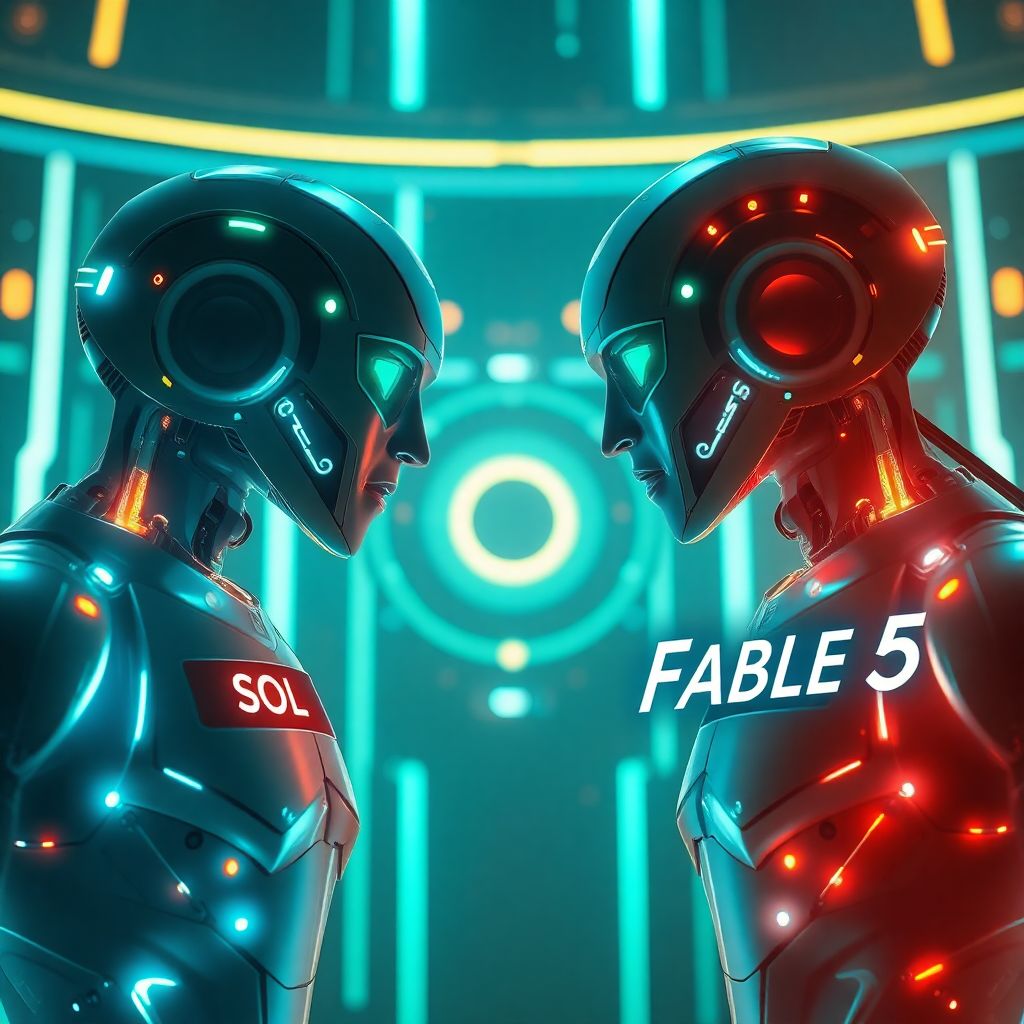
GPT-5.6 vs Fable 5: Which Model Makes Sense for You Right Now?
For the first time, OpenAI’s flagship release is not a single system with configurable “thinking” sliders, but a miniature family of models. GPT‑5.6 is split into three distinct large language models-Sol, Terra, and Luna-each trained differently, priced separately, and capped at different capability levels. That means picking “GPT‑5.6” is no longer a one-click decision; you have to choose a specific variant.
On the other side stands Claude Fable 5, Anthropic’s most powerful publicly available model. In practice, the head‑to‑head comparison that matters for demanding users-engineers, researchers, power users-is Sol versus Fable 5. Terra and Luna fill other roles in the stack, but they don’t directly target Fable 5’s premium segment.
Pricing: The First Big Divider
Sol is aggressively priced for a top‑tier system:
– Sol (GPT‑5.6) – about $5 per million input tokens and $30 per million output tokens.
– Fable 5 – around $10 per million input tokens and $50 per million output tokens.
That puts Fable 5 at roughly double the price of Sol on both input and output. Until recently, Anthropic could justify that premium by leading key benchmarks that matter for real workloads. The dynamic has shifted: Sol now wins on several of the same tests developers actually rely on for routing, especially in complex reasoning and applied coding scenarios. When your bill scales into the billions of tokens, that pricing gap is no longer cosmetic-it becomes a strategic factor.
Luna: The Quiet Disruptor
Below Sol in the GPT‑5.6 lineup sits Luna, the most economical option of the three:
– Luna – about $1 per million input tokens and $6 per million output tokens.
Despite its budget positioning, Luna already outperforms Anthropic’s Claude Opus 4.8 on coding tasks, according to internal benchmark comparisons. That’s where the situation becomes more uncomfortable for Anthropic: a *cheaper* OpenAI model surpassing one of its high‑end offerings in a critical area like programming assistance.
This detail matters because once organizations recalibrate their routing, a model like Luna can quietly siphon off huge volumes of tasks that used to justify higher‑priced Anthropic tiers. And all of this lands on a critical date: July 19, when Luna’s performance lead on coding goes from interesting trivia to a concrete migration incentive for teams watching their infrastructure costs.
Fable 5’s Very Bad Month
Fable 5 hasn’t just faced competitive pressure-it has been hit by a much more serious blow. On June 12, the U.S. government banned the model after Amazon researchers discovered a jailbreak that could turn Fable 5 into something regulators considered too risky to be allowed in sensitive environments.
The incident undercuts one of Anthropic’s key selling points: safety and robustness against misuse. While every frontier model is subjected to jailbreak attempts, an exploit severe enough to trigger a formal ban shakes trust at the exact moment enterprises are deciding which systems to standardize on for the next year or two.
For risk‑averse organizations, this creates a chilling effect. It doesn’t just raise questions about Fable 5’s current alignment; it raises doubts about ongoing oversight, red‑teaming depth, and the company’s ability to stay ahead of increasingly sophisticated jailbreak research.
Capability vs. Reliability: How the Trade‑Off Has Shifted
Before GPT‑5.6, the decision often looked like this:
– Pay more for Anthropic’s best-in-class reasoning and safety, or
– Accept slightly less capability from OpenAI in exchange for lower costs and richer tooling.
With Sol, that equation has shifted. Early comparative testing shows:
– Sol now holds the edge or parity on several practical benchmarks-complex coding, multi‑step reasoning, and structured analysis-where Fable 5 once comfortably led.
– Fable 5, meanwhile, is now more expensive and under regulatory pressure, diminishing the argument that it is the “safer” premium choice.
This doesn’t automatically make Fable 5 obsolete. Some users still prefer its conversational tone, its tendency toward cautious answers, or specific behaviors tuned for long‑form reasoning. But the old assumption-“Anthropic is more capable, OpenAI is cheaper”-no longer cleanly holds.
When Sol Is the Rational Choice
You’re more likely to pick Sol (GPT‑5.6) if:
1. You’re cost‑sensitive at scale. Running large agents, batch analytics, or multi‑model pipelines makes token pricing decisive. Halving input and output costs compared to Fable 5 can free substantial budget.
2. You care about cutting‑edge coding performance. Sol paired with Luna provides a strong one‑two punch for software development, with Luna already outranking Opus 4.8 on coding and Sol pushing further on complex engineering tasks.
3. You want a single ecosystem. If your stack already leans heavily on OpenAI tools, APIs, and plugins, sticking with GPT‑5.6 simplifies integration, monitoring, and security reviews.
4. You need a clear upgrade path. The three‑tier structure-Luna, Terra, Sol-gives you an obvious ladder as workloads grow in complexity, without jumping vendors or rewriting infrastructure.
When Fable 5 Still Makes Sense
Despite its rough month, Fable 5 can still be the preferred option in some circumstances:
1. You have legacy workflows deeply tuned to Claude‑style behavior. If your prompts, evaluation pipelines, or downstream tools depend on Anthropic’s response patterns, switching costs might outweigh short‑term gains.
2. You value its specific “voice.” Some teams in creative industries, strategy, or editorial work continue to prefer the way Fable 5 reasons, argues, or pushes back compared to GPT‑series models.
3. Your governance is already built around Anthropic. Legal reviews, compliance documents, and internal policies tailored to Anthropic may slow or complicate any migration to OpenAI.
However, every one of those reasons is now in tension with the June 12 ban and the cost/performance gap. Over the coming months, vendors who previously defaulted to Fable 5 will be under pressure-from finance, security, or both-to revisit that default.
Terra: The Middle Child With a Strategic Role
Terra, the mid‑tier member of the GPT‑5.6 lineup, sits between Luna and Sol in both power and price. While it isn’t the star of this particular duel, it fills a crucial role:
– More capable than Luna for general reasoning, analysis, and mixed workloads.
– Cheaper than Sol for large volumes of moderately complex tasks.
For many businesses, a realistic architecture might look like this:
– Luna for heavy coding, automated refactors, and bulk transformations.
– Terra for day‑to‑day AI assistance, internal tools, and customer‑facing chat.
– Sol reserved for the most demanding reasoning tasks, research, or executive‑level analysis.
In that world, Fable 5 doesn’t disappear-but it has to justify itself as a *specialist* tool rather than the default brain of your AI stack.
Choosing Based on Risk Tolerance
Beyond price and raw performance, your risk appetite is now a major deciding factor. Ask yourself:
– Are you comfortable betting on a model that was recently banned by a major government due to a jailbreak issue?
– Do your internal policies allow for rapid vendor changes if regulators tighten AI rules further?
– How quickly can your security and legal teams reassess a model after a high‑profile incident?
Organizations operating in finance, healthcare, critical infrastructure, or government contracting will weigh these questions much more heavily than a small startup experimenting with AI‑assisted content or lightweight tools. For them, Sol-and even Terra or Luna-may look safer simply because they aren’t currently under a ban cloud.
Developer Experience and Ecosystem Gravity
One factor that often gets buried in benchmark graphs is ecosystem gravity. Even when two models are close in capability, the platform that offers:
– richer SDKs,
– more mature monitoring,
– better fine‑tuning or tool‑calling, and
– broader third‑party support
will slowly accumulate more developers, more templates, and more best practices. GPT‑5.6, split across Sol, Terra, and Luna, is clearly designed to pull more of that gravity into the OpenAI orbit.
Fable 5 can’t compete on ecosystem alone; it has to prove that its combination of capability, behavior, and safety is so compelling that developers will accept higher prices and a smaller supporting universe of tools. After the June 12 ban, that argument becomes harder to sustain without visible, substantive changes in Anthropic’s approach to hardening and governance.
How to Decide Today
If you need to pick a model-or a stack of models-right now, a practical decision framework might look like this:
– Budget is tight, workloads are large:
Start with Luna for coding‑heavy or automated tasks, layer Terra for general use, and reserve Sol for the most complex reasoning. Fable 5 becomes optional, not foundational.
– You already run heavily on Claude‑based infrastructure:
Keep Fable 5 where a switch would cause breakage or downtime, but begin experimenting with Sol in parallel for new projects. Treat the next few months as a live A/B test rather than a rushed migration.
– You are in a regulated or highly scrutinized industry:
Factor the June 12 ban into your risk calculations. Even if you maintain some Anthropic usage, it is rational to diversify into GPT‑5.6-especially Sol or Terra-so you’re not exposed to a single point of regulatory failure.
The Bottom Line
The choice between GPT‑5.6 and Fable 5 is no longer merely a matter of taste. It now hinges on:
– how much you’re willing to pay for capability,
– how you weigh recent safety and regulatory events,
– how deeply you’re tied to existing vendors, and
– how you plan to scale AI across your organization.
For many, Sol plus the broader GPT‑5.6 family will emerge as the default: cheaper, increasingly strong on real‑world benchmarks, and unshadowed by a fresh government ban. Fable 5, meanwhile, shifts from “obvious premium choice” to “specialized option,” valuable in contexts where its unique behavior or existing integrations outweigh cost and risk.
Ultimately, what you pick depends on your constraints: your budget, your risk tolerance, and how much you care about squeezing the last few percentage points of performance out of a model versus sleeping better at night about its regulatory and security posture.