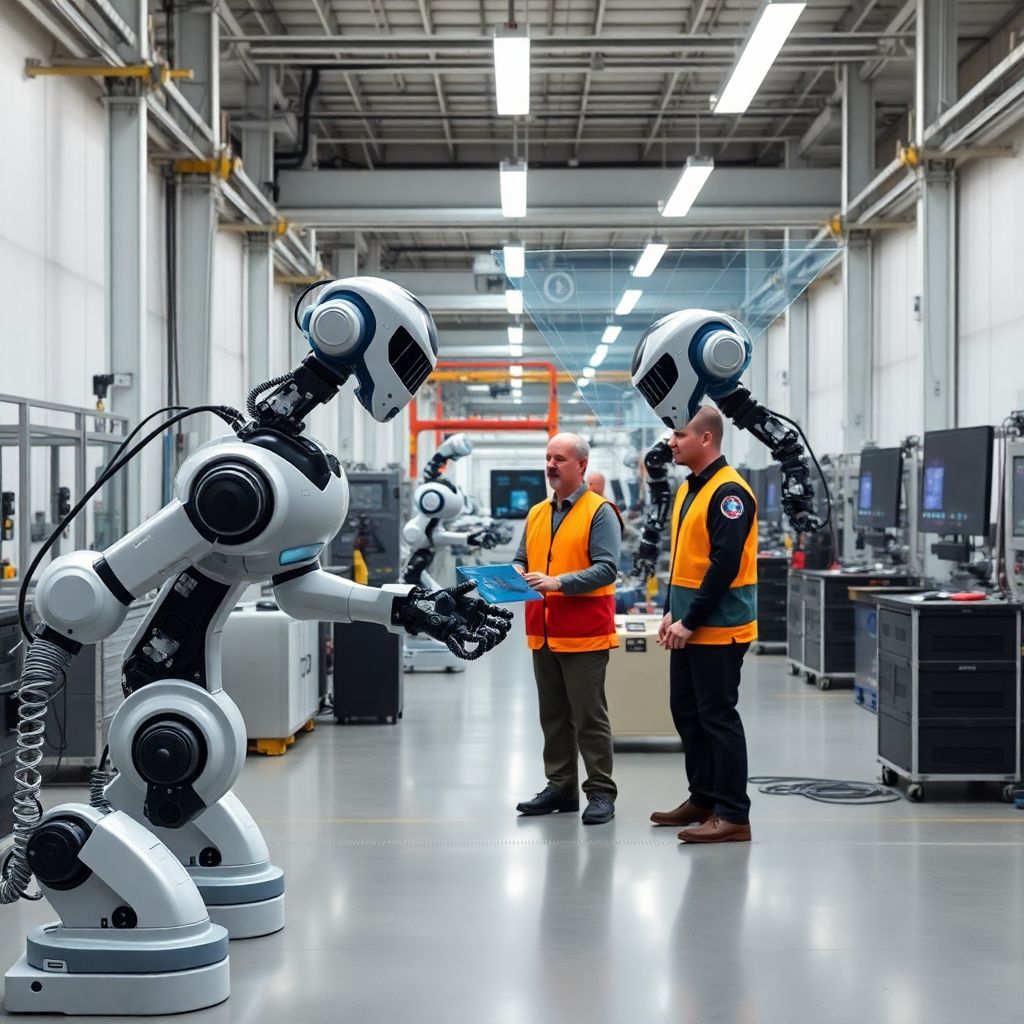
Google is quietly turning industrial robots into far more capable coworkers with its latest upgrade to the Gemini family: Gemini Robotics‑ER 1.6. Developed by Google DeepMind, this new model is built specifically for machines that operate in the physical world, giving them sharper spatial awareness, better task planning, and more reliable ways to judge whether they’ve actually done their job correctly.
Unlike general-purpose AI models that only process text or images, Gemini Robotics‑ER 1.6 is tuned for “embodied reasoning” – the kind of intelligence needed when a system has a body, sensors, and actuators and must interact with messy, unpredictable environments. That makes it especially relevant for factories, warehouses, energy facilities, and other industrial settings where robots need to do much more than repeat pre-programmed motions.
From Simulation to the Real World
Previous generations of AI for robotics often worked well in simulation but struggled in real plants, where lighting, noise, imperfect parts, and human activity introduce chaos. Gemini Robotics‑ER 1.6 is designed to bridge that gap. It doesn’t just classify images or follow a rigid script; it combines perception, reasoning, and action planning in a single model.
According to Google DeepMind, the model shows measurable gains in both spatial and physical reasoning compared to its predecessor and even compared to Gemini 3.0 Flash, a more general multimodal model. That means it’s better at understanding where objects are, how they relate to one another, and what physical interactions are needed to achieve a goal – a crucial step toward reliable autonomy.
Reading the Factory, Not Just the Manual
One of the most striking improvements is the model’s ability to read complex industrial instruments, such as analog gauges and sight glasses. These devices are still widespread in legacy infrastructure, especially in manufacturing, oil and gas, and chemical processing, where full digitalization is expensive and slow.
To tackle this, Google DeepMind worked with Boston Dynamics, known for its advanced mobile robots, to train Gemini Robotics‑ER 1.6 to visually interpret such equipment. Instead of requiring an expensive retrofit to add digital sensors everywhere, a robot equipped with cameras and this AI model can:
– Read an analog pressure gauge or temperature dial
– Interpret the fluid level in a vertical or horizontal sight glass
– Distinguish between normal and abnormal readings
– Use that information to decide what to do next
This capability is more than a neat trick; it lowers the barrier to deploying robots in existing facilities, where physical infrastructure can’t easily be rebuilt or upgraded.
Smarter Task Planning, Not Just Smarter Sensing
Seeing the environment is only half of the challenge. Industrial robots must also plan multi-step tasks: walk to a panel, check several instruments, compare readings against target ranges, then decide whether to adjust a valve or trigger an alert.
Gemini Robotics‑ER 1.6 is explicitly optimized for task planning. Given a high-level instruction like “inspect the pump station and verify it’s operating safely,” the model can break that goal into ordered sub-tasks, such as:
1. Navigate to pump station A.
2. Locate the main flow gauge and record the current reading.
3. Inspect the associated sight glass to check fluid level.
4. Compare both values with expected thresholds.
5. If values are outside permitted ranges, log an incident and notify a human supervisor.
Because the model is multimodal, it does not rely only on text but fuses camera feeds, sensor data, and prior instructions to generate its plan. This reduces the need for rigid, hand-coded workflows and enables more flexible behavior when conditions change.
Built-In Success Detection: Did the Robot Actually Succeed?
A common weakness in traditional industrial automation is that systems assume success unless an alarm is triggered. Gemini Robotics‑ER 1.6 introduces stronger “success detection” – the ability to assess whether an action really achieved the intended result.
For instance, if a robot is instructed to close a valve:
– It can visually confirm the handle angle has changed to the correct position.
– It can read downstream gauges to see if flow or pressure changed as expected.
– If the result doesn’t match the predicted outcome, it can flag a possible mechanical fault instead of silently moving on.
This feedback loop is vital in high-stakes environments where silent failures could lead to costly downtime or safety incidents. The model’s role isn’t just to act, but to reason about the consequences of its actions in context.
Safety: Better at Spotting Hazards
Industrial adoption of robotics has always been limited by safety concerns. Robots working alongside people and high-energy equipment must be able to recognize risky situations early.
In tests focused on hazard identification, Gemini Robotics‑ER 1.6 shows a noticeable improvement. On text-based safety scenarios – such as reasoning about procedures or interpreting written descriptions of a situation – performance increased by around 6%. In more visually grounded or context-rich scenarios, the model improved even more significantly, by roughly 10%.
Practically, this could translate into a robot that’s better at:
– Recognizing when protective gear is missing or improperly worn
– Spotting blocked emergency exits or obstructed walkways
– Seeing fluid leaks, smoke, or abnormal vibrations as red flags
– Interpreting warning labels and signage and factoring them into its decisions
Although these are incremental percentage gains on paper, in the field they can mean the difference between missing and catching a developing problem.
Why This Matters for Industrial Adoption
Enterprises have long been interested in robotics, but many deployments stall because robots struggle with the “last 10%” of tasks that require judgment, adaptation, or fine-grained understanding of the environment. Gemini Robotics‑ER 1.6 directly targets that gap.
Key benefits for industrial organizations include:
– Lower integration cost: Robots can work with existing analog infrastructure instead of requiring full digitization.
– Higher flexibility: AI-driven planning and reasoning let a single robot handle multiple inspection and maintenance tasks instead of being locked into one narrow job.
– Better uptime and reliability: Improved success detection helps catch subtle issues sooner, reducing unplanned downtime.
– Stronger safety posture: Enhanced hazard recognition supports compliance efforts and reduces risk to human staff.
For companies running complex facilities – from refineries and power plants to large warehouses – these capabilities can make the difference between robotics as a limited pilot and robotics as a core part of daily operations.
How Gemini Robotics‑ER 1.6 Differs From General AI Models
At first glance, Gemini Robotics‑ER 1.6 might sound similar to other large multimodal models, but its specialization is important. It is:
– Tuned for embodied agents, not just chat or content generation.
– Evaluated on spatial reasoning benchmarks and real-world robotics tasks.
– Optimized to connect perception (cameras, sensors) with low-level controls via intermediate reasoning.
Where a general model might be excellent at summarizing documents or generating code, Robotics‑ER 1.6 is meant to sit “on the robot,” interpreting what it sees and planning what to do next under real-world constraints such as safety rules, physical reach, and time limits.
Example Use Cases Inside a Plant or Warehouse
To understand how this translates into practice, consider a few concrete scenarios:
– Routine inspection rounds
A mobile robot navigates through a plant, reading gauges, checking sight glasses, scanning for leaks or abnormal heat signatures, and logging all results. Gemini Robotics‑ER 1.6 coordinates the route, interprets each reading, and flags anomalies.
– Startup and shutdown procedures
Instead of relying exclusively on humans to follow detailed checklists, a robot can assist by visually confirming that valves, switches, and panels are in the correct configuration. The AI model ensures each step is actually completed, not just assumed.
– Warehouse quality checks
Robots can inspect packaging, pallet integrity, or labeling in high-density storage environments, reasoning about placement, orientation, and potential hazards (like unstable stacks or blocked aisles).
– Remote operations support
In hazardous or remote locations, engineers can give high-level commands (“inspect the compressor bay and verify it is safe to restart”), while the robot – guided by Gemini Robotics‑ER 1.6 – figures out the concrete steps, collects evidence, and provides a structured report.
Challenges and Open Questions
Despite the progress, there are still important questions for enterprises considering this technology:
– Reliability under extreme conditions
How consistently does the model perform in environments with dust, glare, extreme temperatures, or partial sensor failures?
– Validation and certification
Safety-critical industries need clear methods to test, validate, and certify AI-driven behavior. That’s more complex for a model that reasons autonomously than for a fixed, deterministic control system.
– Human-robot collaboration
As robots get smarter, task boundaries between people and machines will shift. Companies will need clear policies for oversight, escalation, and responsibility when the AI’s judgment conflicts with a human’s.
Addressing these issues will determine how quickly highly capable AI-powered robots leave controlled pilots and become standard tools on shop floors.
What This Means for the Future of Robotics
Gemini Robotics‑ER 1.6 is part of a broader trend: the convergence of large-scale AI with physical automation. Where earlier generations of robots were strong but rigid, the new wave aims to be flexible, context-aware, and capable of reasoning in real time.
In the near term, that likely means more autonomous inspection, monitoring, and low-risk manipulation tasks. Over time, as models like Robotics‑ER continue to improve and are paired with robust hardware, robots will increasingly handle compound operations that currently require skilled technicians – always with humans in the loop for high-level decisions and oversight.
The key shift is conceptual: instead of thinking about robots as programmable machines, enterprises will start thinking of them as adaptive agents powered by specialized AI, able to understand their surroundings, plan their own actions, and evaluate their own performance.
Gemini Robotics‑ER 1.6 is not the final step in that evolution, but it is a notable one – especially for industries that have been waiting for robots to move beyond rigid automation and become genuinely intelligent partners in daily operations.