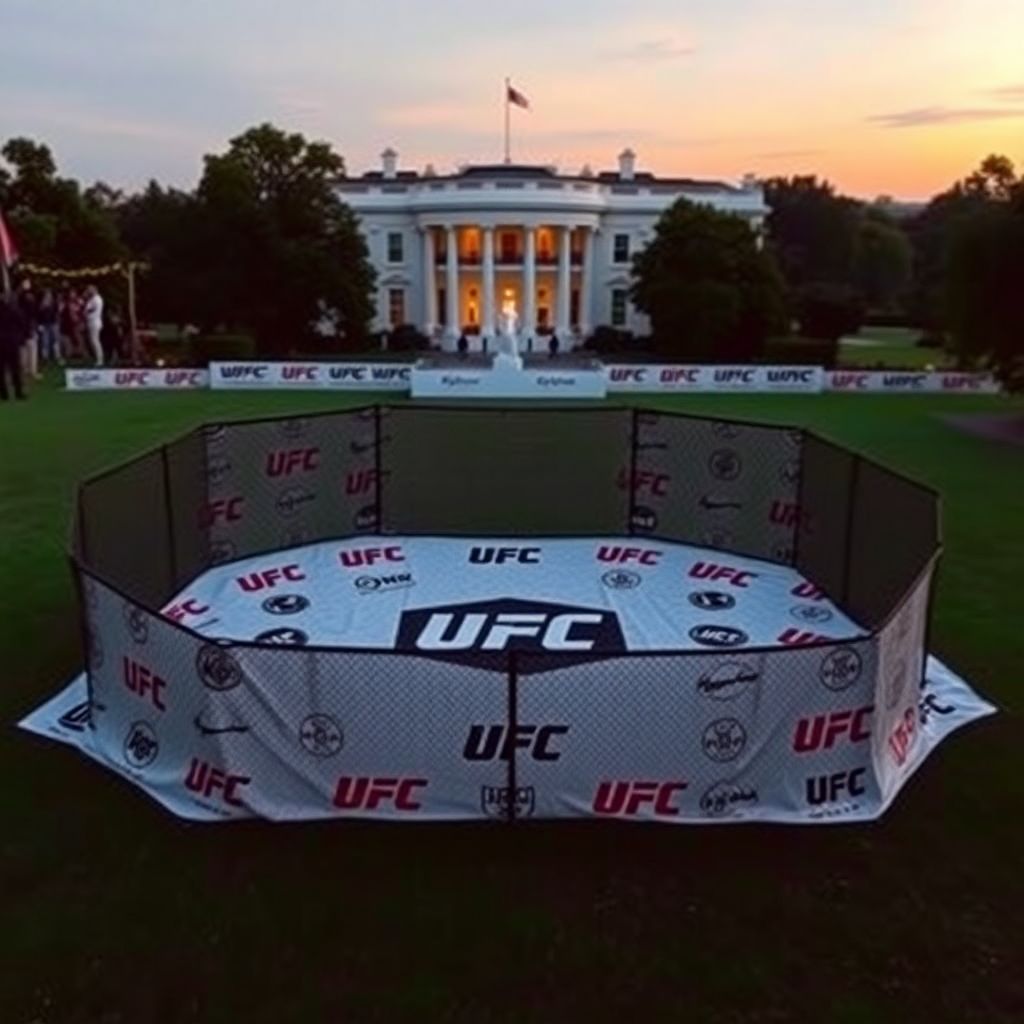
How Crypto Brands Are Taking Over the Octagon at Trump’s White House UFC Showcase
Crypto companies are poised to dominate the visual landscape of Sunday’s high-profile UFC card on the South Lawn of the White House, turning a combat sports spectacle into a powerful marketing stage for digital asset firms.
As with other major UFC events, the centerpiece will be the Octagon itself-but this time, emblazoned with the logos of multiple crypto projects right in front of one of the most famous buildings in the world. Photos shared from the venue show that firms such as VeChain, Polymarket, and Stake have secured prime placement on the canvas and around the cage, positioning themselves in full view of cameras, VIP guests, and millions of viewers.
This kind of visibility would be significant at any UFC event; at the White House, it becomes something closer to a cultural statement. The branding blitz illustrates how deeply intertwined crypto marketing has become with mainstream entertainment, and how President Donald Trump’s pro-crypto posture is quietly reshaping what appears in the background of official Washington.
The push into UFC branding did not happen overnight. Years earlier, the fighting league struck a blockbuster, multi-year sponsorship deal with Crypto.com, which became a co-presenting partner for major cards and secured its own prominent presence in and around the Octagon. Sunday’s event builds on that foundation: Crypto.com remains a core sponsor, while other digital asset firms now piggyback on the same infrastructure and visibility that the original deal helped normalize.
For VeChain, a blockchain platform focused largely on supply chain management and enterprise solutions, Octagon branding represents a chance to step outside the niche of industry insiders and reach a far broader audience that might never read a whitepaper or attend a developer conference. The association with high-performance athletes and a global sports brand taps into an aspirational narrative: resilient, tough, and future-focused.
Polymarket, known for its prediction markets, benefits from positioning its logo in a setting where outcomes, odds, and risk loom large in viewers’ minds. UFC fights are inherently speculative dramas-fans analyze styles, past records, and intangibles to guess who will win. That dynamic mirrors the mindset Polymarket is trying to tap into on-chain, making the association more than just a random ad buy.
Stake, a crypto-focused gambling and casino platform, fits even more naturally into the UFC environment. Combat sports have long been accompanied by betting, and placing its brand front and center at a marquee event reinforces its alignment with an audience already comfortable with risk, odds, and fast-paced decision-making. The White House backdrop only amplifies the impression that crypto-native entertainment has gone fully mainstream.
More broadly, the event highlights the unconventional ways in which Trump’s crypto-friendly stance manifests in public imagery. Rather than policy white papers or congressional hearings, it’s a fight cage erected on the South Lawn, surrounded by logos from blockchain and digital asset companies. The symbolism matters: for many viewers, their first association with crypto might not be charts or regulations, but a UFC knockout replayed across social feeds with a VeChain or Stake logo in the frame.
This convergence of politics, sports, and digital finance also illustrates how branding strategies in the crypto sector have matured. Early on, many projects chased speculative hype within insular circles. Now, the focus has shifted toward mass-market legitimacy: sports arenas, team jerseys, stadium naming rights, and now, a White House fight card. The message is that crypto is not an obscure subculture, but a permanent part of the broader economic and cultural landscape.
The timing is crucial. As digital assets continue to push into regulated products and institutional adoption, visibility at high-prestige events helps soften public skepticism. A logo on the Octagon doesn’t change the fundamentals of a protocol or platform, but it does influence perception-suggesting permanence, seriousness, and enough financial weight to secure top-tier sponsorship slots.
At the same time, the optics are certain to be polarizing. To supporters, the sight of crypto brands at a White House-hosted card will be seen as overdue recognition that the digital asset industry has become a major economic force. To critics, it may look like an uncomfortable blending of official political space with high-risk financial products and offshore casino-style platforms, reinforcing concerns around speculative excess.
Regardless of how it is received, the strategy reflects a clear calculation by crypto marketers: sports-especially combat sports-command one of the most loyal and engaged global audiences. UFC broadcasts reach viewers across continents and demographics, from longtime fight enthusiasts to casual fans drawn in by viral highlights. Having a logo stamped on the mat, visible in almost every camera angle, is one of the most efficient ways to burn a brand into public consciousness.
For Trump, the event also serves a dual purpose. It delivers on his image as a populist showman who blends politics and entertainment, while simultaneously sending a signal to crypto holders, traders, and entrepreneurs that their industry is welcome in his orbit. He does not need to say “I support crypto” in a speech; the logos on the Octagon do that work implicitly.
For the UFC, partnering with crypto companies offers access to a deep pool of sponsors that are hungry for attention and willing to pay for premium placement. Even during volatile market cycles, many major crypto players maintain sizable marketing budgets, seeing downturns as opportunities to gain share while weaker competitors retreat. Aligning with a pro-crypto administration further reduces the risk of political backlash for the league-at least in the short term.
The event also sets a template for future collaborations between digital asset firms and politically adjacent spectacles. Instead of limiting exposure to conventional tech conferences or finance-oriented events, crypto brands can hijack moments that capture the wider public imagination: major fights, concerts, festivals, and headline-grabbing appearances at iconic locations. The South Lawn Octagon is simply the most visible expression of that trend so far.
There is also a subtle shift in narrative playing out. Crypto’s early image revolved largely around technical innovation, libertarian ideals, and, later, speculative mania. By embedding itself into sports and entertainment, the industry is reframing itself as part of everyday life-no more exotic than a payment app or a rewards program. That normalization, more than any slogan or campaign, may be what ultimately cements digital assets in the economic mainstream.
As cameras pan across fighters, politicians, celebrities, and the famous façade of the White House, the logos on the mat will keep reappearing, second after second. For VeChain, Polymarket, Stake, and their peers, that repetition is the real prize: an endless loop of brand exposure at one of the most watched-and most symbolically charged-events of the year.
In the end, Sunday’s card is more than a novelty clash of cage fighting and presidential spectacle. It marks another step in crypto’s long march from fringe experiment to fully integrated part of popular culture, carved directly into the canvas of the Octagon on the White House lawn.