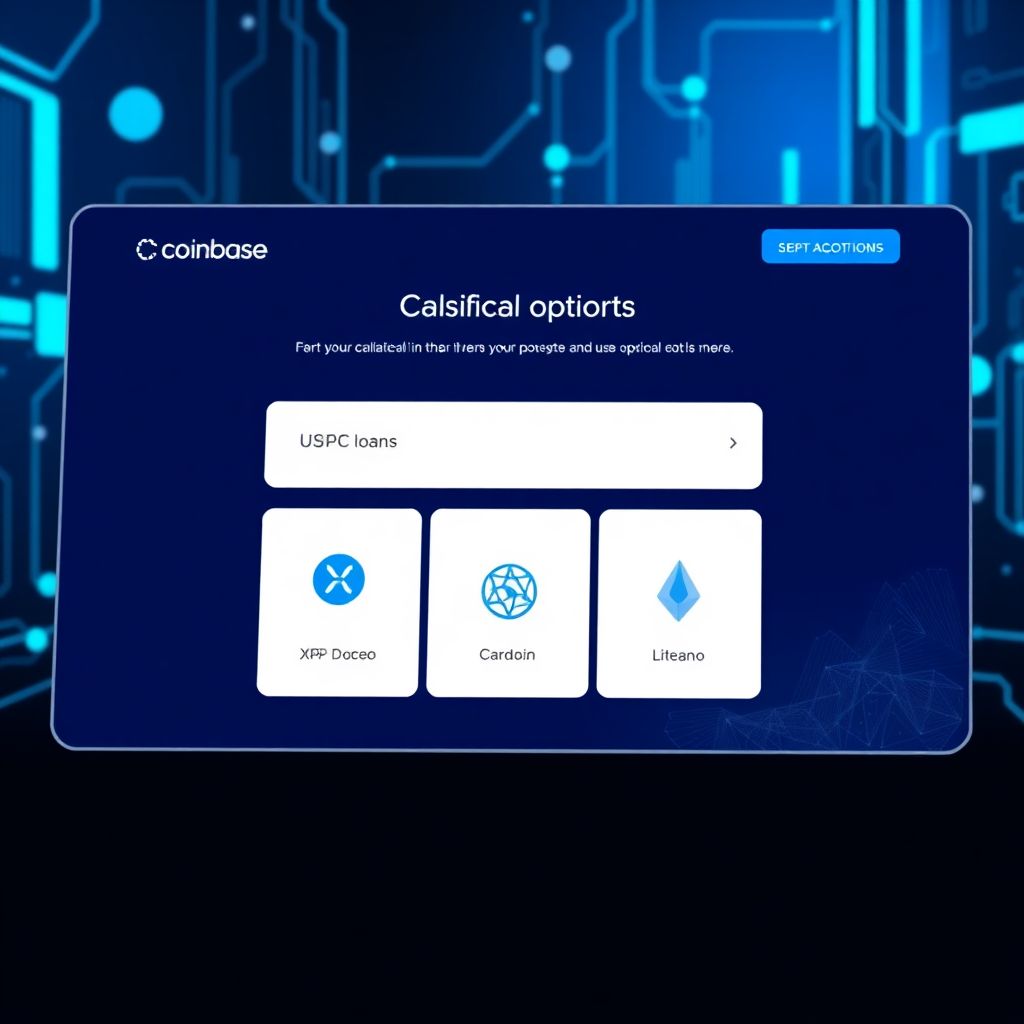
Coinbase is widening the reach of its crypto-backed lending business in the United States, adding support for four major altcoins: XRP, Dogecoin (DOGE), Cardano (ADA), and Litecoin (LTC). The move signals that the exchange is shifting its lending product from a Bitcoin- and Ethereum-focused offering into a broader, multi-asset service aimed at a much larger slice of the crypto market.
According to the company, users can now pledge these assets as collateral via the decentralized finance protocol Morpho and borrow up to 100,000 dollars in USDC, the U.S. dollar-pegged stablecoin issued by Circle. Loans are available to customers across most of the United States, with New York explicitly excluded from access due to regulatory constraints.
This expansion builds on a product that is already gaining meaningful traction. Coinbase’s crypto-backed loans are nearing the 2 billion dollar mark in total originations, based on on-chain and analytics dashboard data. The service first launched with support for Bitcoin, and later added Ethereum in November, gradually growing from a niche offering into a key piece of Coinbase’s strategy to turn idle customer balances into productive collateral.
The choice of new supported assets is not random. XRP, DOGE, ADA, and LTC are among the most liquid and widely traded cryptocurrencies outside of Bitcoin and Ethereum. Together, they commanded a combined market capitalization of around 117 billion dollars as of Wednesday-still less than half of Ethereum’s valuation, but large enough to represent a substantial pool of collateral that many holders have traditionally left untouched in wallets and exchanges.
By integrating with Morpho, Coinbase is effectively bridging its large retail and institutional user base with DeFi infrastructure, while still providing a familiar, centralized on-ramp experience. Users deposit their XRP, DOGE, ADA, or LTC through Coinbase, which then routes the positions into Morpho, allowing borrowers to tap USDC liquidity without needing to navigate DeFi interfaces or handle self-custody smart contract interactions themselves.
For customers, the pitch is straightforward: instead of selling their crypto to unlock liquidity, they can borrow against it. This can be useful for traders looking to leverage positions, long-term holders who need temporary cash flow, or businesses that want capital without realizing taxable gains. So long as the value of the collateral remains above the required threshold, borrowers can maintain their positions while accessing dollars in the form of USDC.
However, the model also inherits the classic risks of collateralized crypto lending. If the market value of pledged assets like DOGE or ADA drops sharply, borrowers may face margin calls or liquidations, losing part or all of their collateral. The volatility profile of these coins is typically higher than that of Bitcoin or even Ethereum, which makes the choice of collateral particularly important. Risk management-such as conservative borrowing levels and close monitoring of market conditions-remains critical for users.
From Coinbase’s perspective, adding altcoins to its lending roster serves several strategic goals. First, it deepens engagement from holders of these assets, giving them a new reason to keep their coins on the platform rather than moving them to competitors or cold storage. Second, it allows Coinbase to capture more of the stablecoin lending and borrowing market, an area that has become increasingly central to crypto finance. Third, it helps the company diversify revenue beyond trading fees, which tend to be cyclical and highly correlated with market volatility.
The exclusion of New York underscores how tightly regulated crypto lending has become in certain jurisdictions. State-level licensing regimes, past enforcement actions against interest-bearing products, and evolving interpretations of securities and lending laws have pushed exchanges to tailor availability on a state-by-state basis. Coinbase’s decision to roll out the product broadly across the U.S. but not in New York reflects a cautious approach amid ongoing regulatory scrutiny.
The timing of the expansion also says something about where the crypto lending space stands today. After a wave of high-profile collapses among centralized lenders, the market has shifted toward more transparent, on-chain structures that combine DeFi protocols with established intermediaries. By using Morpho as a backend while presenting a Coinbase-branded front end, the company is betting that users will prefer a hybrid model: DeFi rails under the hood, but a centralized platform to handle onboarding, custody, and support.
For XRP, DOGE, ADA, and LTC holders, the new feature effectively turns these assets into flexible collateral that can be deployed without leaving the Coinbase ecosystem. Long-term believers in these networks can opt to borrow stablecoins instead of liquidating their holdings during short-term cash crunches or market dips. At the same time, more sophisticated users may see an opportunity to execute strategies such as arbitrage, yield farming in other DeFi protocols using borrowed USDC, or hedging spot positions.
The macro implication is that more of the crypto market is becoming “financialized” in a traditional sense. Where previously many tokens simply sat in wallets as speculative bets, they are now being integrated into lending, borrowing, and credit markets. This can deepen liquidity and price discovery but also creates linkages between assets that may amplify contagion during periods of stress. If a broad sell-off hits collateral values across multiple altcoins simultaneously, it can trigger forced liquidations and systemic deleveraging.
Coinbase’s near-2 billion dollar lending milestone suggests that demand for crypto-backed credit remains strong despite previous industry setbacks. By layering in additional large-cap assets, the company is positioning itself to capture further growth if the market continues to mature and if regulators allow such products to expand. The evolution of this offering will likely be watched closely not only by competitors, but also by policymakers evaluating how consumer protection, transparency, and systemic risk intersect in crypto lending.
For individual users considering the new options, the calculus boils down to a few key questions: How stable is the asset you want to post as collateral? How much drawdown can you tolerate without facing liquidation? And does the flexibility of accessing USDC without selling your holdings justify the interest costs and market risk? As Coinbase brings XRP, DOGE, ADA, and LTC into its lending framework, those questions move from theory to practice for a much larger segment of the crypto-owning public.