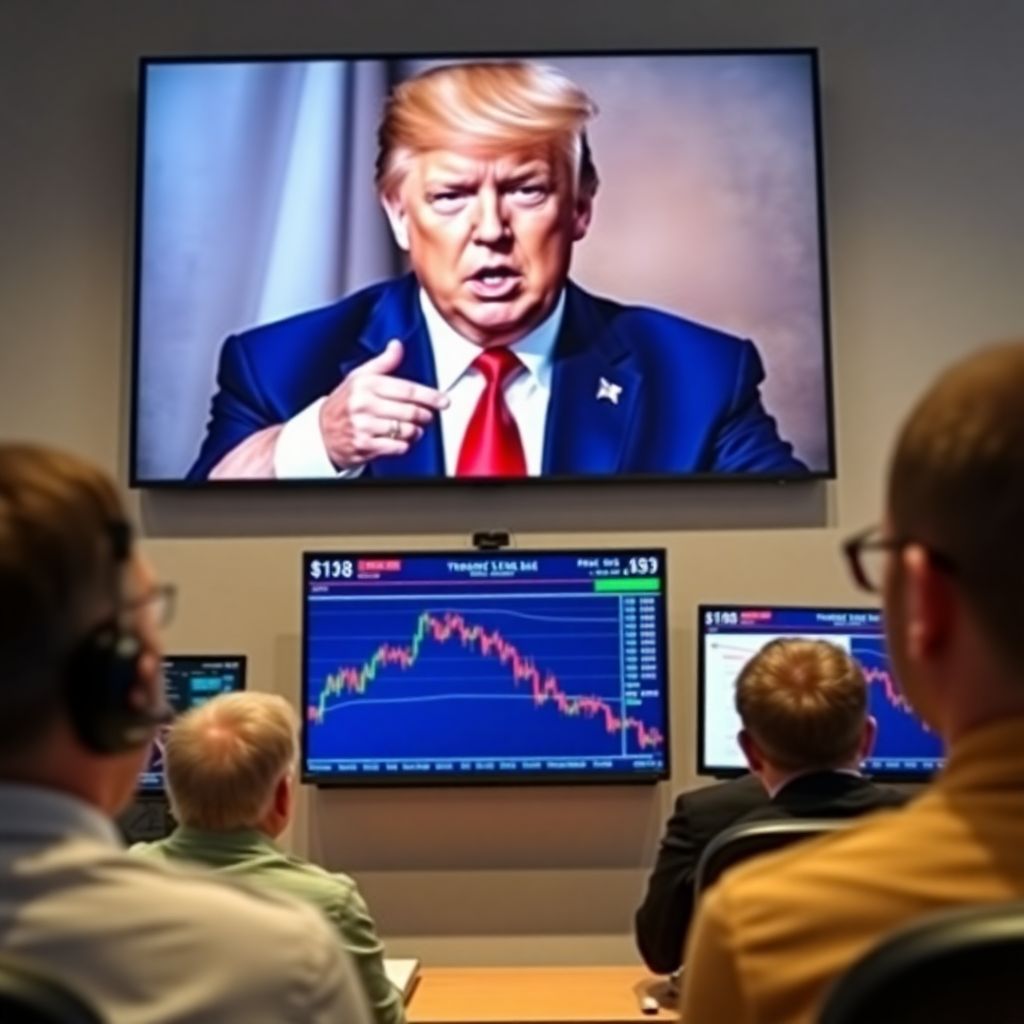
Bitcoin has now erased every dollar it gained in the so‑called “Trump trade” rally-and fallen significantly further, leaving latecomers to the move deep in the red.
After Donald Trump’s 2024 reelection, investors poured into Bitcoin, betting on a more crypto‑friendly White House and looser regulations. That wave of optimism sent BTC to fresh record highs throughout late 2024 and into 2025. The narrative was simple: a pro‑business administration, lighter regulatory pressure, and a weaker dollar over time would all favor scarce, politically neutral assets like Bitcoin.
For a while, that thesis looked brilliant. On November 4, 2024-the day before the election-Bitcoin closed around $67,793, according to market data. As election results crystallized on November 5, Bitcoin finished the day near $69,355. Within 24 hours, the market went into overdrive: BTC blasted through its previous record and printed a new all‑time high north of $75,000. Analysts and traders alike began floating six‑figure price targets as a matter of “when, not if.”
That surge was quickly branded the “Trump trade” in crypto: buying Bitcoin as a proxy bet on a more permissive regulatory stance, favorable tax treatment for digital assets, and a renewed appetite for risk across financial markets. Institutional desks, retail traders, and crypto‑native funds all leaned into the same narrative, adding fuel to the rally.
Fast‑forward nearly two years, and the picture looks very different. Bitcoin recently changed hands around $60,619-roughly 12.6% below its closing price on election day itself and far off its peak above $75,000. From the top of that euphoric spike, BTC has shed more than half its value, wiping out all of the post‑reelection gains and then some. Anyone who bought into the hype near the highs is now staring at steep unrealized losses.
The unwind of the “Trump trade” highlights a familiar pattern in Bitcoin’s history: politics and narratives can light a fire under prices in the short term, but they rarely override macroeconomic reality. As markets digested the initial optimism, several forces converged to pressure BTC lower-tighter global liquidity, renewed regulatory uncertainty, shifting expectations around interest rates, and simple market exhaustion after a parabolic run.
Another key factor has been the macro backdrop. While many investors expected a sustained wave of inflation and continued dollar debasement that would benefit Bitcoin, central banks proved more aggressive than anticipated in tightening financial conditions. Higher real yields and more attractive returns in traditional fixed‑income markets reduced the urgency for institutions to chase riskier assets like crypto. As the cost of capital rose, leveraged bets on Bitcoin became more painful to maintain.
Regulatory dynamics also cooled enthusiasm. Even under a theoretically friendlier administration, the U.S. regulatory apparatus remains fragmented and often adversarial toward parts of the crypto industry. Enforcement actions against exchanges and DeFi projects, mixed messaging around stablecoins, and uncertainty over spot ETF approvals all contributed to a more cautious stance from large investors. The idea that one election could instantly transform the regulatory environment for Bitcoin proved overly simplistic.
Market structure amplified the move in both directions. As Bitcoin screamed higher after the election, derivatives markets became frothy: funding rates soared, open interest ballooned, and leveraged longs piled in. When the trend reversed, that leverage turned into a crushing headwind. Liquidations cascaded, forcing mechanically driven selling and accelerating the drop. What had been a one‑way trade suddenly became a liquidity trap for late entrants.
For long‑term holders, the current price action is uncomfortable but not unprecedented. Bitcoin has repeatedly experienced deep drawdowns-often 50-80% from peaks-before stabilizing and eventually grinding higher over multi‑year horizons. From that perspective, the fact that BTC still trades above $60,000 despite a major washout in speculative excess can be read as a sign of underlying resilience and ongoing institutional adoption.
Shorter‑term traders, however, are grappling with a different reality. The idea that political events alone can sustain a bull market has been badly undermined. Many are re‑evaluating strategies that relied too heavily on headlines and not enough on risk management. The “Trump trade” in Bitcoin has turned into a case study in how quickly narrative‑driven rallies can reverse once expectations outrun fundamentals.
Looking ahead, the key questions for Bitcoin are less about which party occupies the White House and more about structural drivers: the trajectory of global interest rates, the pace of sovereign debt expansion, the health of the ETF and custody ecosystem, and the real‑world integration of Bitcoin into payment, savings, and treasury strategies. If those drivers remain intact, political cycles may end up being noise rather than signal over the long run.
For individual investors trying to make sense of this reversal, a few lessons stand out. First, anchoring to narrative highs-like “Trump just won, so Bitcoin must go up”-is dangerous. Markets discount expectations quickly, and by the time a story is widely known, much of its effect is already priced in. Second, sizing and time horizon matter more than any single event; those who treated Bitcoin as a long‑term position rather than a short‑term election trade are still up massively compared to prior cycles, even after the drawdown.
Finally, the unwinding of the post‑reelection rally reinforces a core truth about Bitcoin: it remains a highly volatile asset whose price can deviate sharply from any single narrative, political or otherwise. Elections can spark momentum and shape sentiment, but they do not change the underlying code, monetary policy, or global supply‑demand balance that ultimately drive value over years, not weeks.
The “Trump trade” era in Bitcoin may be over, but the broader experiment of a decentralized, scarce digital asset navigating a shifting geopolitical and macroeconomic landscape is still very much alive. For now, the market has delivered a harsh reminder: political optimism can ignite a rally, but it cannot guarantee that gains will last.