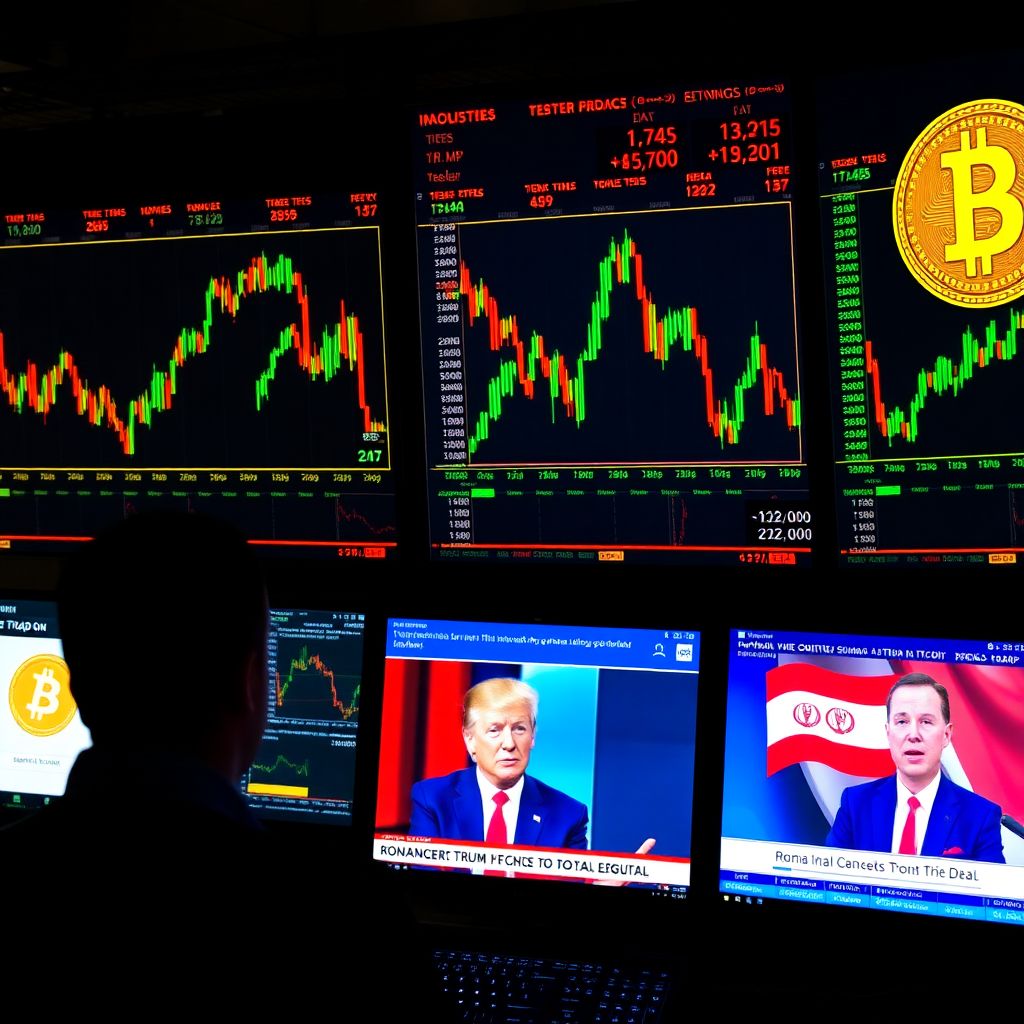
Bitcoin briefly reclaimed the $65,000 mark after former U.S. President Donald Trump declared a completed deal with Iran, yet many crypto traders are treating the move as a short‑term “relief rally” rather than the start of a sustained bull run.
According to market data trackers, Bitcoin climbed to around $65,860, gaining about 2.2% in the last 24 hours and roughly 4% over the past week. The jump came shortly after Trump posted on his social platform on Sunday, boasting of a “Great Deal” with Iran and claiming he had authorized the “toll free opening of the Strait of Hormuz” and the removal of a U.S. naval blockade.
The Strait of Hormuz is one of the world’s most critical chokepoints for oil shipments, and any disruption there tends to send shockwaves through global markets. News that tensions might ease, at least on paper, helped spark risk‑on appetite across several asset classes, with Bitcoin among the beneficiaries.
What makes this round of negotiations stand out is that it didn’t rely solely on Trump’s own announcements. Pakistan’s prime minister publicly confirmed the deal before Trump’s posts, lending an extra layer of perceived credibility. Even so, professional investors are still treating the agreement as “not done until it’s signed.”
Market participants remain acutely aware that geopolitical deals are fragile. As Markus Levin, co‑founder of XYO, noted in comments to the press, traders are unlikely to fully price in any long‑term resolution until the agreement is formally signed in Switzerland, which is scheduled for Friday. Until that moment, the market is operating in a zone of speculation rather than certainty.
This hesitancy is visible not only in spot prices, but also in derivatives and prediction markets. Futures funding rates and options skew show that traders are not rushing to price in a new macro uptrend. Instead, they appear to be positioning for heightened volatility around the signing date, with some hedging against the possibility that the deal unravels or is delayed.
Prediction markets, where participants bet on the likelihood of political and geopolitical events, also indicate a cautious stance. Contracts tied to the durability of any U.S.-Iran understanding, or to the risk of renewed conflict in the region, suggest that a significant portion of traders doubts this deal will deliver lasting stability. This skepticism bleeds into crypto pricing, limiting the upside reaction despite the headline‑grabbing news.
For Bitcoin specifically, the rally highlights a recurring pattern: geopolitical news can act as a short, sharp catalyst, but it rarely changes the asset’s long‑term fundamentals on its own. Over the last few years, Bitcoin has alternated between behaving like “digital gold” – a hedge against geopolitical and monetary turmoil – and a high‑beta risk asset that rises and falls with broader speculative sentiment. The latest move looks more like the latter.
Many traders view the current price action as a textbook relief rally after weeks of choppy, directionless trading. In a relief rally, prices bounce as immediate fears recede – in this case, the prospect of a severe escalation in the Gulf region – but without a clear shift in underlying macro or regulatory conditions. Without stronger catalysts, these moves often fade once the initial burst of optimism wears off.
Skeptics also point to Bitcoin’s recent failure to convincingly break above key resistance zones. While reclaiming $65,000 is psychologically important, technical analysts highlight that the market still faces supply pressure from long‑term holders taking profit, miners selling into strength, and large funds rebalancing portfolios. Until Bitcoin can establish support well above these levels on strong volume, many will treat rallies as opportunities to sell rather than to accumulate.
Another factor tempering enthusiasm is the broader macro backdrop. Interest rates in major economies remain elevated, liquidity conditions are tighter than during earlier bull cycles, and regulatory scrutiny of digital assets continues to weigh on institutional participation. Against that picture, one diplomatic development – even a significant one like a U.S.-Iran deal – is unlikely to rewrite the entire investment thesis.
At the same time, some analysts argue that any easing of geopolitical risk in the Middle East can indirectly support Bitcoin over the medium term. Reduced war premiums on oil could help contain inflation, potentially giving central banks more room to eventually loosen monetary policy. A pivot toward lower rates and improved liquidity has historically been positive for speculative assets, including cryptocurrencies. But that is a multi‑month to multi‑year story, not something that resolves over a single week of headlines.
The episode also underscores Bitcoin’s core “fundamental problem” in the eyes of many professionals: it is still driven less by its original narrative as a decentralized, apolitical money and more by short‑term positioning, macro flows, and news shocks. Each geopolitical flare‑up brings a new wave of claims that Bitcoin is a safe haven, yet the data often shows that its correlation with tech stocks and other risk assets remains stubbornly high during periods of market stress.
For traders, the current environment demands nuance. On one hand, volatility around geopolitical events can create attractive short‑term setups, especially for those comfortable trading leverage and derivatives. On the other hand, basing a long‑term investment thesis solely on fragile diplomatic developments is risky. If the deal stumbles in Switzerland, or if additional conditions and side‑agreements emerge that reignite tensions, today’s optimism could quickly turn into another sharp drawdown.
Long‑term investors are therefore more focused on structural drivers: Bitcoin’s halving cycle, institutional adoption via exchange‑traded products, regulatory clarity in major jurisdictions, and the health of the broader crypto ecosystem. These factors determine whether price rallies can be sustained, not simply whether one geopolitical headline breaks favorably.
There is also a psychological dimension. After multiple boom‑and‑bust cycles, a large share of the market has grown wary of overreacting to news, especially when it involves highly polarizing political figures or regions with a history of sudden reversals. That accumulated experience feeds into the current skepticism: traders have seen too many “historic deals” or “turning points” that ultimately failed to change much on the ground.
From a risk‑management perspective, the move above $65,000 is prompting some participants to rebalance. Short‑term traders may lock in profits ahead of Friday’s signing, anticipating heightened volatility around the event. Longer‑term holders might use the bounce to reduce leverage, build cash buffers, or rotate into assets they perceive as less headline‑driven. These cross‑currents can cap upside momentum even when the immediate news is positive.
For those trying to interpret what this means for Bitcoin’s trajectory, a few key points stand out:
1. Headline sensitivity remains high. Bitcoin is still highly reactive to geopolitical developments, especially those affecting energy markets and global risk sentiment.
2. Skepticism is now the default. After years of false dawns, traders are slower to believe that any single event marks the beginning of a fresh, durable bull market.
3. Structural trends matter more than single deals. Adoption, regulation, macro policy, and network health will define the next major leg higher or lower.
4. Short‑term rallies can coexist with long‑term uncertainty. Prices can jump on relief and still sit within a broader sideways or corrective phase.
In that sense, the latest spike above $65,000 says less about a fundamental re‑rating of Bitcoin and more about how quickly capital moves in response to perceived shifts in global risk. Unless the U.S.-Iran deal is not only signed but proves stable over time – and is followed by broader improvements in macro conditions – many traders will continue to see this move as temporary.
For now, markets are in a holding pattern: pricing in some optimism about reduced tensions in the Strait of Hormuz, but unwilling to fully commit until the ink is dry in Switzerland and the real‑world implications of the deal become clearer. Bitcoin’s rise to the mid‑$60,000s reflects that cautious hope, while the lingering skepticism shows just how fragile that hope remains.