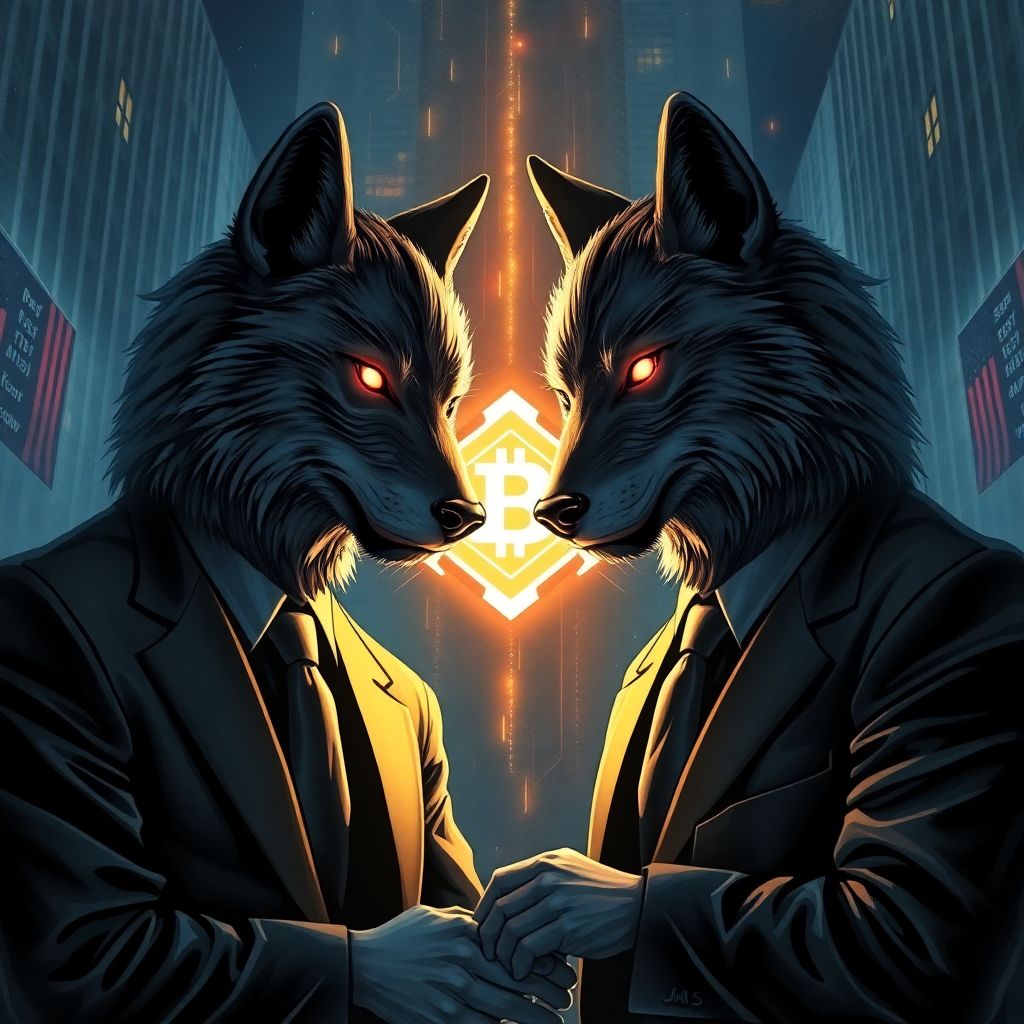
Robinhood wants its new blockchain to feel equally familiar to Wall Street professionals and to crypto-native traders-and that tension sits at the heart of its design.
That’s what CEO Vlad Tenev was getting at with his “two wolves” metaphor, and it’s how Robinhood’s head of crypto, Johann Kerbrat, explains the vision behind Robinhood Chain, the company’s Ethereum layer-2 network. One “wolf” represents sober, institution-friendly finance: tokenized stocks, derivatives, compliance, and risk controls. The other embodies the chaotic energy that made crypto explode in the first place: memes, experimental tokens, and speculative trading.
According to Kerbrat, the point is not to choose one over the other, but to deliberately build a network where both can coexist.
“We want to show customers that we care about what they care about,” he said. For Robinhood, those customers range from first-time investors buying their first stock to meme coin traders chasing the next hype cycle. The chain has to work for both, and that means designing the infrastructure and user experience in a way that doesn’t alienate either side.
Robinhood Chain is built as an Ethereum layer-2, which already signals its intent. By sitting on top of Ethereum, it taps into the most established smart contract ecosystem, while using L2 scaling techniques to reduce fees and speed up transactions. That’s crucial if you want to support both high-volume trading of financial instruments and the frenetic on-chain activity that often accompanies meme seasons.
On the “serious” side of the ledger, the roadmap centers on real-world financial products being mirrored on-chain. Think tokenized equities that represent traditional stocks, on-chain versions of derivatives contracts, and other structured products that traders already understand from legacy markets. These instruments demand clear rules, predictable settlement, and rigorous risk management tools-features that institutional investors and regulated platforms expect as a baseline.
At the same time, Robinhood knows that what keeps many users coming back to crypto are not sober yield curves and options greeks, but culture: memes, jokes, viral tokens, and the social experience of trading. That’s the second wolf. The company is not pretending that this side of crypto doesn’t exist-if anything, it’s explicitly making room for it. A network that only supports “serious” finance might be compliant but barren; a network that only chases hype risks burning out and losing credibility. Robinhood Chain is pitched as a middle path.
Kerbrat frames this as a customer-first philosophy. Different segments of Robinhood’s user base care about different things: some about safety and regulated access to familiar products; others about speed, low fees, and a playground for experimentation. The aim is to ensure the chain “works for what people care about,” whether that means executing a tokenized equity trade with institutional-grade reliability or aping into a meme coin with one tap from a mobile app.
From a strategic perspective, this dual identity is also a way for Robinhood to differentiate itself in a crowded crypto landscape. Purely “degen” chains compete on how wild and speculative their ecosystems can be. More conservative, institution-focused chains compete on compliance, custody, and partnerships. Robinhood already straddles both worlds in its core business-serving retail traders with a sleek interface, while integrating with market makers and institutional liquidity behind the scenes. Extending that model on-chain is a logical next step.
The early traction of Robinhood Chain suggests that this hybrid approach is resonating. In just a short time since launch, the network has seen brisk adoption, with meaningful on-chain activity across trading, transfers, and early experiments in tokenized assets. The tight integration with the existing Robinhood app and brand lowers the barrier to entry for millions of users who may have never previously used a self-custodial wallet or interacted directly with a blockchain.
A big part of the bet is user experience. Traditional crypto networks often require juggling multiple wallets, bridges, and confusing token standards. Robinhood is trying to hide that complexity behind an interface that feels like the app its users already know: clear balances, simple order flows, and educational prompts. Under the hood, it’s still an Ethereum L2; on the surface, it should feel like just another tab in the Robinhood product suite.
This “two wolves” model also has regulatory and reputational implications. By putting tokenized equities and derivatives on the same chain as meme coins and experimental tokens, Robinhood has to be extremely careful about how it manages risk, disclosures, and access. That likely means building strong controls at the application layer-what users see in the app-while allowing the underlying network to remain open and composable for developers.
Developers, in turn, are crucial to making the vision work. Without a vibrant ecosystem of apps, Robinhood Chain would be little more than a technical curiosity. The hope is that builders will see the opportunity in a chain that can eventually connect traditional financial instruments with the creativity of Web3: on-chain portfolios that blend stocks and tokens, structured products that pay out in crypto, or social trading experiences built around both meme assets and blue-chip equities.
For retail users, the upside of such a network could be unprecedented access. A single on-chain account might one day hold a mix of tokenized shares, stablecoins, options-like instruments, and purely speculative meme assets, all tradable 24/7 with transparent settlement. That’s a very different world from the current split between brokerage accounts on one side and crypto wallets on the other.
Of course, trying to satisfy both wolves comes with real risks. If the chain leans too far into speculation, it could undermine Robinhood’s attempts to court more conservative regulators and institutional partners. If it clamps down too aggressively in the name of safety, it might drive away the very crypto-native users who give on-chain ecosystems their energy. Balancing these forces is not just a branding exercise; it’s an ongoing governance and product challenge.
Over time, the success of Robinhood Chain will likely be measured by how seamlessly these two identities blend. Are tokenized equities actually being used by serious traders and investors on-chain, or do they remain a niche curiosity? Do meme tokens and community-driven projects flourish without overwhelming the network with noise and scams? Can the chain foster a culture where “degens” and “suits” are not at odds, but part of the same financial fabric?
Kerbrat’s comments suggest that within Robinhood, this is seen not as a contradiction, but as the company’s core advantage. The platform grew by making complex financial markets feel accessible and even fun to everyday users, without entirely shutting out more advanced traders. Robinhood Chain extends that ethos into the world of decentralized finance: trustworthy enough for serious money, playful enough to remain culturally relevant.
In that sense, the “two wolves” inside Robinhood Chain are less a conflict to be resolved and more a design principle. The network is being built with the assumption that modern finance will continue to have these two sides-formal and informal, regulated and experimental, analytical and memetic-and that the most powerful platforms will be those that can host all of them in one place.
Whether Robinhood can maintain that balance as volumes grow, products get more complex, and scrutiny increases remains to be seen. But the intention is clear: Robinhood Chain is not choosing between becoming a polished financial hub for professionals or a chaotic playground for crypto natives. It is trying to be both at once-and to prove that the future of finance will be shaped where those two worlds meet.