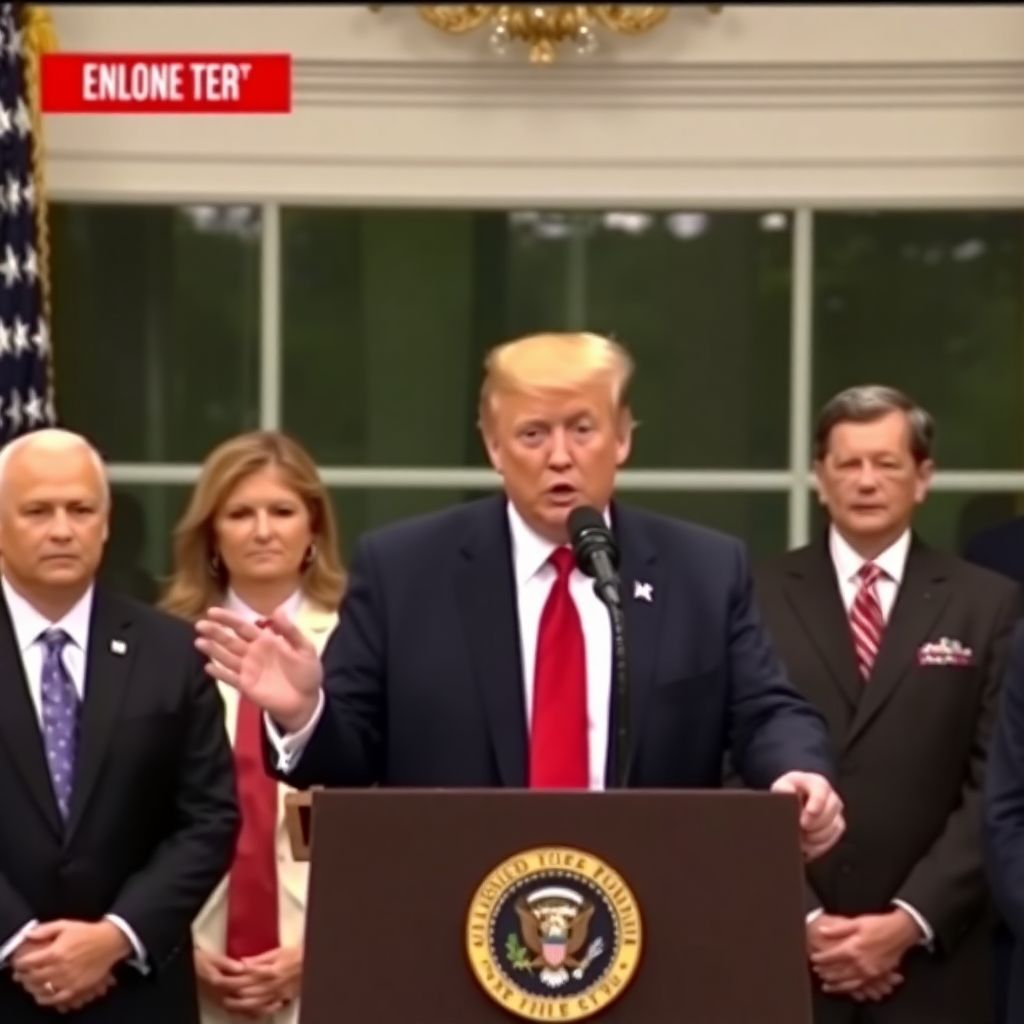
Trump is preparing to put newly declassified intelligence on the 2020 U.S. election at the center of a prime-time address, a move that has drawn intense interest from financial markets, political analysts, and prediction traders alike.
The speech is scheduled for Thursday at 9:00 PM ET and will feature the president flanked by the country’s most senior national security and law enforcement officials: CIA Director John Ratcliffe, Homeland Security Secretary Markwayne Mullin, FBI Director Kash Patel, and Acting Director of National Intelligence Bill Pulte. Their presence signals that the White House intends to frame the issue not just as a political dispute, but as a matter of national security and institutional trust.
Early chatter suggested the televised address might focus on the escalating tensions with Iran. However, people familiar with the planning indicate the administration has shifted the emphasis: the centerpiece will be intelligence documents on the 2020 election that have recently been declassified and prepared for broader public release.
These documents trace back to assessments compiled in early 2021 by the Department of Justice, the FBI, and the Department of Homeland Security. The original mandate was narrow but critical: determine whether foreign powers had succeeded in tampering with U.S. election infrastructure or otherwise undermining the security and legitimacy of the vote.
Investigators conducted a wide-ranging review of election systems and procedures. They studied digital and physical infrastructure, including voter registration databases, systems used for tabulation and reporting, ballot handling processes, and mechanisms for certifying and publishing final results. The overarching question was whether any foreign state-linked actor had been able to stop eligible citizens from voting, alter votes, manipulate ballots, corrupt vote counts, or delay or distort the public release of results.
The official government assessment found no evidence that foreign governments achieved any of these core objectives. While cyber intrusions and attempted intrusions were documented, investigators concluded that no foreign actor prevented people from casting ballots, changed vote tallies, tampered with ballot integrity, or significantly interfered with the timely reporting of outcomes in a way that would have altered the certified result of the 2020 presidential election.
At the same time, the reports did not downplay ongoing cyber activity from abroad. Intelligence agencies recorded operations linked to Russia and Iran that targeted election-related networks and ancillary systems. In some cases, those campaigns did gain access to limited election-related data or peripheral systems. Nonetheless, the assessment states that these intrusions did not materially affect voter registration records, ballot security, vote totals, or the final electoral outcome.
The documents also examined information campaigns and narratives pushed by foreign actors. Several claims promoted by Iran about alleged structural vulnerabilities in the U.S. electoral process were described in the assessment as either overstated or outright inaccurate. According to the declassified findings, such narratives appeared designed more to cast doubt on democratic institutions than to reflect verified flaws in election mechanics.
With these materials now declassified, the outstanding question is not simply what the reports say-those conclusions have been broadly known-but how the administration will present and interpret them. Market participants and political strategists are watching for any shifts in emphasis, newly disclosed details, or reinterpretations that might influence public perception of the 2020 race or shape the narrative going into the next election cycle.
Prediction traders have already begun reacting. Data from Polymarket shows that traders currently assign roughly an 8% probability that U.S. courts will ultimately determine that the 2020 election was fraudulent. Despite renewed media focus on the declassified intelligence, those odds remain low, suggesting that informed speculators still see a legal overturning of the 2020 result as highly unlikely. If the president’s address introduces new, concrete evidence that contradicts the existing official assessments, that probability could shift rapidly; if it mainly reiterates familiar findings, markets may respond with a shrug.
The timing of the speech is particularly significant because it lands amid a period of elevated geopolitical risk that has already spilled over into asset prices. In the days leading up to the announcement, the administration moved to reinstate a blockade targeting Iranian vessels and customers in the Strait of Hormuz, one of the world’s most critical chokepoints for oil and gas shipments. Alongside this, new cargo fees were introduced for ships transiting the narrow waterway.
Those moves rattled energy markets and fed into broader risk aversion. Bitcoin, often seen as a high-beta asset responding quickly to shifts in macro sentiment, slid more than 2% toward the 62,000 dollar level following the blockade announcement. The decline underscored how tightly crypto prices remain correlated with global political developments and perceived threats to trade routes, energy supply, and regional stability.
Trump underscored the strategic stakes of Hormuz with uncompromising language, declaring that the strait would remain open “with or without Iran” and proclaiming that the United States would be recognized as “THE GUARDIAN OF THE HORMUZ STRAIT.” The comments came after renewed attacks and incidents around the shipping lane heightened confrontations between Washington and Tehran, reviving fears of miscalculation or escalation.
Despite this tense backdrop, officials say the upcoming address will prioritize the declassified 2020 election materials rather than detailing new Iran policy. The choice of guests on stage-intelligence chiefs and law enforcement heads rather than diplomatic or military leaders-reinforces the impression that the White House wants to recast the election narrative as a security issue, not just a partisan dispute.
Legislators on both sides of the aisle, advocacy groups, and institutional investors are likely to watch closely for any divergence from previously released findings. One focal point will be whether the administration unveils documentation or analysis that had not yet been public, or whether it simply repackages existing assessments for a prime-time audience. Even subtle alterations in tone-emphasizing doubt instead of certainty, or highlighting edge cases instead of aggregate conclusions-could influence public confidence in U.S. election systems.
For markets, the stakes are less about relitigating 2020 and more about what the speech signals for the future. If the address escalates domestic political tensions, traders may start pricing in higher risk premiums for U.S. assets ahead of the next election cycle. Heightened polarization around election integrity could translate into volatility around key dates such as party conventions, debates, and state-level legislative actions affecting voting rules.
The crypto sector in particular is sensitive to these shifts. Digital assets often rally when investors fear institutional instability, monetary disorder, or a crisis of confidence in traditional governance. However, they can just as easily sell off if uncertainty translates into stricter regulation, reduced risk appetite, or liquidity stress. The reaction of Bitcoin and other major tokens after the address will offer an immediate barometer of how traders interpret the broader implications.
There is also a long-term institutional angle. By bringing declassified election intelligence into a televised political moment, the administration is effectively testing how far intelligence products can be integrated into public debate without eroding trust in the agencies that produce them. If viewers perceive the material as being selectively presented or framed for partisan effect, it could deepen skepticism toward future assessments on everything from cyber threats to foreign interference and national security crises.
On the other hand, a transparent and sober presentation that carefully distinguishes between verified facts, analytical judgments, and unresolved questions could help reinforce trust. Much will depend on how clearly officials articulate what the intelligence community can and cannot say with confidence, and how candidly they acknowledge the limits of any retrospective assessment of complex, distributed election systems.
Another dimension concerns foreign actors themselves. Publicly airing detailed findings about Russian and Iranian operations sends a signal abroad: their tactics are being scrutinized, documented, and, when necessary, exposed. That could deter some future interference efforts but may also prompt adversaries to refine their methods, shifting away from direct infrastructure targeting toward more subtle psychological and information operations that are harder to attribute and counter.
Domestic legal battles form a parallel track. Even though current prediction markets assign only modest odds that courts will overturn any aspect of the 2020 result, new material included in the speech could be invoked in future lawsuits, legislative hearings, or state-level debates over election law reforms. Attorneys and advocacy groups will comb through the address, and any supporting documents, looking for statements that might bolster their arguments for tightening or loosening various election rules.
For voters, the prime-time spectacle risks reinforcing an already polarized environment. Supporters and critics of the administration are likely to interpret the same set of facts in radically different ways, filtering them through prior beliefs about fraud, fairness, and institutional bias. In that sense, the address is not just about what happened in 2020, but about who gets to define reality for 2024 and beyond.
As the countdown to the speech continues, three broad questions loom: Will the administration present genuinely new evidence or mostly reframe existing conclusions? Will financial and crypto markets treat the address as a meaningful source of new risk, or as political theater with limited real-world impact? And will the use of declassified intelligence in a prime-time setting strengthen or weaken public trust in the electoral system and the agencies charged with protecting it?
Those answers will begin to take shape the moment Trump steps in front of the cameras flanked by his intelligence chiefs, setting the tone not only for the latest chapter in the 2020 election saga, but also for how the United States manages the intersection of national security, democratic legitimacy, and market confidence in the years ahead.