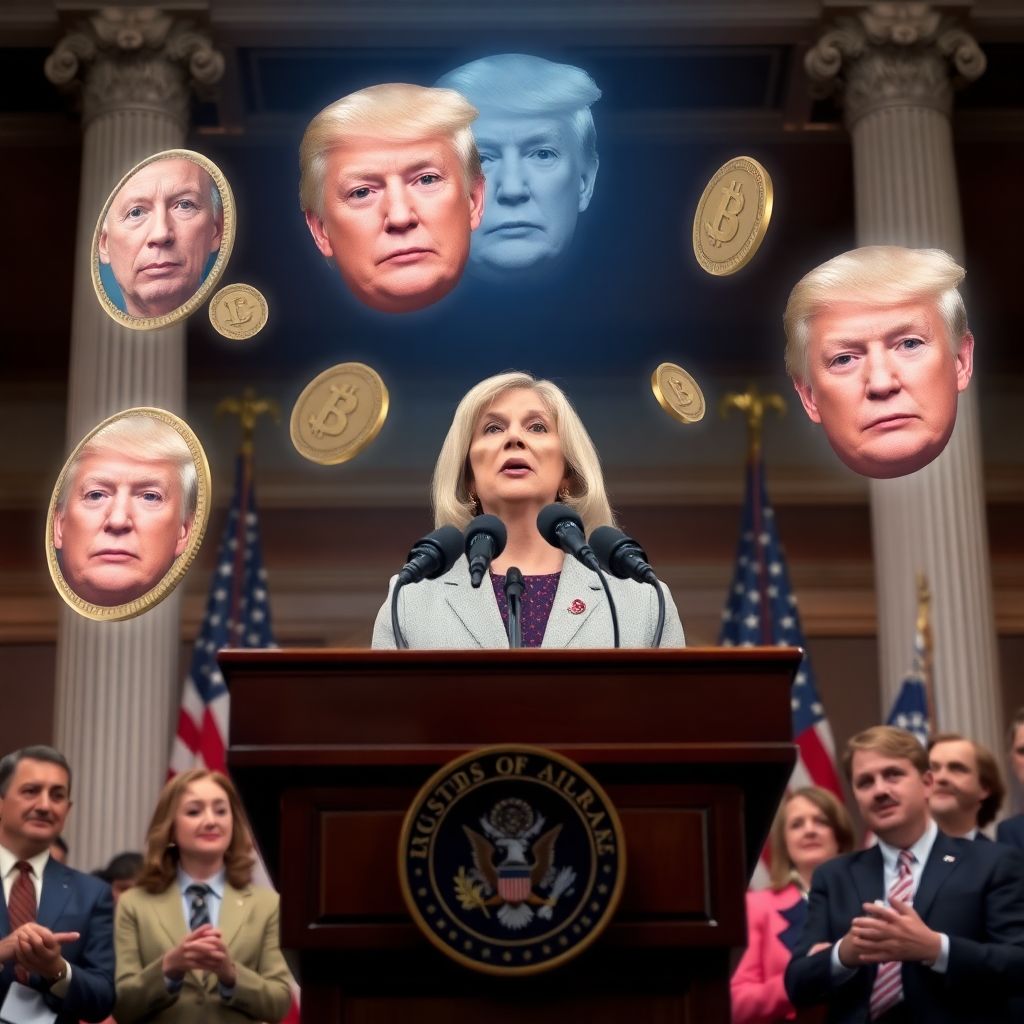
Senator Gillibrand Moves to Block Trump and Other Officials From Launching Meme Coins
New York Senator Kirsten Gillibrand is pushing a new ethics crackdown aimed squarely at the collision of politics and speculative crypto. After recent filings showed that former President Donald Trump raked in more than $1.2 billion from crypto-related ventures last year, Gillibrand has renewed her call to prohibit elected officials and their spouses from creating, issuing, or promoting digital assets-including meme coins.
According to the latest financial disclosures, a sizable share of Trump’s windfall came from a Solana-based meme coin themed around his political brand. Reports indicate that this single token brought him more than $635 million in 2023, turning what started as an online in-joke into a vast, personality-driven financial vehicle.
Gillibrand argues that this emerging trend-politicians leveraging their public image and influence to launch highly speculative tokens-poses a serious conflict of interest and opens the door to abuse. In a statement, she described her proposal as a straightforward safeguard: public officials and their spouses, she said, should not be in the business of issuing meme coins or any digital asset that directly monetizes their name and office.
For the senator, the issue is less about whether crypto is good or bad and more about who should be allowed to profit from it while wielding political power. She warns that “self-dealing” by elected officials could distort policymaking, erode trust in markets, and undermine ongoing attempts to build stronger consumer protections in the digital asset space. If lawmakers can personally profit from tokens that react to their public statements and legislative actions, the incentives become dangerously misaligned.
Under her approach, the ban would apply broadly to federal elected officials, potentially including members of Congress, the president, and other senior officeholders, as well as their spouses. The prohibition would likely cover both the direct issuance of tokens and their public promotion-closing the loophole of a politician claiming a coin was “community-driven” while still benefiting from allocations or revenue-sharing arrangements behind the scenes.
The controversy arrives at a moment when meme coins have become a powerful, if volatile, force in crypto markets. These tokens often have little or no underlying utility; their value is driven almost entirely by online hype, social media virality, and association with celebrities or public figures. When that public figure is a politician with millions of supporters and the ability to shape national policy, the potential for manipulation is obvious. A single tweet or campaign speech could send a politically branded token soaring or crashing, enriching or wiping out holders overnight.
Gillibrand’s proposal fits into a broader push in Washington to tighten guardrails around digital assets. She has previously worked on comprehensive crypto legislation and has framed this latest effort as part of a larger strategy: reduce opportunities for corruption, constrain illicit finance, and build a regulatory framework that allows innovation without turning voters and retail investors into collateral damage. In her view, banning officials from exploiting viral tokens is a basic ethical floor, not an anti-crypto crusade.
The Trump example, however, has become a lightning rod. Supporters claim the meme coin surge around his persona is simply a reflection of free markets and political enthusiasm meeting new technology. Critics counter that when a former president and likely future candidate can generate hundreds of millions of dollars from a speculative token tied to his name, the line between campaigning, fundraising, and market speculation begins to blur beyond recognition.
Ethics watchdogs have long argued that lawmakers should not be allowed to trade individual stocks in industries they regulate. Gillibrand’s move extends that logic into the crypto era: if owning and trading a stock is a potential conflict, then engineering and profiting from an entire tokenized ecosystem centered on one’s political identity is an even more direct conflict. It turns a public office into a kind of meme-driven IPO machine.
What makes meme coins uniquely problematic in this context is their structure. Unlike traditional fundraising or book deals, a token can be spun up quickly, distributed to insiders, hyped online, and then left to retail buyers to absorb the risk once the early promoters cash out. When the promoter is a political figure whose every public move is market-moving for the token, it starts to resemble a personalized micro-economy that lives or dies on their media presence and electoral fortunes.
Supporters of crypto might push back that banning politicians from token issuance could chill legitimate experimentation with blockchain technology in the public sector. Some may argue that clear disclosure rules, caps on holdings, or blind trusts would be a better solution than an outright prohibition. They also claim that political figures are already heavily monetized through books, speaking fees, and media deals; crypto, they say, is simply another frontier.
Gillibrand’s camp would likely respond that meme coins and similar personality-driven assets are categorically different from traditional post-office revenue streams. The timing overlaps with active political campaigns, the speed and opacity of token markets, and the direct linkage between official acts and token prices create a feedback loop that standard ethics regimes were never designed to handle. In such an environment, a hard line may be simpler and safer than a patchwork of partial measures.
If a ban of this kind were enacted, it would send a clear signal to both politicians and crypto entrepreneurs: political brands cannot be used as fuel for speculative token schemes. It would also force campaigns and public figures to rethink how they engage with digital assets. Instead of launching their own coins, they might be limited to accepting established cryptocurrencies under strict disclosure and reporting frameworks, much as they do with traditional donations.
For the broader crypto industry, the debate highlights a growing tension. On one hand, meme coins and personality tokens have driven huge bursts of activity and on-chain volume. On the other, they attract regulatory scrutiny and strengthen the argument that parts of the sector operate more like unregistered gambling than finance. As regulators and lawmakers look for high-visibility examples to justify tougher rules, politically branded tokens have become an easy target.
Longer term, the outcome of this push could shape how digital assets intersect with democracy itself. If politicians are barred from issuing tokens, that may reduce direct conflicts but won’t stop politically themed coins from appearing organically. Anonymous teams and online communities can still create tokens around any personality, real or fictional. The question then shifts: should the officeholder be allowed to endorse or tacitly encourage those coins? Should they be allowed to hold them? Gillibrand’s initiative may be only the opening move in a deeper conversation about political finance in a tokenized age.
In any case, the staggering sums reported in Trump’s disclosures have made it impossible for lawmakers to ignore the issue. When a former president’s meme coin can generate more income in a year than many major companies, it signals a new phase in both politics and crypto-one in which reputations, elections, and speculative markets are more intertwined than ever. Gillibrand’s bid to ban meme coin issuance by public officials is a direct attempt to pull those worlds a little farther apart before they become inseparable.