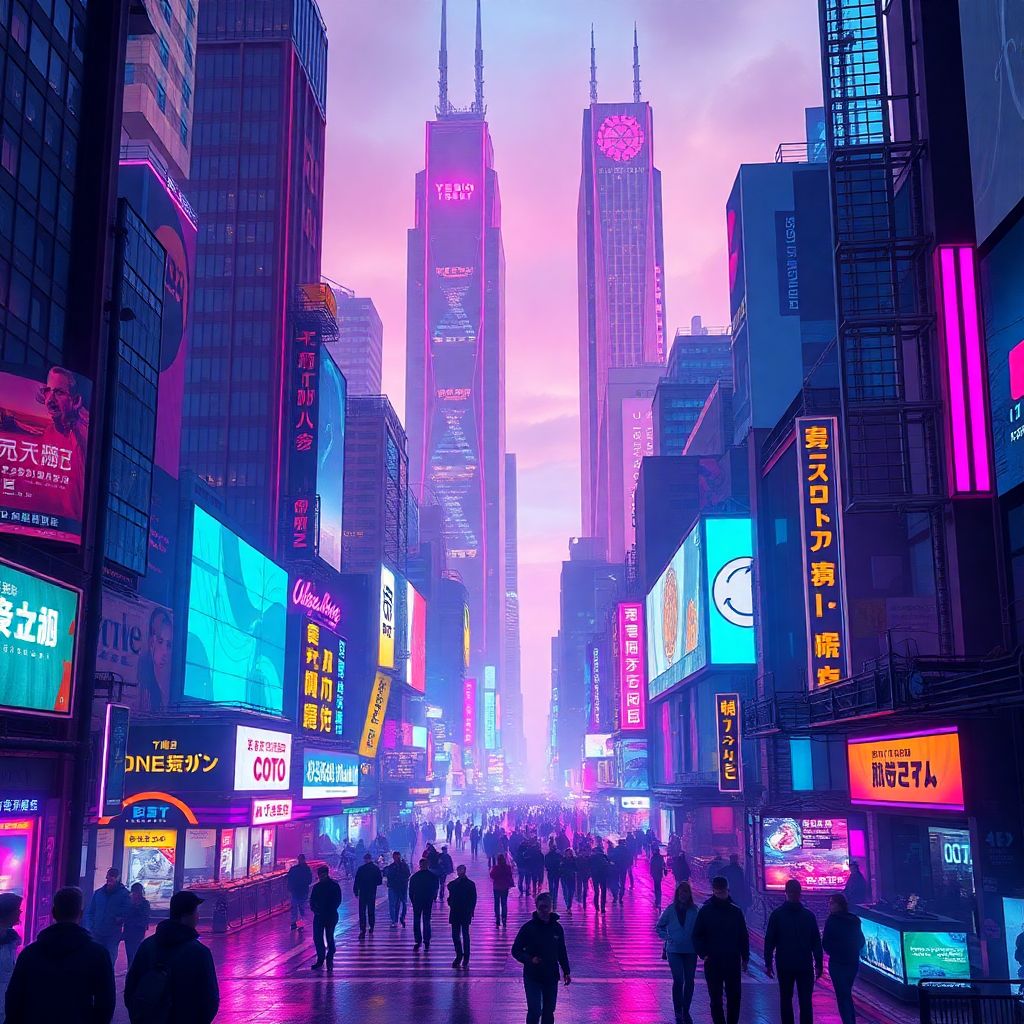
The neon‑drenched futures of cyberpunk were supposed to be safely locked in the pages of novels and on scratched VHS tapes. Instead, they’re starting to look more like the nightly news.
For years, the genre painted a world of data cowboys jacked into “cyberspace,” mercenaries enhanced with chrome and carbon fiber, and lone hackers waging guerilla wars against globe‑straddling corporations. Forty‑odd years later, the outlines of that future are no longer fictional. Brain‑computer interfaces exist. AI assistants mediate our conversations and our work. A tiny group of tech giants quietly steers the direction of global communications and knowledge.
Cyberpunk didn’t predict everything, and it got plenty wrong. But in several crucial ways, the genre understood where we were heading-especially in terms of power, inequality, and the messy human fallout of rapid technological change.
From “jacking in” to Neuralink
The classic cyberpunk image is a character plugging a cable directly into their nervous system to dive into the digital world. That fantasy of hardwired connectivity now has a real‑world cousin: brain‑computer interfaces.
Companies experimenting with neural implants and non‑invasive brain‑computer systems are turning what used to be science fiction into experimental medicine and, increasingly, a commercial industry. Neuralink is the highest‑profile example, but it’s part of a broader ecosystem of labs and startups trying to translate brain signals into software commands and, eventually, restore or enhance human capabilities.
These aren’t the fully immersive virtual realities described in novels, and we’re still a long way from casual “decking into cyberspace.” Today’s implants are crude compared to cyberpunk’s sleek ports. They require invasive surgery, face major safety and ethical scrutiny, and are usually aimed at medical applications like treating paralysis or neurological conditions. Yet the underlying idea-directly connecting the human nervous system to machines-is no longer just a narrative device. It’s a research program.
Wearable augmentation instead of chrome arms
Cyberpunk futures are littered with characters sporting synthetic arms, telescopic eyes, and full‑body cybernetic overhauls. Reality has landed somewhere between that fantasy and practicality.
Robotic prosthetics have advanced dramatically. Modern artificial limbs can respond to muscle signals or even nerve impulses, enabling more fluid movement, fine motor control, and in some cases touch feedback. Exoskeletons assist people with mobility impairments and help workers reduce strain in industrial settings. None of it looks quite as stylish-or as casually adopted-as the genre imagined, but functionally, we’re edging closer.
There’s also a quieter, more mundane wave of augmentation that cyberpunk only sometimes hinted at: high‑end hearing aids, implanted medical devices, pacemakers, insulin pumps connected to software, and experimental retinal implants. These aren’t framed as “becoming a cyborg,” yet they blur that line in everyday, utilitarian ways.
Where cyberpunk generally assumed people would choose visible, flashy mods, today’s enhancements trend toward being as small, discreet, and medically justified as possible. The social stigma, regulatory hurdles, and sheer cost of radical augmentation mean we’re much more conservative than fiction suggested.
AI: from rogue intelligences to office coworker
In many cyberpunk tales, artificial intelligences are either godlike corporate tools or runaway entities plotting their own agendas. Modern AI is far less cinematic-but perhaps more pervasive.
Large language models and generative AI systems, built by companies like OpenAI, xAI, Anthropic, Meta, and Google, now sit at the heart of search engines, productivity tools, recommendation feeds, and creative software. These systems draft emails, summarize reports, write code, generate art, and increasingly serve as first‑line interfaces between humans and the digital world.
This is not the sentient AI overlord of dystopian fiction. Instead, we get something subtler: statistical systems that feel conversational but remain constrained, biased, and embedded in corporate strategies and economic incentives. The control isn’t in an AI’s “will,” but in who owns and deploys the models, what data they’re trained on, and which goals they are tuned to optimize.
Cyberpunk got one thing very right here: it intuited that powerful AI wouldn’t exist as a neutral public utility. It would be wrapped in proprietary code, steered by corporate objectives, and integrated into opaque platforms that shape how billions of people think, talk, and work.
The rise of corporate megastructures-without the logos in the sky
Where the genre is most eerily accurate is not in its gadgets, but in its depiction of power. Cyberpunk worlds revolve around megacorporations that rival or surpass nation‑states, ruling through data, finance, and technology rather than tanks and flags.
We don’t live in a world where conglomerates field private armies on every street corner. Yet a handful of tech and financial giants now exercise influence on a planetary scale. A small circle of companies owns the dominant operating systems, app stores, cloud infrastructure, AI platforms, social networks, and ad networks. Their decisions ripple across economies and societies: who gets visibility, how information is ranked, which speech is considered acceptable, how data is mined and monetized.
Crucially, this power is often exercised through terms of service and algorithmic design rather than explicit laws. It’s a soft power that feels mundane while being profound. Cyberpunk imagined towering skyscrapers emblazoned with logos; our equivalent is platform lock‑in, quietly enforced standards, and the practical impossibility of opting out of certain ecosystems without sacrificing work, communication, or financial opportunity.
On this point, the genre didn’t miss. It simply dramatized in neon and rain what we now experience as app updates and policy changes.
Cyberspace vs. the messy internet
One of cyberpunk’s signature ideas was “cyberspace”-a coherent, navigable digital realm you could visually traverse, hack, and reshape. The modern internet is less like a sleek, 3D grid and more like an endlessly spreading tangle of feeds, apps, and closed platforms.
Yet conceptually, we did build something close to what those writers imagined: a global, persistent, networked environment where identity, value, and social life can exist primarily in digital form. Instead of jacking in via a port in the skull, we scroll through handheld supercomputers and soon, perhaps, light AR overlays in smart glasses.
Virtual and augmented reality have taken steps toward immersive digital spaces, but not at the scale or centrality cyberpunk assumed. Instead of one unified “matrix,” we have countless overlapping digital enclaves, walled gardens, and protocols. Data is more fragmented, and control is more centralized in platforms than the genre typically forecast.
Interestingly, cyberpunk underestimated just how social this realm would be. It focused heavily on lone hackers and elite operators, and less on the daily, relentless public performance and surveillance we experience via social media, influencer culture, and ubiquitous cameras.
Surveillance capitalism and the erosion of privacy
If there’s an area where cyberpunk’s paranoia feels almost understated, it’s surveillance.
In the stories, tracking was often the domain of governments and corporations using targeted high‑tech tools: satellites, face recognition, omnipresent cameras. In our world, those capabilities exist-but mass surveillance is also built into consumer technology by design. Smartphones broadcast our movements, preferences, and conversations. Apps harvest behavioral data as a business model. Recommendation systems profile us in real time to maximize engagement and ad revenue.
This isn’t just about being watched; it’s about being continuously measured and nudged. While cyberpunk pictured oppressive regimes and brutal corporate security forces, we’re more often managed through convenience: frictionless payments, personalized feeds, biometric unlocking, “smart” everything.
The destination, however, is similar. Individual privacy erodes. Power accrues to whoever can collect, analyze, and exploit oceans of personal data. Cyberpunk understood that information would be the ultimate raw material; it just didn’t fully anticipate how willingly we would hand it over.
Inequality and the new class divide
Neon‑soaked skyscrapers towering over decaying slums are central cyberpunk imagery. The genre is fundamentally about a world where technology accelerates inequality, creating glittering islands of wealth amid growing precarity.
That theme feels uncomfortably current. Advanced tech has generated vast fortunes for a small slice of founders and investors, while automation and offshoring hollow out traditional middle‑class paths. Access to high‑quality education, healthcare, and digital tools increasingly defines who can participate in the “future” and who is left managing gig work, unstable contracts, and shrinking safety nets.
Gentrified urban cores with hyper‑connected elites coexist with marginalized communities facing environmental hazards, inadequate infrastructure, and limited upward mobility. Global cities compete to attract capital and talent, while entire regions are left dealing with the fallout of climate change, resource extraction, and changing labor markets.
Cyberpunk didn’t predict every economic mechanism, but it understood the shape: a stratified society where technology amplifies divides instead of automatically lifting all boats.
Where cyberpunk missed the mark
For all its prescience, the genre also misfired in important ways.
First, it often assumed a more literal, visible militarization of everyday life-corporate soldiers, armored drones in every alley, open street wars between factions. Reality has been more subtle: financial pressure, legal threats, information warfare, and platform bans often replace overt violence in wealthier regions, even as conventional conflicts continue elsewhere.
Second, cyberpunk was deeply rooted in a particular 1980s vision of style: trench coats, mirrorshades, analog switchboards, and cathode‑ray monitors. Today’s future is clean, minimalist, and almost invisibly integrated: wireless earbuds, unobtrusive sensors, quiet industrial design. The aesthetic changed, even if the underlying tensions did not.
Third, many stories assumed that once technologies like augmented reality or neural interfaces existed, they would rapidly saturate society. In reality, cost, regulation, cultural resistance, and accessibility issues all slow down adoption. Most people still interact with the digital realm through rectangles of glass, not spinal sockets or retinal overlays.
Finally, cyberpunk often treated climate change and ecological collapse as mere background noise-a reason for acid rain and offworld colonies, not a core driver of politics and economics. In the real world, climate is moving to the center of our technological, financial, and geopolitical decisions.
Crypto, digital money, and networked power
One area where reality took its own twist is money. Classic cyberpunk pictured anonymous digital cash and shadowy credit systems. We have something related but distinct: cryptocurrencies, stablecoins, and digital payment rails that operate outside or alongside traditional banking systems.
These tools haven’t dismantled financial institutions, but they have introduced new ways to move value globally, challenge capital controls, and experiment with decentralized governance. Instead of a monolithic “credstick” currency controlled by a megacorp, we see a chaotic ecosystem of tokens, experiments, and speculative manias.
This divergence still echoes a core cyberpunk insight: in a high‑tech world, control over code and networks becomes as important as control over land and factories. Whether that control is wielded by centralized exchanges, developer teams, miners, or validators, it raises similar questions about who actually owns the infrastructure of value.
Human agency in a high‑tech dystopia
Perhaps the deepest throughline between cyberpunk fiction and our present is the question of individual agency. The genre’s protagonists are usually people trying to carve out slivers of autonomy against overwhelming systems-corporations, states, AIs.
Today, that struggle plays out in more mundane ways: workers resisting algorithmic management, communities pushing back on surveillance technologies, artists fighting for control of their data in the age of generative AI, patients weighing the risks and benefits of invasive implants.
Cyberpunk’s biggest prediction was never just about gadgets. It was about the emotional texture of living in a world where technology outpaces governance and ethics, and where ordinary people must navigate systems that barely acknowledge them except as data points or revenue streams.
So, how much did cyberpunk get right?
Measured in specific technologies, the scorecard is mixed:
– Brain‑computer interfaces and advanced prosthetics? Cruder than imagined, but real.
– AI as a pervasive, corporate‑controlled force? Very close, albeit less sentient and more statistical.
– A global, immersive digital realm? Real in principle, fragmented and messy in practice.
– Corporate power rivaling states? Not absolute, but closer than many were comfortable predicting.
– Visible, all‑encompassing cybernetic body modification? Limited, niche, and mostly medical so far.
Where cyberpunk was most accurate was in its themes: concentrated corporate power, data as capital, collapsing privacy, and the way new tools intensify old inequalities. It was less a literal blueprint than an emotional weather forecast-and that forecast, for better or worse, looks eerily familiar.
The future cyberpunk imagined isn’t here in full neon and chrome. But its outlines are visible in the glow of our screens, the fine print of our user agreements, the implants entering operating rooms, and the AI systems quietly mediating how we see the world. The question now is whether we continue drifting deeper into the dystopian parts of that vision-or use the clarity those stories offered to change course.