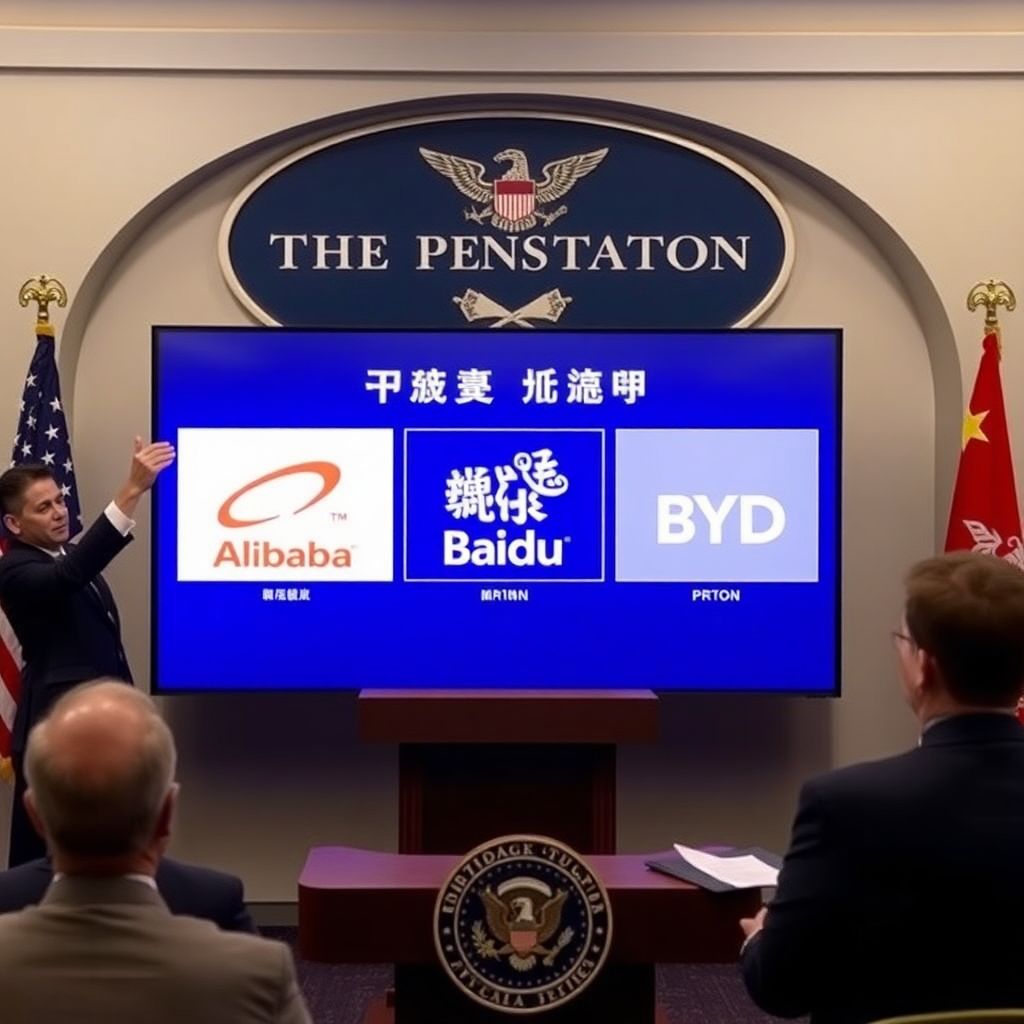
Pentagon puts Alibaba, Baidu and BYD on expanded list of Chinese “military-linked” companies
The U.S. Department of Defense has formally added Chinese tech giants Alibaba and Baidu, as well as electric vehicle manufacturer BYD, to its roster of companies it considers connected to China’s military. The same update sweeps in a range of firms from the semiconductor, biotech, robotics and telecom sectors that operate in the United States, underscoring Washington’s widening focus on China’s technology ecosystem.
The list, maintained by the Pentagon under U.S. law, does not itself trigger sanctions. Instead, it reshapes how the Defense Department can do business with the named companies and their affiliates, and it signals to other U.S. agencies and private contractors that these firms are now viewed as part of China’s broader military-industrial apparatus.
What changed in the new Pentagon list
According to a Pentagon filing published on Monday, the newly named firms meet the statutory definition of “Chinese military companies,” a designation created by Congress to identify commercial entities that are seen as supporting, or being controlled by, China’s defense establishment.
The update replaces an earlier version of the list prepared for early 2025 and follows a February draft that briefly appeared online before being withdrawn. While the substance of the new list closely mirrors that earlier iteration, it also includes several additional heavyweights in the chip industry, notably memory manufacturers CXMT and YMTC.
Beyond Alibaba, Baidu and BYD, the list now encompasses WuXi AppTec in biotech, robotics groups such as RoboSense and Unitree, and telecom equipment supplier Baicells, which U.S. authorities had already scrutinized in previous probes. China BlueChemical Limited was also added, with the Pentagon noting that its parent, oil major CNOOC, is directly controlled by the Chinese government.
Companies added and removed
The expansion of the list is not one‑way. Alongside the new designations, the Pentagon removed CNOOC China Ltd and CNOOC International Trading.
Companies can exit the list for several reasons, including corporate restructurings, rebranding, reductions in U.S. operations, or successful petitions demonstrating that they no longer meet the legal criteria. The filing explicitly states that listed entities may apply for removal, though that process is often lengthy and opaque.
Several of the newly named firms – including Alibaba, Baidu, BYD, CXMT, YMTC, Unitree, CNOOC and Nvidia – did not respond immediately to requests for comment on the U.S. action.
Beijing’s response: accusations of discrimination
China’s embassy in Washington condemned the updated roster, arguing that the U.S. is weaponizing economic and security tools to suppress Chinese companies.
A spokesperson said Beijing “firmly opposes” the practice of compiling what it described as discriminatory lists targeting Chinese businesses, insisting that Chinese firms abide by local laws and regulations in the countries where they operate. The embassy urged Washington to halt what it called “wrong practices” and to restore a level and non‑discriminatory playing field for international commerce.
WuXi AppTec pushes back
Among the companies newly tagged, WuXi AppTec publicly rejected its inclusion. The biotech firm called the designation “clearly a mistake” and said it would move quickly to contest the classification through the available channels.
Other added companies have so far stayed silent, but the filing makes clear that all listed entities have some form of operational presence or activity in the United States – a critical factor because the restrictions apply primarily to U.S. government contracting and procurement.
Support on Capitol Hill
On the U.S. side, the move drew praise from lawmakers who have urged a tougher line on Chinese technology. House Select Committee on the Strategic Competition between the United States and the Chinese Communist Party Chair John Moolenaar welcomed the update, framing it as a warning to American corporations, state and local governments, and individual consumers.
According to Moolenaar, the companies now on the list “are working with the Chinese military against our national interests.” He highlighted the inclusion of Unitree, a Chinese robotics firm that recently attracted attention when Nvidia announced plans on June 1 to collaborate with it on research robots.
What the designation actually does
The Pentagon’s list does not, by itself, impose asset freezes, trade bans or other classic sanctions. However, it triggers a series of procurement restrictions under U.S. law that could significantly affect business with the Defense Department.
Later this month, a ban on direct Pentagon contracts with listed companies is scheduled to take effect. That means the Defense Department will no longer be able to sign contracts directly with these firms. Starting in 2027, indirect dealings will also come under restrictions, limiting what the Pentagon can buy through third‑party vendors if those goods or services originate from listed entities.
These measures are designed to close loopholes in the U.S. supply chain, preventing sensitive components, software or services tied to Chinese military‑linked corporations from flowing into defense programs through resellers or complex subcontracting arrangements.
Ripple effects for global supply chains
The impact of the designation is likely to extend well beyond direct Pentagon contracting. U.S. defense suppliers, major government contractors and even some large private‑sector buyers typically align their own due‑diligence standards with Defense Department rules, both to comply with regulations and to avoid reputational risk.
As a result, companies that rely on components from Alibaba’s cloud services, Baidu’s AI tools, BYD’s batteries or Unitree’s robotics platforms may now reassess their exposure. Some may preemptively diversify suppliers or seek alternative technologies to avoid complications in bidding for U.S. government work.
The rules could also reverberate in allied countries whose defense markets are interlinked with U.S. programs. Partners that share platforms, data systems or hardware with the United States often mirror American restrictions to keep joint projects compliant and smoothly interoperable.
Legal and diplomatic tensions likely to grow
Chinese firms have previously challenged similar U.S. lists in court, arguing that designations were arbitrary, lacked evidence or violated due‑process rights. While some lawsuits have succeeded in forcing reconsideration or removal, the process can take years and does not always lead to a reversal.
This latest round of designations is likely to deepen existing friction between Washington and Beijing over trade, technology and national security. For China, the move reinforces a narrative that the U.S. is trying to contain its rise in high‑tech industries such as semiconductors, AI, robotics and biotech. For the U.S., it reflects a growing belief that China’s civil and military sectors are so intertwined that major tech firms cannot be treated as purely commercial actors.
Diplomats on both sides will now have to manage these tensions against the backdrop of broader negotiations on tariffs, export controls, investment screening and military‑to‑military communication.
Why Alibaba, Baidu and BYD matter
The inclusion of Alibaba, Baidu and BYD is symbolically and economically significant because these are not niche defense contractors but globally recognized consumer and industrial brands.
– Alibaba runs one of the world’s largest e‑commerce platforms and a rapidly growing cloud computing business. Its cloud and AI services are integral to countless Chinese enterprises and public‑sector projects, making it a central node in China’s digital infrastructure.
– Baidu is a leader in search, autonomous driving and artificial intelligence research. Its work in high‑performance computing, mapping and machine learning has clear potential dual‑use applications in both civilian and military contexts.
– BYD, best known internationally for electric vehicles and batteries, is also a major player in industrial electronics and energy storage. Battery technologies, power management systems and electric drivetrains can all carry military relevance, especially for logistics, drones and unmanned systems.
By sweeping such flagship companies into the “military‑linked” category, Washington signals that it views a wide slice of China’s tech and industrial base as strategically sensitive.
The broader U.S. strategy on Chinese tech
Experts see the update as part of a coherent, long‑term approach rather than a series of disconnected steps. Craig Singleton, a China specialist at the Foundation for Defense of Democracies, said the revised list illustrates how Washington increasingly looks at China’s entire “technology stack” – from chips and cloud infrastructure to AI, robotics and biotech – as a contested strategic domain.
In this view, it is not just individual products or one‑off contracts that worry U.S. policymakers, but the possibility that reliance on Chinese technology across multiple layers of hardware and software could create systemic vulnerabilities in defense, critical infrastructure and intelligence.
The Pentagon is required by law to refresh its list at least once a year, but the pace of recent updates suggests that revisions may come more frequently as new investigations conclude and as corporate structures evolve.
Implications for investors and multinational firms
For global investors, the designation does not automatically prohibit holding equity or debt in the listed companies. However, it does increase regulatory and reputational risks. Institutional investors that already face pressure from their own governments or stakeholders to review exposure to Chinese tech may treat the list as an additional red flag.
Multinational corporations with joint ventures, R&D partnerships or supply agreements involving Alibaba, Baidu, BYD or other listed firms will likely reassess contractual terms. Clauses on export controls, data handling, security standards and termination rights may be tightened to account for evolving U.S. rules.
Some companies may adopt “China‑plus‑one” strategies in technology procurement, mirroring what many manufacturers have done for physical production – adding redundant suppliers outside China to reduce vulnerability to sudden regulatory shifts.
A new phase in U.S.-China tech competition
The timing of the Pentagon’s move, coming less than a month after a meeting between then‑President Donald Trump and Chinese President Xi Jinping in Beijing, underscores how diplomacy and economic competition now run on parallel tracks. High‑level political engagement has not slowed the steady build‑out of controls, lists and screening mechanisms on both sides.
For now, the practical effect of the designations will play out in contract reviews, compliance checklists and behind‑the‑scenes supply‑chain recalibrations. But as more core Chinese tech players appear on U.S. government lists, the space for unencumbered cooperation in areas like cloud computing, AI research, autonomous systems and advanced manufacturing continues to narrow.
What began as targeted restrictions on a handful of state‑owned enterprises has evolved into a broader effort to decouple, at least in sensitive sectors. The addition of Alibaba, Baidu and BYD signals that this process is entering a new, more consequential stage for global technology, trade and security.