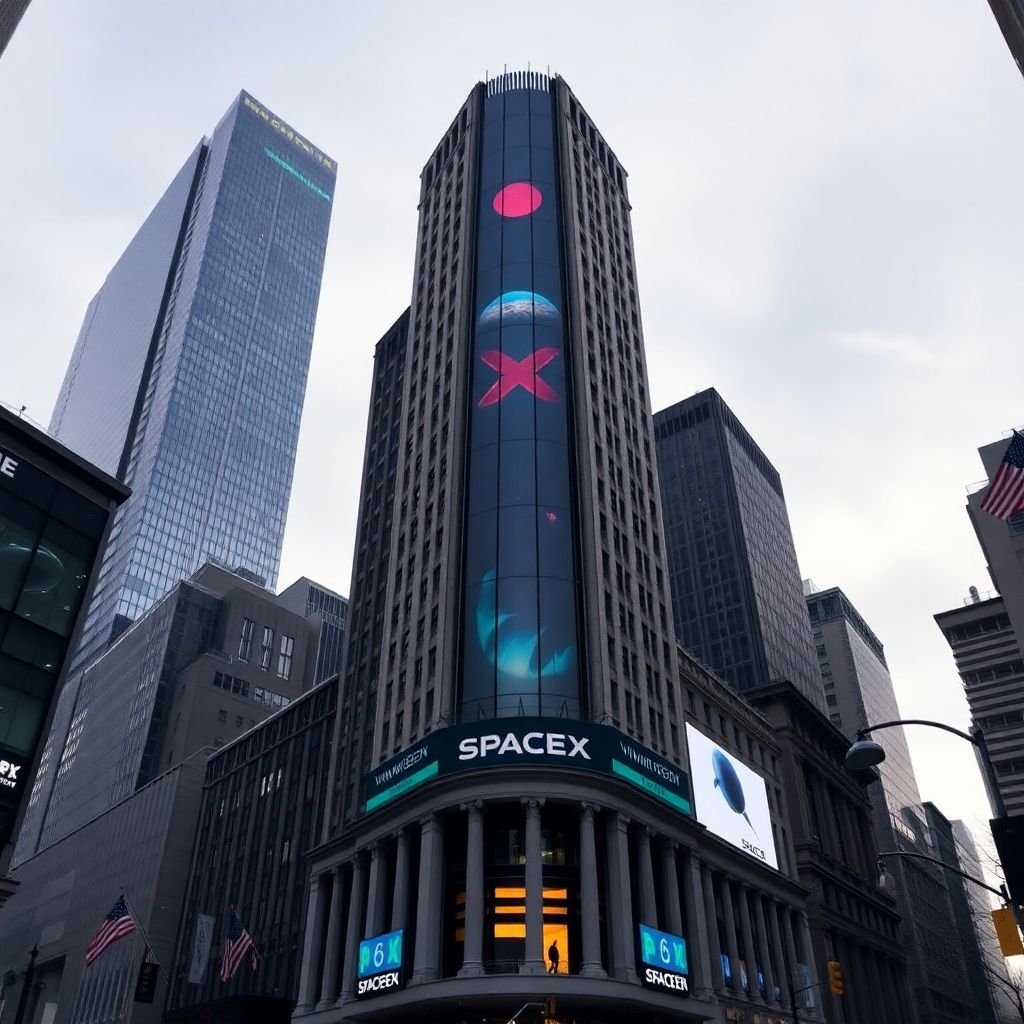
Kraken unveils tokenized SpaceX IPO access, taking aim at Wall Street’s tight grip on new listings
Kraken has opened a new front in the battle over who gets to participate in blockbuster initial public offerings, rolling out tokenized access to the upcoming SpaceX IPO for retail investors in more than 110 markets. The move directly challenges the long‑entrenched Wall Street model, where allocations in high‑profile IPOs are typically reserved for institutions and ultra‑wealthy clients.
Under the new program, called xStocks IPO Access, SpaceX will be the first company offered through Kraken’s tokenized equity service. Instead of applying for shares through a traditional brokerage, eligible users can submit requests for allocations inside the Kraken mobile app, receiving digital tokens that represent underlying SpaceX stock if they are successful.
Kraken is positioning the SpaceX deal as a flagship launch for xStocks. The SpaceX tokenized instrument, listed under the ticker SPCXx, reflects a claim on actual SpaceX equity. Each SPCXx token is designed to be backed one‑for‑one by a corresponding share held with a regulated custodian, mirroring the economic exposure of conventional stock ownership while remaining native to blockchain infrastructure.
To participate, users must maintain a verified Kraken account and submit an IPO access request before the allocation window closes and the shares begin trading. The service currently targets clients in the European Economic Area and more than 110 additional jurisdictions around the world. However, regulatory constraints mean that residents of the United States, Canada, Australia, and the United Kingdom are excluded from this initial rollout, underscoring how fragmented global securities regulation remains.
For those who do receive allocations, SPCXx tokens will be tradable 24/7 on Kraken and across other platforms that are part of the broader xStocks network. Around‑the‑clock secondary trading stands in contrast to the limited operating hours of traditional stock exchanges and highlights one of the key advantages advocates see in tokenized capital markets: continuous liquidity and global access, independent of time zones.
Kraken’s affiliated entity, Payward Services, recently outlined how the broader xStocks Alliance intends to work. Customers of Kraken and selected alliance partners will be able to register interest in U.S.‑listed IPOs ahead of their public debut. Successful applicants will receive tokenized shares at the IPO offer price on the day of listing, while the underlying equities remain securely held by a regulated custodian. The goal is to replicate the economics of traditional IPO participation, but deliver it through a digital wrapper that allows smaller investors to take part.
This framework aims squarely at a long‑standing pain point in global equity markets: retail investors often get access to hyped IPOs only after the first day of trading, when prices may have already surged. By contrast, institutional players and select high‑net‑worth clients historically receive allocations at the initial offering price. Kraken’s tokenized model seeks to flatten that hierarchy, at least in markets where regulators permit such structures.
The choice of SpaceX as the first high‑profile listing for xStocks is significant. According to reporting on the deal, SpaceX is expected to start trading publicly on June 12, targeting a roughly 75 billion dollar capital raise at a valuation north of 1.8 trillion dollars. Market demand for the listing has reportedly already exceeded the number of available shares, highlighting the intense investor interest in the company’s growth story.
If the IPO proceeds at that scale, it would mark the largest listing in history, surpassing the 2019 debut of Saudi Aramco, which raised 29.4 billion dollars. Such a milestone would further solidify SpaceX’s status as one of the most valuable private companies to ever tap public markets, and underline how strongly investors are betting on the future of commercial spaceflight and satellite‑based services.
A major pillar of SpaceX’s valuation is Starlink, its rapidly expanding satellite internet division. Starlink has moved from pilot deployments to broad commercial availability in multiple regions, providing high‑speed connectivity in areas underserved by traditional broadband infrastructure. The rapid growth of Starlink subscribers, as well as prospects for enterprise and government contracts, has become a central driver of expectations around SpaceX’s long‑term revenue potential.
At the same time, SpaceX remains heavily engaged in capital‑intensive projects, from orbital launch services and reusable rocket technology to spacecraft development and deep‑space missions. These ongoing investments contribute to both the company’s technological moat and its financial risk profile. Public market investors will have to weigh massive growth prospects against equally significant spending needs and execution risks once shares begin trading freely.
Beyond its space and satellite businesses, SpaceX has quietly emerged as a major player in AI infrastructure. The company has secured multibillion‑dollar compute contracts that place it at the heart of the race to build large‑scale data processing capacity for advanced artificial intelligence models.
Regulatory filings show that Google has committed to payments of 920 million dollars per month from October 2026 through June 2029 in exchange for access to approximately 110,000 NVIDIA GPUs, CPUs, memory, and related equipment provisioned by SpaceX. This enormous capacity is intended to support surging demand for Google’s Gemini Enterprise AI products, bridging the gap while Google continues to expand its own internal infrastructure.
In a separate agreement, SpaceX has disclosed a long‑term deal with Anthropic, one of the leading AI research and development firms. Under that contract, Anthropic will pay 1.25 billion dollars per month through 2029 for compute capacity at the Colossus 1 data center near Memphis, Tennessee. Together, these arrangements position SpaceX not just as a spaceflight and connectivity company, but as a major landlord of high‑performance computing resources in the AI era.
The AI infrastructure push adds another powerful growth driver to the SpaceX story and helps explain why investor interest in the IPO is so intense. It also diversifies the company’s revenue beyond launch and satellite services, embedding SpaceX directly into the digital backbone powering large language models, generative AI tools, and enterprise AI solutions.
For Kraken, the SpaceX offering arrives at a time when the exchange is deliberately expanding its business model beyond straightforward cryptocurrency trading. In late 2025, Kraken acquired Backed Finance, the operator behind xStocks, effectively buying the technology and regulatory stack needed to offer tokenized securities at scale. The exchange later announced plans to introduce regulated Bitcoin perpetual futures in the United States, leveraging infrastructure obtained through its acquisition of derivatives platform Bitnomial.
These strategic moves suggest Kraken is aiming to become a broader digital markets venue, blurring the line between traditional finance and crypto‑native assets. Tokenized IPO access fits neatly into this vision, as it allows Kraken to attract equity‑focused investors who may have little prior exposure to cryptocurrencies, while still relying on blockchain rails to deliver the product.
From an investor’s perspective, tokenized IPO participation raises a number of practical questions. One is how liquidity will develop in SPCXx and future tokenized equities compared with their underlying shares on traditional exchanges. Another is how corporate actions – such as dividends, stock splits, or voting rights – will be handled for holders of tokenized representations rather than direct registered stock.
Kraken’s structure, where a regulated custodian holds the underlying shares, is designed to provide a clean bridge between on‑chain tokens and off‑chain corporate events. In practice, this should allow token holders to receive equivalent economic benefits, though governance rights may be intermediated or limited depending on how the custodial and legal arrangements are structured in each jurisdiction.
The initiative also shines a light on regulatory tensions. By excluding residents of the United States, Canada, Australia, and the United Kingdom, Kraken is acknowledging that securities regulators in major financial hubs are still wrestling with how to treat tokenized equities and digital‑asset‑based access to traditional markets. Future changes in regulation could either open these products to a wider audience or tighten the rules further, depending on how policymakers evaluate risks around investor protection, market integrity, and custody.
For Wall Street, the rise of tokenized IPO access represents both a threat and a potential opportunity. On one hand, it challenges the dominance of established banks and brokers in controlling allocations to marquee offerings. On the other, traditional institutions could eventually partner with or emulate platforms like xStocks to modernize their own distribution channels, reducing friction and broadening participation while retaining oversight.
If Kraken’s SpaceX launch proves successful, it may set a template for how future mega‑IPOs are offered to a global, digitally native investor base. Retail traders who have grown comfortable with crypto exchanges and 24/7 markets may increasingly expect the same level of access to equities and other traditional assets. That expectation could accelerate a shift toward tokenization across stocks, bonds, funds, and even more complex instruments.
For now, the SpaceX IPO tokens mark a high‑stakes experiment at the intersection of space exploration, AI infrastructure, and financial innovation. Kraken is betting that demand for participation in one of the most anticipated listings in history, combined with the flexibility of tokenized trading, will be enough to convince a new wave of investors that the future of capital markets lies on‑chain – not just on Wall Street.