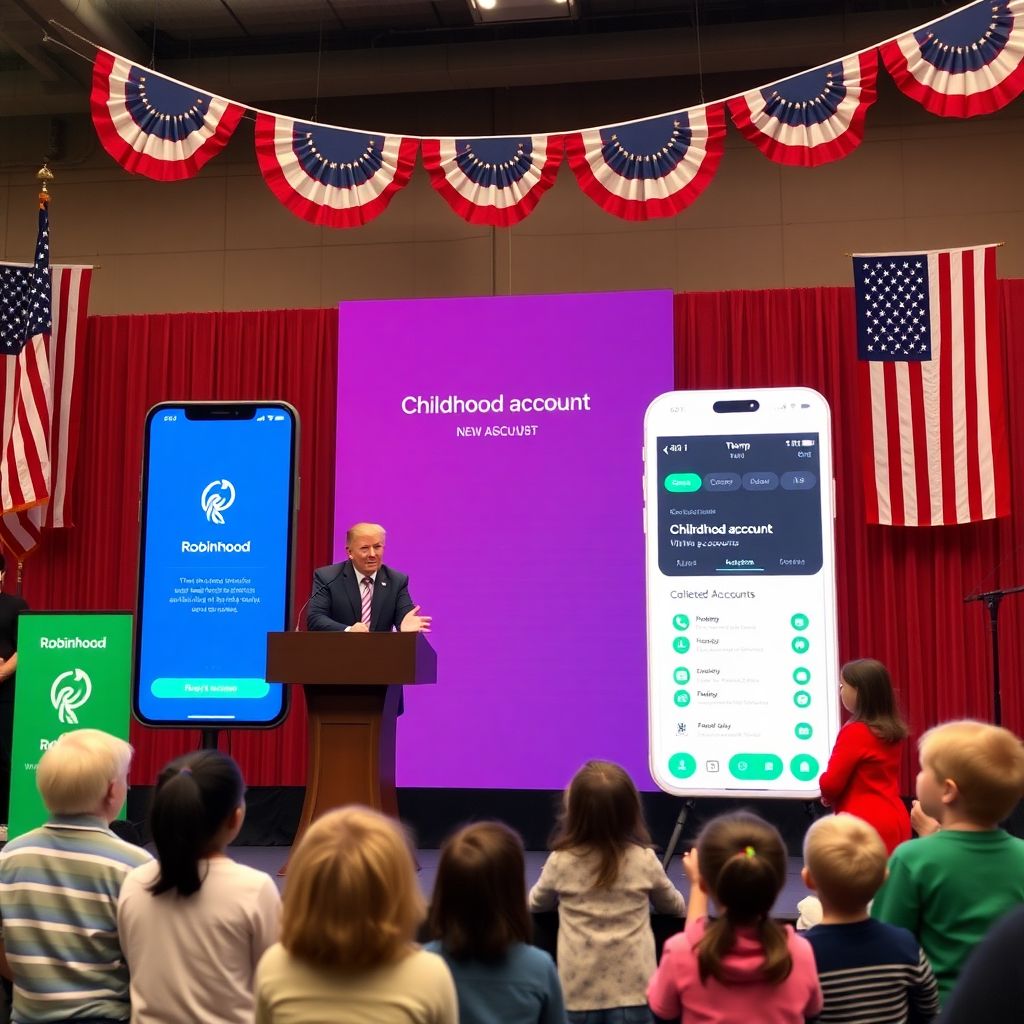
Trump turns to Robinhood as centerpiece of new $1,000 child investment accounts
The Trump administration is positioning trading app Robinhood as a central gateway to its new “Trump Accounts” program, a federal initiative that will seed eligible children with a $1,000 U.S. Treasury-backed investment account starting July 4.
According to program details, Robinhood is expected to be one of the main platforms through which families access and manage these accounts, giving minors a foothold in long‑term investing through government-supported savings vehicles. While officials have stopped short of calling Robinhood the exclusive partner, the company is widely viewed as the lead retail investment app in the rollout.
How the Trump Accounts program works
Under the framework, children under 18 will qualify for an account if at least one parent has a valid Social Security number. For each eligible child, the federal government will make an initial contribution of $1,000 into a Treasury-backed account designed to hold traditional investment products.
Beyond the government seed funding, families, relatives, and other approved contributors can add up to $5,000 per child annually. These voluntary contributions are expected to be reported and routed via IRS Form 4547, which will serve as the primary tax and compliance document tied to the program.
The structure connects several core institutions:
– The U.S. Treasury, responsible for funding and oversight
– The Internal Revenue Service, which will administer tax reporting and contribution limits
– Brokerage firms that will act as custodians of the assets
– Retail investing platforms such as Robinhood that will provide user-facing access
Transfers are set to open through the Treasury ahead of the July 4 launch date, allowing brokerages to begin populating and funding accounts in advance. That early access window is intended to reduce bottlenecks when the program officially goes live.
Robinhood’s role in the rollout
Robinhood’s anticipated involvement stems from its existing infrastructure, which already combines stock and ETF investing within a mobile-first platform used heavily by younger demographics and first-time investors. In the Trump Accounts context, Robinhood is expected to manage front-end access, account views, and potentially educational tools for families overseeing their children’s portfolios.
For users who already hold brokerage accounts with Robinhood, the arrangement could eventually allow them to see their own investments and their child’s Trump Account side by side, should regulators approve such an integrated view. That type of interface could standardize government-supported accounts as just another tab in a familiar investing app rather than a separate, unfamiliar product.
However, the current version of the program remains strictly limited to conventional financial instruments. Despite Robinhood’s prominent crypto features, Trump Accounts do not permit cryptocurrency holdings, tokenized securities, or blockchain-based assets in any form under the existing rules.
No crypto, at least for now
Regulators have drawn a clear line between Trump Accounts and digital assets. The portfolios are intended to focus on regulated securities and cash-equivalent instruments, keeping them firmly under existing securities and banking frameworks rather than the emerging crypto regulatory perimeter.
This separation reflects a broader regulatory push in the United States: traditional securities are being kept distinct from cryptocurrencies and other digital tokens as agencies refine what counts as a security, a commodity, or a novel digital asset. Trump Accounts therefore serve as another example of tightly regulated custodial products entering mainstream retail finance without venturing into crypto territory.
That said, the program’s proximity to platforms like Robinhood-which already host both stocks and crypto-may shape future policy debates. If millions of users come to view government-backed child accounts inside the same app where they trade bitcoin or other tokens, policymakers could face renewed pressure to clarify how, or whether, such products should ever coexist within a unified interface.
High-profile corporate interest and speculation
In a recent CNBC interview with Joe Kernen, President Donald Trump floated the idea that Elon Musk could contribute SpaceX stock to the program, suggesting that private companies might one day donate or allocate shares into Trump Accounts. Trump acknowledged he had not recently spoken with Musk and did not present any such move as finalized, framing it more as a possibility than an imminent plan.
Trump also cited expressions of support from business leaders including Michael Dell and executives at Micron, positioning the initiative as one that has drawn interest from prominent corporate figures. So far, however, neither Musk nor SpaceX has announced any confirmed commitment to donate equity into the program.
Following Trump’s public comments, SpaceX-related trading sentiment appeared to stabilize. The SPCX ticker, which had dipped toward an intraday low near 155 dollars, rebounded to close around 162 dollars on July 3, a gain of roughly 3% from the low as buyers stepped back in after early selling pressure. While market moves are driven by many factors, the timing placed SpaceX back into focus amid the Trump Accounts narrative.
A new channel for long-term investing
Research into retail finance has repeatedly highlighted app-based brokerages as a primary gateway into risk assets for everyday investors. If Trump Accounts are deeply integrated into those same platforms, long-term, government-supported investing may become more intuitive and accessible for younger generations and their families.
Instead of opening an unfamiliar custodial account at a legacy institution, parents could see child investment balances directly inside a familiar app, track performance over time, and schedule recurring contributions up to the annual $5,000 cap. That design is likely intended to reduce friction and boost participation rates in lower- and middle-income households.
In practice, this could resemble a hybrid between a college savings plan and a basic brokerage account, but with an upfront federal contribution. Families might use the accounts to build diversified portfolios of index funds or blue-chip stocks, giving children a financial base that compounds over years or even decades.
Potential benefits and unanswered questions for families
Supporters argue that the initiative could:
– Encourage financial literacy by prompting parents to discuss saving and investing with their children
– Narrow long-term wealth gaps by providing every eligible child a starting capital base
– Harness compounding returns when accounts are opened at birth or early childhood
– Provide more flexibility than traditional education-only savings vehicles
However, many operational details remain unclear. Families will want to know:
– What default investment options will be offered if parents do not actively choose a portfolio?
– How conservative or aggressive will those default allocations be relative to a child’s age?
– What happens to the account when a child turns 18-does it convert into a standard brokerage account, or are there restrictions on withdrawals or spending?
– How will fees be handled across different brokerages, and will some providers be cheaper or more transparent than others?
Clarity on these questions will determine whether Trump Accounts primarily benefit financial firms via fee income, or whether they truly function as a low-cost, long-term wealth-building tool for families.
Intersections with Trump’s own crypto record
The rollout takes place against a politically charged backdrop. Trump’s 2025 financial disclosures showed at least 1.4 billion dollars in crypto-related income associated with ventures such as his memecoin and World Liberty Financial. Those figures have fueled ethics debates in Washington as lawmakers work through the CLARITY Act and other digital asset legislation.
Trump has since denied detailed knowledge of those earnings and has insisted that nothing about the arrangements was illegal. The existence of that crypto-linked income, however, contrasts sharply with the Trump Accounts program, which explicitly excludes digital assets for now. That contrast underscores the divide between Trump’s personal business footprint in speculative crypto markets and the government’s cautious, regulation-heavy approach for child-focused investment products.
Regulatory implications and future evolution
Even without crypto, the program could shape broader financial regulation. As more brokerages participate, regulators will need to oversee how government-seeded accounts are marketed, how risk is disclosed, and whether there is any misalignment between profit incentives and the best interests of children as end beneficiaries.
Future debates may center on whether to:
– Allow limited exposure to emerging asset classes once clearer regulation exists
– Introduce guardrails on the kinds of equities or funds that can be held in Trump Accounts
– Standardize fee structures across platforms so that the level of government support is not diluted by high costs
– Coordinate with states that run their own college savings or child wealth-building programs to avoid duplication and confusion
If the experiment is deemed successful, policymakers could consider expanding the contribution size, indexing it to inflation, or linking additional benefits to milestones such as completing financial education courses or maintaining the account until adulthood.
Economic and social stakes
From a broader perspective, Trump Accounts represent an attempt to embed investing into the financial lives of Americans from childhood. For supporters, the initiative aligns with a vision of an “ownership society,” in which more citizens hold stakes in public companies and capital markets, rather than relying solely on wages and public benefits.
Critics, however, are likely to question whether a 1,000‑dollar seed-while meaningful, especially for lower-income families-can materially change long-term inequality in the absence of broader wage, housing, and education reforms. They may also scrutinize whether the program primarily channels new customers into a handful of dominant platforms like Robinhood.
The ultimate impact will depend less on the announcement and more on implementation: how straightforward it is to enroll, how well families are protected from excessive risk and costs, and whether the accounts are integrated with broader efforts to improve financial literacy and economic opportunity.
What comes next
As the July 4 launch begins, brokerages and app-based platforms will test their systems for onboarding millions of potential new accounts. Families will start receiving instructions on eligibility, enrollment, and initial funding, while regulators monitor compliance and operational risks.
If Robinhood and other firms deliver a smooth rollout, Trump Accounts could quickly become a widely recognized fixture of the U.S. financial landscape-a default savings and investing tool that accompanies many children from birth through adulthood. If technical issues, unclear rules, or political controversy dominate the early phases, the program may struggle to gain the trust necessary to achieve its long-term goals.
For now, the initiative stands as a notable experiment: a federal attempt to pair public seed capital with private-sector technology in order to give the next generation an earlier, and potentially more powerful, start in the world of investing.