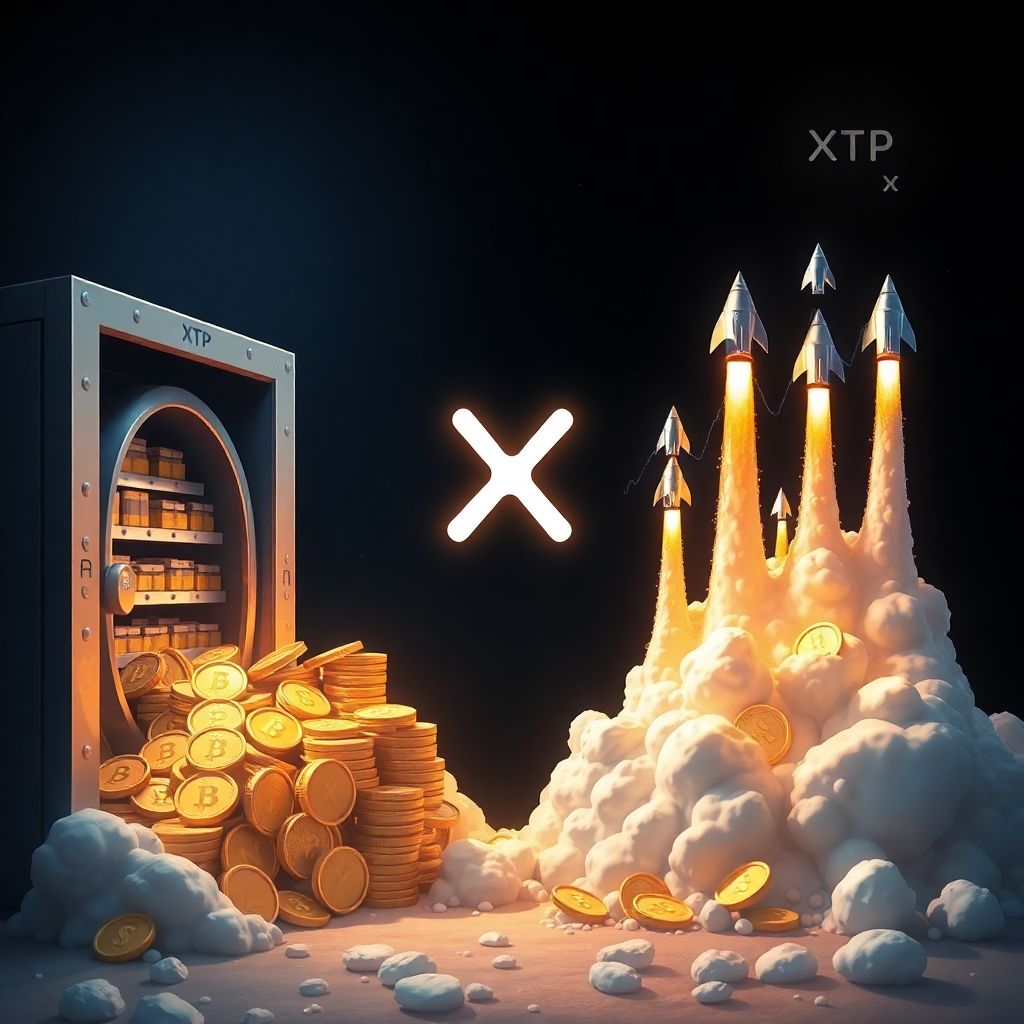
Crypto analyst Chad has outlined two possible trajectories for XRP amid the current bearish trend in the cryptocurrency market—both of which, he argues, could result in gains for investors regardless of which path materializes.
According to Chad, the first scenario envisions XRP maintaining its current price level over the next year, during which time exchange-traded funds (ETFs) would accumulate the entire circulating supply. In the second scenario, the price of XRP experiences a significant surge, making it more expensive and thereby slowing down the pace of ETF accumulation. Regardless of the outcome, Chad believes XRP holders stand to benefit.
This analysis comes in the wake of the recent launch of the first XRP ETF under the 1933 Securities Act, which has already demonstrated strong investor interest. Data from SoSo Value indicates that the Canary XRP Fund saw inflows of $245 million on its debut day, followed by another $243 million on the second day—figures that underscore institutional appetite for XRP exposure.
Further momentum is building as additional ETFs prepare to enter the market. Franklin Templeton, having revised its S-1 filing to remove delays, is expected to launch its XRP ETF imminently. Other major players like Bitwise and 21Shares may also roll out their respective funds in the coming days, suggesting that the ETF-driven demand for XRP could expand rapidly.
Chad emphasizes that these ETF launches are inherently bullish for XRP. The influx of institutional capital through these funds could dramatically reshape the token’s market dynamics. Strong early performance by the Canary XRP Fund—leading the year in both volume and inflows—has already set a high bar for upcoming ETFs.
To provide further clarity, Chad introduced a model projecting the potential impact of ETF launches on XRP’s price. Based on the assumption that 20 ETFs each receive $45 million in capital (totaling $900 million), the model suggests that this combined investment could absorb approximately 1.5% of XRP’s total supply. In that case, Chad estimates XRP’s price could jump to between $10 and $17 within 30 days, and potentially reach $13 to $24 within 60 days.
He also warned of a looming supply crunch. Initially, over-the-counter (OTC) trading desks may accommodate the ETFs’ demands. However, once those channels are exhausted, funds will be forced to purchase XRP directly from public exchanges. Currently, the available XRP supply on exchanges stands at 2.8 billion tokens—a volume Chad believes could be entirely acquired by ETF managers under sustained investment pressure.
At the time of reporting, XRP is trading at approximately $2.25, experiencing a modest uptick in the last 24 hours, reflecting growing investor optimism.
Beyond the ETF headlines, the longer-term implications for XRP investors are multifaceted. First, the legitimization of XRP via regulated ETFs offers a bridge for traditional investors to enter the market without the complexities of managing digital wallets or dealing with crypto exchanges. This could catalyze broader adoption and, in the long term, drive up demand.
Second, the introduction of ETFs brings a level of transparency and regulatory oversight that might help dispel lingering skepticism around XRP’s utility and legal standing. This is especially significant given XRP’s protracted legal battle with the SEC, which has clouded investor sentiment in recent years.
Third, as ETFs accumulate XRP, the token’s liquidity profile may change. With more coins locked in institutional portfolios, the circulating supply available for trading could shrink, increasing volatility and potentially driving prices higher during bullish phases.
Fourth, these developments could influence Ripple Labs’ strategy. As the primary entity behind XRP’s development, Ripple may adapt its corporate roadmap, possibly accelerating partnerships or expanding its On-Demand Liquidity (ODL) services to match the growing institutional interest.
Fifth, retail investors who have held XRP through years of uncertainty may finally see payoff for their patience. The dual scenario laid out by Chad means that whether ETFs hoard supply while prices stay flat or prices spike due to buying pressure, long-term holders are positioned to benefit.
Furthermore, this ETF-driven demand could also serve as a confidence signal to other asset managers considering similar crypto products. If the XRP ETFs continue to perform well, it won’t be surprising to see a wave of new altcoin-based ETFs enter the market, further diversifying the crypto investment landscape.
In conclusion, while the broader crypto market remains volatile and unpredictable, the emergence of XRP ETFs has introduced a new dynamic that could fundamentally alter the asset’s trajectory. Whether through steady accumulation or a dramatic price breakout, the road ahead appears promising for XRP investors who are prepared to navigate the evolving market landscape.