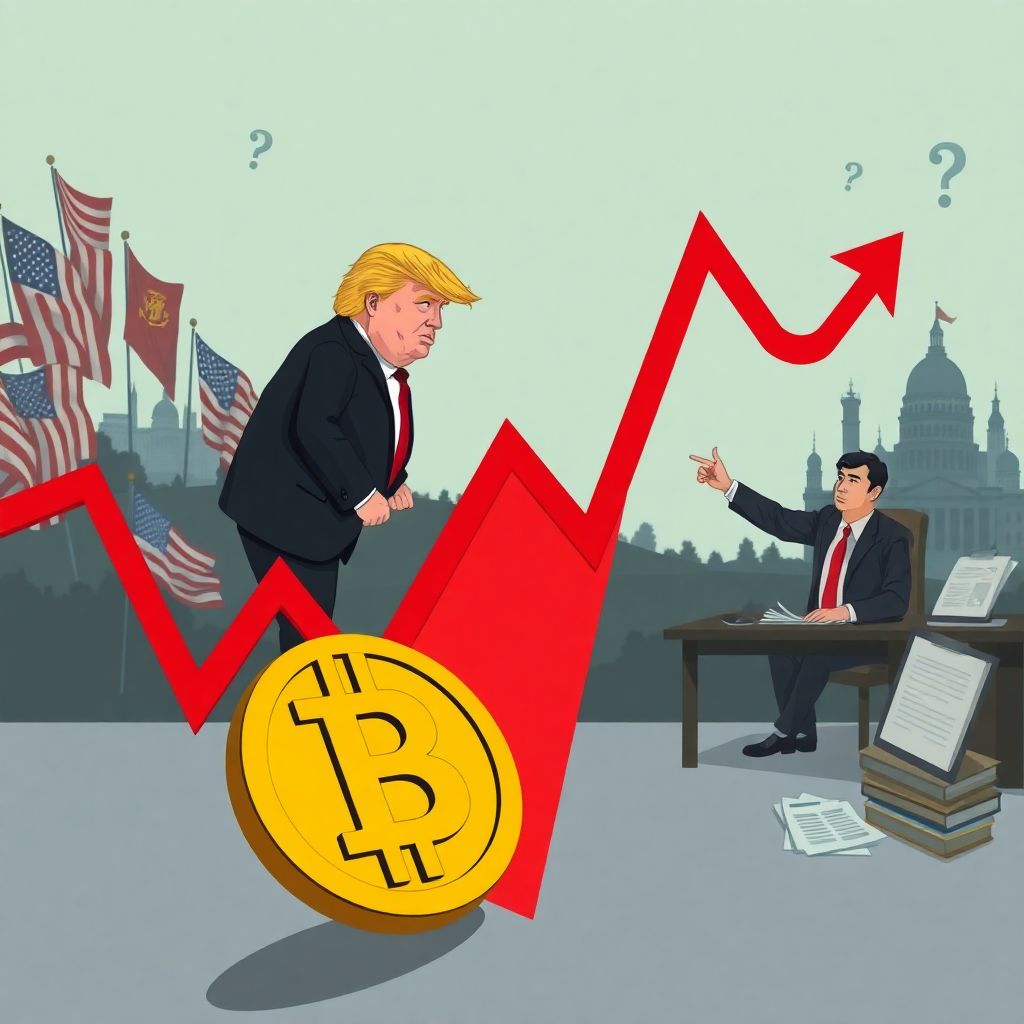
Why Is Bitcoin Falling? Economist Paul Krugman Points to Donald Trump
Bitcoin’s latest downturn has puzzled many traders who only months ago watched the leading cryptocurrency smash fresh all‑time highs. One prominent voice, however, thinks the explanation lies less in blockchain fundamentals and more in U.S. politics—specifically, in the fortunes of Donald Trump.
Nobel Prize-winning economist Paul Krugman, a long-time critic of Bitcoin and other digital assets, argues that the same political catalyst that helped fuel Bitcoin’s rally earlier this year is now dragging it down. In a recent Substack essay titled “The Trump Trade is Unraveling,” Krugman claims that Bitcoin has effectively become a proxy bet on Trump’s political success—and as his polling numbers slide, so does BTC.
Earlier in the year, Trump’s return to the White House and his open embrace of the cryptocurrency sector were widely credited as key drivers behind Bitcoin’s explosive price move. His campaign rhetoric cast him as a champion of digital assets, promising a friendlier regulatory approach and positioning the United States as a hub for crypto innovation. That narrative, Krugman suggests, turned Bitcoin into a political trade as much as a financial one.
According to Krugman, the logic is simple: if investors believe a Trump administration will roll back regulatory pressure and create tailwinds for the industry, then rising probabilities of his victory should be good for crypto prices. The reverse is also true. A visible decline in Trump’s perceived political strength—reflected in weaker polling data or growing doubts about his prospects—undercuts that bullish thesis.
“Trump’s power is visibly diminishing,” Krugman writes, arguing that Bitcoin’s market performance has become increasingly intertwined with expectations about Trump’s influence and longevity on the political stage. When the candidate was riding high and signaling that he would empower the digital asset industry, Bitcoin soared. As confidence in his dominance ebbs, so does enthusiasm for crypto as a policy winner.
Krugman has never been a fan of Bitcoin. For years, he has mocked its volatility, questioned its utility as money, and compared speculative manias in crypto to historical bubbles. In that context, his latest argument is not merely about short‑term price action; it is also a way of underscoring what he sees as Bitcoin’s dependence on hype, narratives, and political fashion rather than on real-world adoption or intrinsic value.
By casting Bitcoin as “a bet on Trump,” Krugman effectively suggests that the asset lacks independent fundamentals and instead behaves like a political derivative—something whose worth hinges on who sits in the Oval Office and how friendly they are to the industry. For him, that is further evidence that the ecosystem remains fragile and overly exposed to shifts in mood and power.
However, whether Bitcoin is truly so tightly tethered to Trump is a matter of debate. Correlation is not causation, and many market analysts highlight a wider set of forces weighing on BTC. Rising real interest rates, changing expectations about central bank policy, shifts in liquidity, and the broader risk-off tone in global markets have all been cited as reasons for the latest pullback. In that view, Trump’s polling slump is at most one factor among many, not the decisive cause.
At the same time, there is no denying that politics have become an increasingly important part of the crypto story. Regulatory crackdowns, enforcement actions, tax guidance, and licensing regimes can rapidly change the economics of trading, mining, and building crypto businesses. When a major political figure like Trump openly courts the sector, traders naturally try to price in what a more permissive environment might mean for future profits.
This political overlay creates a feedback loop. As Trump leans into pro‑crypto messaging, some investors interpret each poll, debate, and legal development through the lens of crypto policy. Bitcoin ceases to be only a macro asset reacting to interest rates and liquidity, and starts behaving like an election-sensitive trade—rallying on perceived friendly outcomes and stumbling on signs of political weakness. Krugman’s “Trump trade” framing captures this reflexive dynamic.
The irony is that Bitcoin was originally marketed as a hedge against government power and political risk—a neutral, decentralized system immune to the whims of any single leader. Krugman’s critique flips that narrative on its head. If he is right and Bitcoin’s price is now heavily swayed by the rise and fall of a particular politician, it undermines one of the core ideological pillars that early adopters championed.
Crypto supporters push back on that conclusion. They argue that while traders may temporarily chase political narratives, the long-term drivers of Bitcoin’s value remain its capped supply, increasing institutional participation, and its growing role as a digital store of value. From this perspective, election‑season volatility is noise layered over a deeper adoption curve rather than a sign that the asset is structurally political.
Still, even many Bitcoin bulls admit that the market has become more narrative‑driven as it has gone mainstream. The launch of spot Bitcoin exchange-traded products, growing corporate exposure, and constant media coverage have encouraged short‑term speculation on headlines, soundbites, and polls. In such an environment, tying Bitcoin’s fate to Trump—rightly or wrongly—can easily become a self‑fulfilling trade as enough participants believe in that linkage.
Krugman’s interpretation also raises a broader question: what happens to Bitcoin if the political winds shift decisively against crypto, regardless of who wins elections? If regulators tighten oversight, restrict certain business models, or clamp down on stablecoins and exchanges, the industry could face structural headwinds that no single politician’s rhetoric can offset. Markets may be starting to price this uncertainty as the election drama unfolds.
For investors, the practical takeaway is less about taking sides in U.S. politics and more about acknowledging that macro and political risk are now deeply embedded in crypto pricing. Betting on Bitcoin today often means indirectly betting on regulatory trajectories, enforcement priorities, and the strength of pro‑ or anti‑crypto coalitions in government. Krugman’s “Trump trade” label is one way to express that idea, but the underlying issue is broader than one candidate.
In the short run, Bitcoin is likely to remain sensitive to polling swings, policy statements, and legislative proposals that hint at the future treatment of digital assets in the United States and other major economies. Traders positioning around these events may see opportunities, but they also assume the risk that narratives can reverse quickly—as Krugman argues has already happened with Trump’s waning momentum.
In the longer term, the question is whether Bitcoin can decouple from the day‑to‑day noise of partisan politics and reassert its identity as a global, politically neutral asset. If adoption continues to grow across borders and use cases, the impact of individual political figures may fade. If instead the market continues to trade Bitcoin as a referendum on leaders and parties, Krugman’s critique—that its value is hostage to political cycles—will resonate more strongly.
For now, Bitcoin’s recent slide provides ammunition for both sides. To Krugman, it validates his view of crypto as a speculative instrument propped up by shifting narratives, with Trump’s declining fortunes as the latest example. To many in the crypto community, it is one more volatile chapter in a long history of boom-and-bust cycles that have not, so far, derailed the broader march of digital assets into the financial mainstream.
Whether one agrees with Krugman or not, his argument underscores a crucial point: understanding Bitcoin’s price today requires looking well beyond charts and on-chain metrics. In a world where presidential polls, campaign promises, and regulatory rumors can move markets, Bitcoin has become as much a political story as an economic one—and that, for better or worse, is part of why it is down.