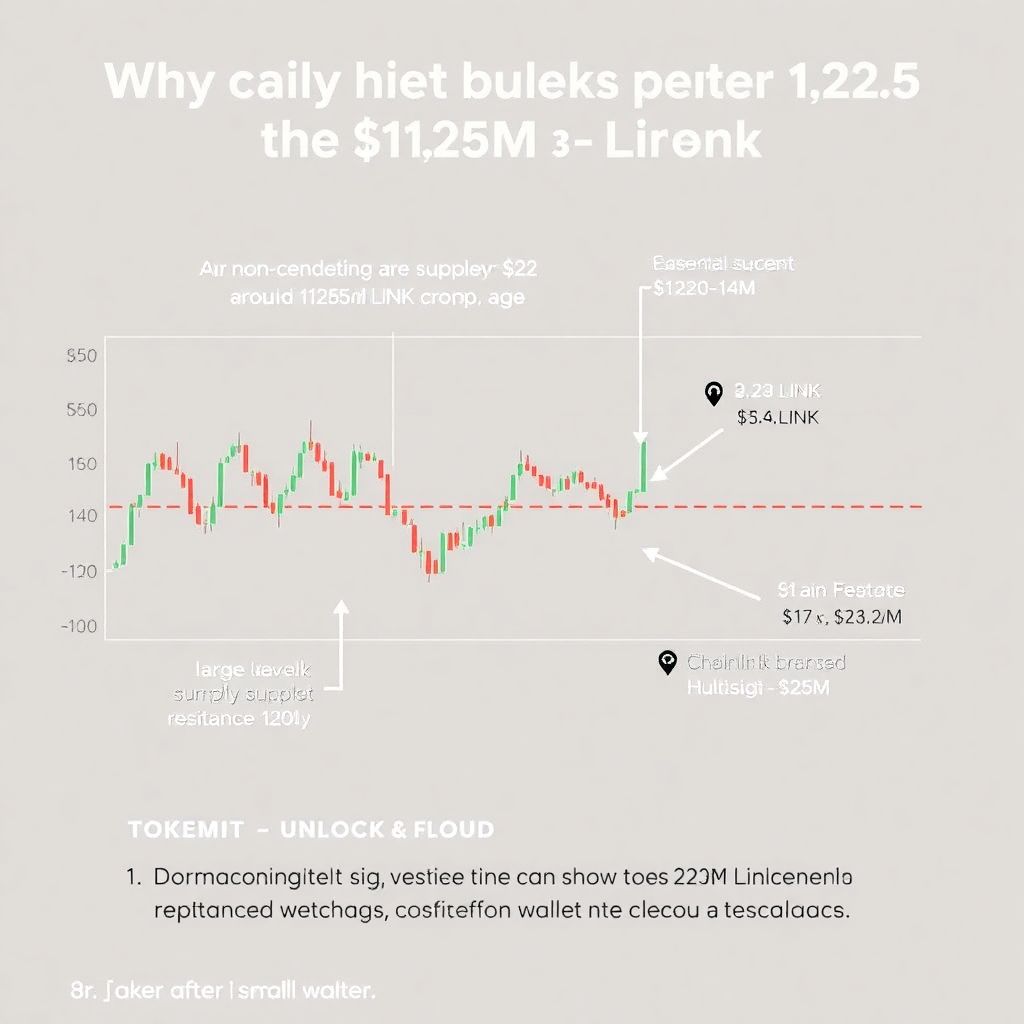
Why Chainlink Stayed Above $12 Despite a 11.25M LINK Unlock
Chainlink faced a potentially heavy selling event when a major non-circulating supply wallet unlocked 11.25 million LINK. Under normal conditions, a move of this size into exchanges is enough to trigger a sharp drawdown. Instead, the token briefly dipped toward 11.7 dollars and then stabilized around 12–12.5 dollars, holding a key support zone and avoiding a deeper slide.
On the daily timeframe, LINK has been trapped in a descending channel ever since it was rejected near 23 dollars roughly two months ago. The broader trend has been bearish: the token was still down about 8.8% on the week and around 9.3% over the month at the time of the unlock. In other words, the market was already under pressure before the fresh supply hit the market.
Against this backdrop, the non-circulating supply wallet executed a sizeable unlock. Onchain Lens data showed that 11.25 million LINK were released. Out of this total, approximately 9.23 million tokens, worth around 115–116 million dollars, were moved to Binance in two separate transfers. One transaction carried roughly 5.22 million LINK, while the other involved close to 4 million LINK.
The remaining 2.02 million LINK, with an estimated value near 25 million dollars, did not go directly to an exchange. Instead, these tokens were sent to a multisignature wallet associated with the Chainlink ecosystem. This suggests that not all unlocked tokens were immediately positioned for potential selling, although markets usually focus first on what lands on centralized exchanges.
These on-chain movements were especially notable because this particular wallet had been inactive for more than two months. Historically, when large dormant wallets unlock and send funds to exchanges, it often precedes or coincides with increased sell pressure. This pattern explains why traders were closely monitoring the situation as soon as the transactions were detected.
Exchange metrics reflected the magnitude of the move. Data from CryptoQuant indicated that Exchange Inflow spiked to about 10.2 million LINK, while Exchange Outflow stood at just 1.1 million. As a result, netflows into exchanges ballooned to around 9.1 million LINK, reaching a two‑month high and confirming that a large amount of fresh supply was now potentially available to be sold.
However, this surge in net inflows did not last. After the initial wave, the indicator cooled off significantly and eventually flipped slightly negative, hovering around -117,000 LINK. This reversal in netflows suggested that the bulk of the immediate selling associated with the unlock had already been absorbed and that the market was not experiencing an ongoing flood of tokens onto exchanges.
Despite the sizable inflows, the price reaction was relatively restrained. LINK briefly slipped to around 11.7 dollars but quickly rebounded and was trading close to 12.5 dollars afterward. The 12‑dollar area acted as a strong support zone, preventing a deeper breakdown that many market participants had anticipated amid the unlock narrative.
One of the main reasons LINK held this level was the presence of active dip buyers. Derivatives and volume data from Coinalyze showed that buy orders began to outweigh sell orders as the price approached support. Over the relevant period, Chainlink registered about 3.5 million in buy volume versus 3.2 million in sell volume, generating a positive Buy/Sell Delta of roughly 300,000 LINK.
This positive delta was particularly important because it was the first time in roughly two weeks that buy volume clearly exceeded sell volume. After a prolonged phase of consistent selling pressure, that shift signaled a short‑term improvement in demand and suggested that some traders considered the sub‑12‑dollar range attractive either for spot accumulation or for short‑term speculative positions.
Momentum indicators supported this interpretation. On the daily chart, the Stochastic Relative Strength Index made a bullish crossover and climbed to around 23 points, still within oversold conditions but moving upward. A crossover from oversold levels often hints that sellers are losing control and that buyers are beginning to regain some momentum, even if it does not yet confirm a full trend reversal.
In technical terms, the 12‑dollar area has now become a critical battleground. If buyers continue to defend this level successfully, LINK could attempt a recovery toward the next resistance zone near 13.02 dollars. A more convincing rebound, supported by increasing volume and improving broader market sentiment, would likely bring the 13.7‑dollar region into focus as a stronger resistance band.
Conversely, if this support fails and sellers manage to push the price below 12 dollars with conviction, downside targets would re‑enter the spotlight. The immediate lower area of interest lies near 11 dollars, with 10.9 dollars acting as a key level that traders will be watching for potential liquidity and buyer interest. A sustained breakdown below this level would strengthen the bearish structure of the descending channel.
Why such a large unlock did not immediately crash the price can be explained by a mix of market structure and expectations. First, the unlock was not entirely unexpected; seasoned traders often track large wallets and token schedules, so part of the sell‑off may have been “priced in” ahead of time. As a result, some participants had dry powder ready to buy if price tested known support areas.
Second, the fact that a portion of the unlocked tokens went to a multisig wallet instead of directly to an exchange may have eased the most extreme fears. While 9.23 million LINK did hit Binance, the remaining amount not being immediately available on order books reduced the instant sell‑side overhang. This nuance matters when evaluating the real versus perceived pressure on price.
Third, the broader crypto market context also plays a role. If overall market sentiment is not in full risk‑off mode, traders are often more willing to step in on large dips in established projects. Chainlink remains a leading oracle network with long‑term followers, and that base of holders can act as a stabilizing force when sudden supply events occur, particularly if they see those events as temporary liquidity shocks rather than a fundamental shift.
From a trading psychology standpoint, token unlocks frequently create a short‑lived window of fear and uncertainty. Short sellers often pile in anticipating forced selling, while existing holders may panic at the sight of big inflows to exchanges. Yet, when price holds firm at a technical level despite such a narrative, it can create a powerful signal that the market has absorbed the shock and that late shorts may be at risk of being squeezed.
For short‑term traders, the current environment around LINK suggests a range‑bound opportunity, with 12 dollars as a pivotal zone. Aggressive players may look to buy near support and target the 13–13.7‑dollar region, while keeping tight risk management in case support gives way. More conservative traders might wait for a confirmed breakout above the descending channel or a clear reclaim of higher resistance levels before committing.
For longer‑term participants, the key takeaway is different. The ability of LINK to hold above 12 dollars amid an 11.25‑million token unlock showcases underlying demand and resilience. It does not guarantee that the bottom is in, but it indicates that large supply events, by themselves, do not automatically translate to a collapse when the market structure and buyer interest are relatively robust.
Still, risks remain. If additional large tranches of tokens are moved from non‑circulating wallets to exchanges in quick succession, or if macro conditions for cryptocurrencies deteriorate, the current support could eventually fail. Traders and investors should therefore continue to monitor on‑chain flows, exchange balances, and volume dynamics to assess whether the recent stabilization is a temporary pause or the start of a more sustained base‑building phase.
In summary, millions of unlocked LINK entered the market, exchange inflows spiked to a two‑month high, and yet sellers could not fully seize control. Prompt dip‑buying near 12 dollars, a positive shift in buy/sell volume, and early signs of momentum recovery on the Stochastic RSI combined to keep Chainlink afloat. The 12‑dollar level now stands as a decisive support, with the next chapters for LINK depending on whether buyers can continue to defend it or if another wave of selling finally pushes the price into a deeper leg down.