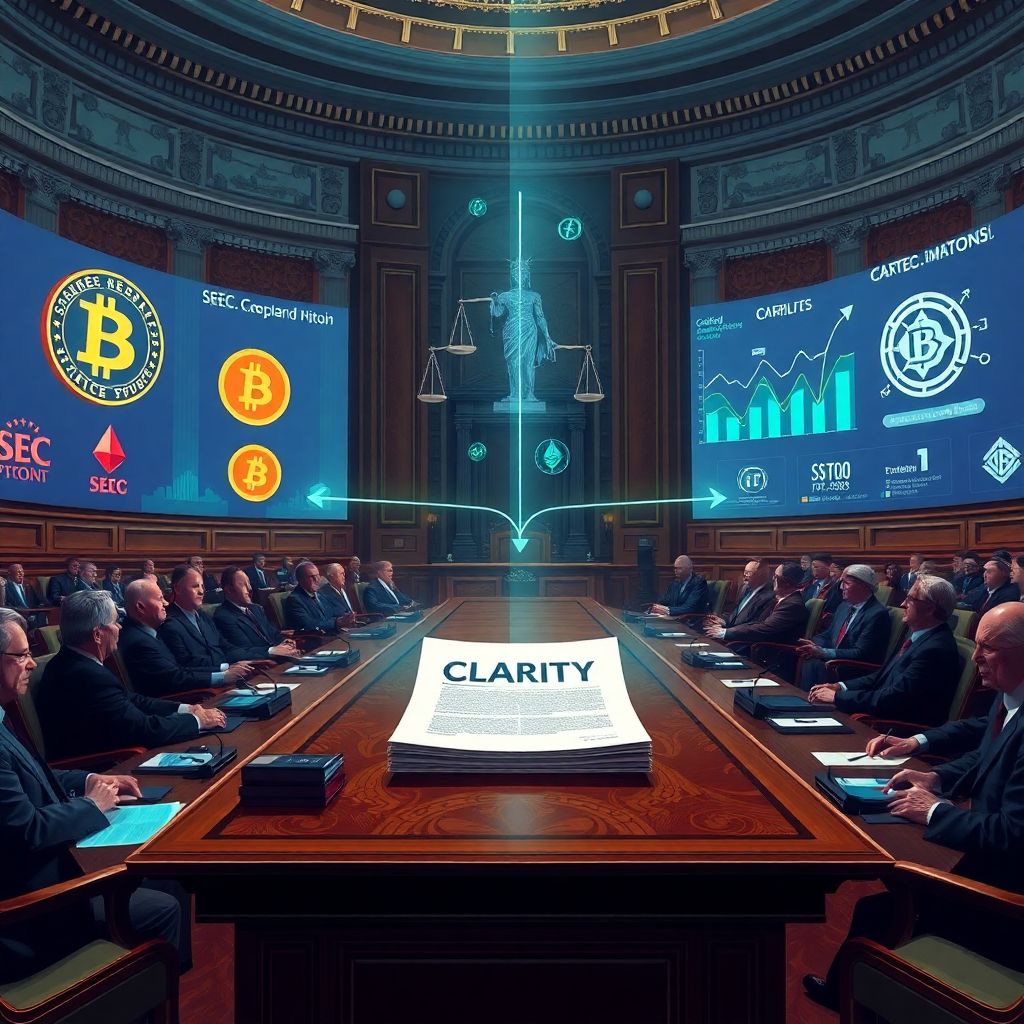
Senate leaders have locked in January as the month they will finally take up a sweeping crypto market structure bill in committee, a key procedural step that could set the stage for a full Senate vote later in 2025. White House AI and crypto adviser David Sacks said Thursday that the long-anticipated markup is officially on the calendar, even as Democratic skepticism about regulatory independence threatens to complicate the bill’s path forward.
According to Sacks, Senate Banking Committee Ranking Member Tim Scott and Senate Agriculture Committee Ranking Member John Boozman confirmed during a call that they intend to move ahead with a markup of the “Clarity” legislation in January. That means senators will formally debate, amend, and vote on the bill at the committee level for the first time, a critical hurdle for any major piece of financial legislation.
Sacks credited Scott and Boozman with pushing the process forward and framed the moment as the closest Congress has ever come to enacting a comprehensive federal framework for digital assets. He also highlighted the role of key House allies, including Representative French Hill and Representative Glenn “GT” Thompson, who have been spearheading companion efforts on the other side of the Capitol.
The crypto market structure bill—often referred to by shorthand as “Clarity”—seeks to answer the central unresolved question in U.S. digital asset policy: which regulator is in charge. The legislation aims to draw a line between tokens that should be treated as securities overseen by the Securities and Exchange Commission and those that fall under the jurisdiction of the Commodity Futures Trading Commission as commodities. For exchanges, brokers, and token issuers, that distinction determines everything from registration obligations and disclosure rules to enforcement exposure.
Supporters of the bill argue that the current patchwork approach, dominated by case-by-case SEC enforcement actions and decades-old securities laws, is driving innovation offshore and leaving both investors and companies in limbo. A statutory framework, they contend, would give entrepreneurs predictable rules, encourage compliant behavior, and provide regulators with clearer authority to police fraud and market manipulation in crypto markets.
Yet Democratic lawmakers and some policy experts remain wary. One of the loudest concerns centers on regulatory independence. Critics worry that in trying to clarify the boundaries between agencies, Congress could end up constraining the SEC’s discretion or tilting the playing field in favor of the CFTC, which is perceived in some quarters as more industry-friendly. That shift, they warn, might weaken investor protections just as retail participation in digital assets is surging again.
Another fault line is how much leeway the bill gives large trading platforms and custodians. Progressives argue that if the legislation carves out too generous a path for exchanges to qualify as commodity platforms rather than securities intermediaries, it could create a parallel, lightly regulated market infrastructure sitting alongside the traditional financial system. That could amplify systemic risks in periods of stress, especially if stablecoins and tokenized real-world assets continue to grow.
Still, the political calculus is changing. After multiple high-profile collapses in the sector and a series of partial enforcement wins by regulators, some Democrats have become more open to codifying rules rather than relying solely on litigation. For moderate lawmakers in both parties, the prospect of establishing guardrails without outlawing innovation outright has become a compelling middle ground.
The January markup will be a revealing test of just how much common ground exists. During the session, senators can introduce and debate amendments that could significantly reshape the bill. Expect proposed changes on issues such as disclosure standards for token issuers, capital and custody requirements for intermediaries, consumer protection measures, and the precise legal definition of when a token transitions from a security-like asset to a decentralized commodity.
The process will also expose where the coalition behind the bill is strongest—and where it is fragile. If Republicans largely line up behind Scott and Boozman while a critical mass of centrist Democrats are willing to negotiate rather than block the effort outright, the bill could emerge from committee with genuine bipartisan momentum. Conversely, if concerns about weakening the SEC harden into a party-line split, leadership may be reluctant to bring such a divisive measure to the floor in an election year.
Industry stakeholders are watching closely because a successful markup does more than move a single bill: it signals that Congress is now prepared to legislate on digital assets at scale. For venture funds, trading firms, and developers, that could influence capital allocation decisions, token issuance strategies, and even where companies choose to incorporate and operate.
The White House’s role, through advisors like Sacks, is another factor to monitor. A more engaged executive branch could help broker compromises between agencies and lawmakers, smoothing some of the sharpest inter-regulator conflicts. At the same time, any perception that the bill is being driven too aggressively by the administration or by industry-aligned voices could intensify resistance from skeptics who see crypto as a speculative or destabilizing force.
If the legislation advances, its impact would extend far beyond centralized exchanges. A clearer market structure framework could eventually shape how decentralized finance protocols interface with regulated entities, how stablecoin issuers structure reserves and disclosures, and how tokenized versions of traditional assets are launched and traded. Even if DeFi itself remains largely outside the initial scope, the behavior of on- and off-ramps will inevitably be influenced by any new rules.
There is also an international dimension. Other major jurisdictions have already moved ahead with bespoke regimes for digital assets, leaving the United States at risk of becoming a regulatory laggard. A credible, durable U.S. framework could help restore some leadership in setting global norms, while also giving cross-border firms a clearer basis for compliance when serving American customers.
For now, the most immediate question is tactical: can the bill survive the markup process without being watered down into irrelevance for the industry or toughened to the point that it loses key Republican or business support? The January session will offer the first concrete answers, transforming years of hearings, white papers, and drafts into line-by-line lawmaking.
Whatever emerges from committee, the decision to schedule a markup marks a turning point. Crypto policy in Washington is shifting from theoretical debates about what digital assets are to practical decisions about how they should be regulated. Whether the result is a landmark statute or another stalled attempt will depend on how senators navigate the twin pressures of protecting investors and preserving room for innovation as the bill moves through its most consequential phase yet.