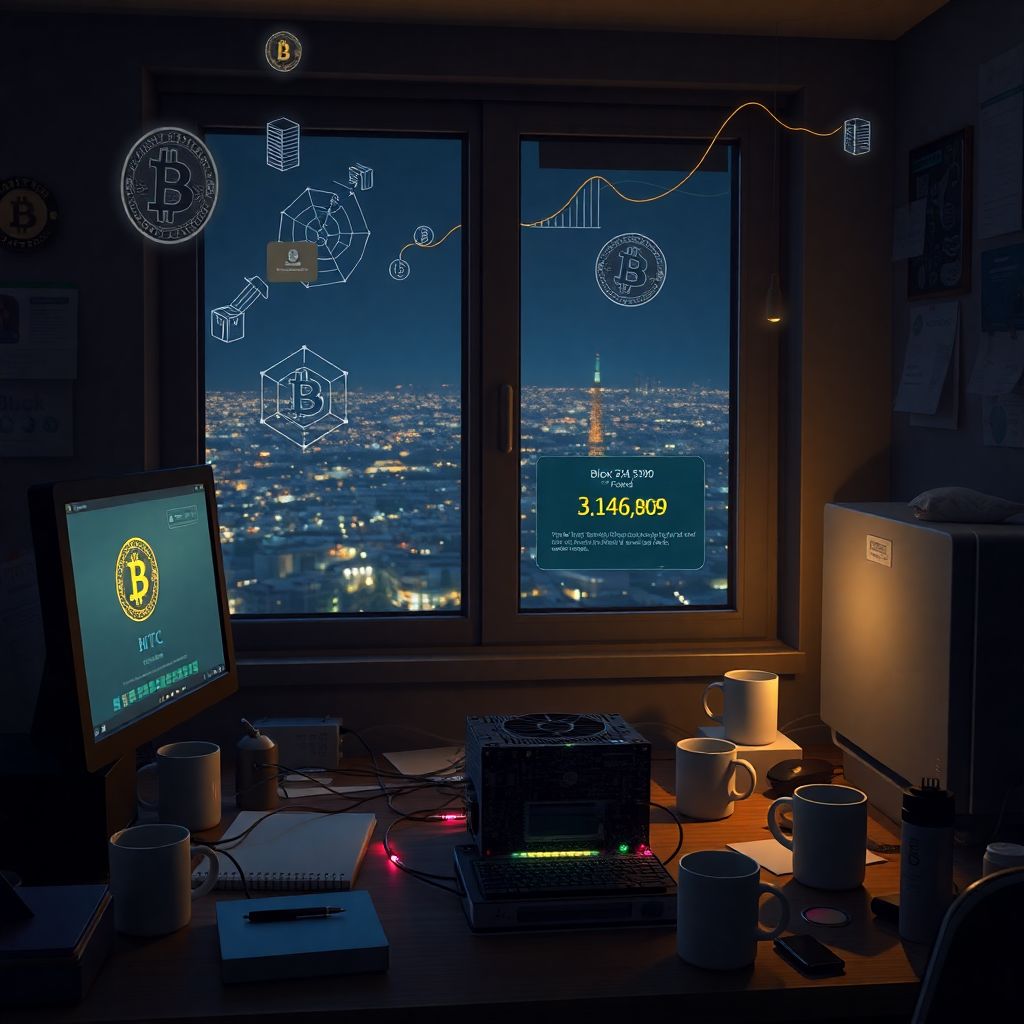
Solo Bitcoin Miner Defies the Odds, Lands $266,000 Bitcoin Block Reward
A lone Bitcoin miner has pulled off the digital equivalent of winning the lottery, successfully mining Bitcoin’s 924,569th block and walking away with roughly 3.15 BTC—about $266,000 at current prices. What makes this feat remarkable is not just the size of the reward, but the fact that it was earned with hardware more commonly associated with hobbyists than industrial-scale mining farms.
According to data from CKPool, a service that tracks and supports solo mining, the miner’s chances of striking a block were estimated at less than 1 in 100,000 per day. In other words, statistically, this person could have mined for years without ever finding a single block. Yet on that particular Friday, probability broke in their favor.
The reward itself totaled 3.146 BTC. That figure includes the standard Bitcoin block subsidy of 3.125 BTC as well as transaction fees from the transactions confirmed in that block. While the subsidy has been decreasing over time due to Bitcoin’s programmed halving events, the combination of subsidy and fees still adds up to a substantial payout—especially for a solo operator.
What sets this event apart is the modest scale of the miner’s hardware. Rather than running a warehouse full of ASICs drawing megawatts of power, this individual was using equipment with an estimated hash rate of around 1.2 terahashes per second (TH/s). That performance is similar to devices like the Bitaxe Gamma, a compact, open-source, hobby-focused Bitcoin miner designed to be inexpensive and relatively easy to run at home.
In today’s environment, where professional mining operations deploy fleets of ASICs each capable of 100 TH/s or more, a 1.2 TH/s machine is essentially a drop in the ocean of Bitcoin’s total network hash rate. This amplification of scale is precisely why most miners join large mining pools: pooling resources smooths out rewards, turning extremely rare jackpots into smaller, more predictable payouts split among many participants.
Solo mining, by contrast, exposes a miner to the full statistical volatility of the process. Blocks are discovered probabilistically: each hash is a “lottery ticket,” and the more hashes you compute per second, the greater your chance of winning. For small miners, the expected time to find a block can range from many years to effectively never. Yet the protocol does not discriminate—any valid block found by any miner, regardless of their size, is accepted by the network if it meets the consensus rules.
That is why events like this are so symbolically powerful. They serve as a reminder that Bitcoin remains permissionless and open. While large companies dominate the hash rate, an ordinary individual with modest hardware still has a non-zero chance of being rewarded directly by the protocol with a full block subsidy and fees. The economics may discourage most from going it alone, but the possibility remains embedded in Bitcoin’s design.
From a probability perspective, the miner’s success illustrates the nature of expected value versus realized outcomes. On average, a 1.2 TH/s miner might have an expected time to hit a block measured in decades, assuming the current network hash rate stays constant. But randomness does not care about averages. Even incredibly unlikely events can materialize early, just as a coin can come up heads ten times in a row without violating any laws of probability.
For hobbyists, this story is likely to reignite interest in solo mining as an experiment or passion project, even if not as a serious investment strategy. Running a small miner at home can be an educational way to understand how proof-of-work, difficulty adjustment, and block propagation operate in practice. The idea that there’s a small but real chance of “hitting the jackpot” adds an element of excitement that mining pool payouts can’t match.
At the same time, the underlying economics remain harsh. Electricity costs, hardware wear, and the continually rising network hash rate mean that solo mining is usually unprofitable if treated as a business. Most individuals opt for mining pools that provide steady, fractional payouts in exchange for sharing their hash rate with thousands of others. For them, predictable cash flow beats the highly volatile odds of going solo.
However, beyond personal profit, solo mining also has a systemic importance. When more independent miners participate directly in block production, even at small scales, it can contribute to the decentralization of the network. A mining landscape composed solely of a handful of massive, centralized entities would present greater risks—from regulatory pressure to potential collusion. Solo miners and small-scale operations, even if they rarely find blocks, help diversify the sources of valid blocks.
This win also underscores how transaction fees are becoming an increasingly relevant part of miner revenue. As block subsidies halve approximately every four years, fees are expected to play a growing role in sustaining the security of the Bitcoin network. In this case, the miner’s reward was slightly higher than the base subsidy because the block included enough fee-paying transactions to push the payout above 3.125 BTC.
From a technical perspective, using a low-power, hobby-grade ASIC reflects a broader trend toward experimentation at the edges of the network. Devices like compact miners allow enthusiasts to tinker with firmware, energy optimization, and network configurations. While they aren’t competitive with industrial machines in sheer performance, they offer a hands-on way to engage with Bitcoin’s infrastructure without the barriers of large capital investment.
For new entrants considering whether to try solo mining, this story illustrates both the dream and the reality. Yes, there is a non-zero chance of landing a life-changing payout, as this miner did. But that outcome is extremely rare. A more realistic approach is to treat solo mining as a learning experience or a hobby—possibly powered by cheap or excess electricity—rather than as a guaranteed path to profit.
Risk tolerance also plays a key role. Someone willing to accept years of zero income in exchange for a tiny probability of a large payout might find solo mining conceptually appealing. Those who prefer steady returns are far better served with mining pools or simply buying Bitcoin directly on the market, avoiding the operational complexities and randomness of mining altogether.
Psychologically, moments like this can skew perceptions. Headlines about solo miners “hitting the jackpot” can encourage survivorship bias—people see the rare winner, not the countless others who never find a block. For a balanced perspective, it’s important to recognize that this success is an outlier that stands out precisely because it almost never happens.
Still, these outliers are part of what makes Bitcoin mining culture unique. The system’s design allows for both industrial-scale operations and lone miners to coexist under the same rules, competing on equal cryptographic footing. No miner—no matter how large—can buy a “special” advantage at the protocol level. Each valid hash has the same chance of producing the next block as any other.
As Bitcoin continues to mature, the share of hash rate controlled by institutional players is likely to grow. Yet as long as individuals with modest machines can occasionally beat the odds and mine a block, stories like this will continue to surface. They reinforce a core principle: Bitcoin is an open network where participation is not limited by permission, size, or geography.
For this particular solo miner, the reward is both financial and symbolic. Financially, a 3.146 BTC payout is substantial by any measure, especially given the minimal hash rate behind it. Symbolically, it validates the idea that even in a landscape dominated by large mining operations, a single enthusiast with a hobby device can still leave a mark on the blockchain.
Their block—number 924,569—will now live on permanently in Bitcoin’s ledger as a testament to that possibility. Behind that block is not just a string of hashes and transactions, but a story of improbable success that captures the imagination of miners and observers alike.